Conservation
Letters
Conservation and culture
Dear Sir,
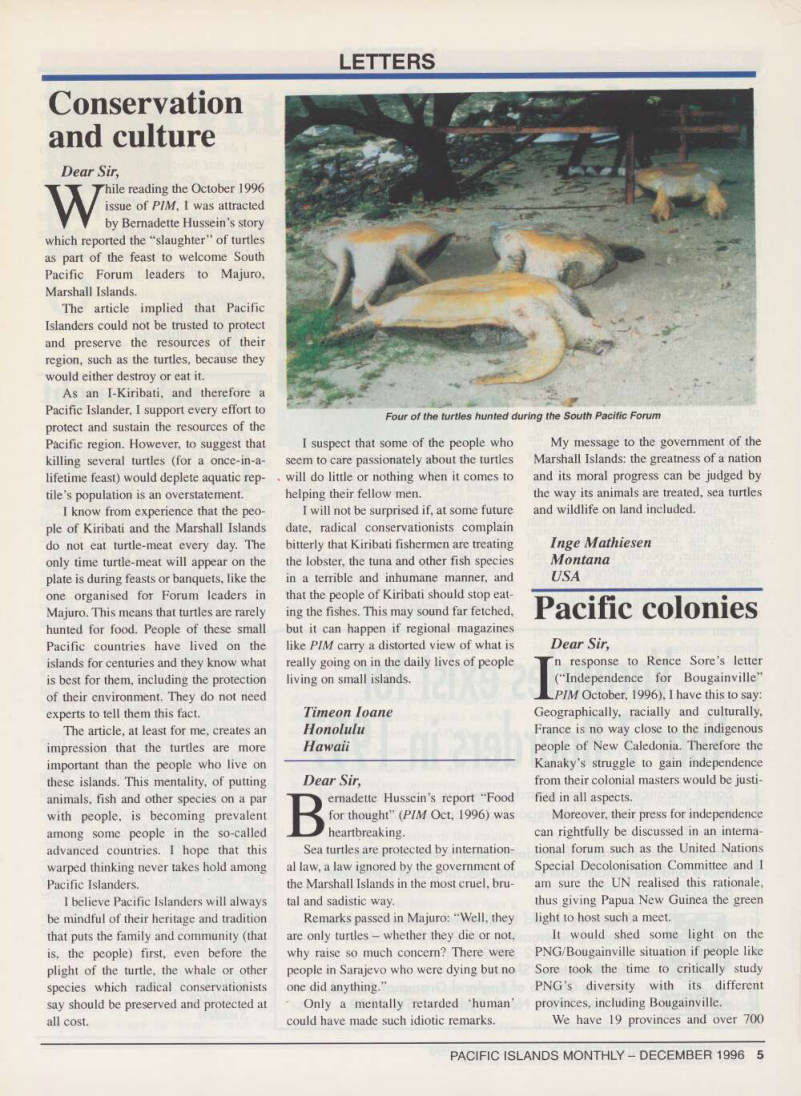
While reading the October 1996 issue of PIM, I was attracted by Bernadette Hussein’s story which reported the “slaughter” of turtles as part of the feast to welcome South Pacific Forum leaders to Majuro, Marshall Islands.
The article implied that Pacific Islanders could not be trusted to protect and preserve the resources of their region, such as the turtles, because they would either destroy or eat it.
As an I-Kiribati, and therefore a Pacific Islander, I support every effort to protect and sustain the resources of the Pacific region. However, to suggest that killing several turtles (for a once-in-a lifetime feast) would deplete aquatic rep tile’s population is an overstatement.
I know from experience that the peo ple of Kiribati and the Marshall Islands do not eat turtle-meat every day. The only time turtle-meat will appear on the plate is during feasts or banquets, like the one organised for Forum leaders in Majuro. This means that turtles are rarely hunted for food. People of these small Pacific countries have lived on the islands for centuries and they know what is best for them, including the protection of their environment. They do not need experts to tell them this fact.
The article, at least for me, creates an impression that the turtles are more important than the people who live on these islands. This mentality, of putting animals, fish and other species on a par with people, is becoming prevalent among some people in the so-called advanced countries. I hope that this warped thinking never takes hold among Pacific Islanders.
I believe Pacific Islanders will always be mindful of their heritage and tradition that puts the family and community (that is, the people) first, even before the plight of the turtle, the whale or other species which radical conservationists say should be preserved and protected at all cost.
I suspect that some of the people who seem to care passionately about the turtles will do little or nothing when it comes to helping their fellow men.
I will not be surprised if, at some future date, radical conservationists complain bitterly that Kiribati fishermen are treating the lobster, the tuna and other fish species in a terrible and inhumane manner, and that the people of Kiribati should stop eat ing the fishes. This may sound far fetched, but it can happen if regional magazines like PIM carry a distorted view of what is really going on in the daily lives of people living on small islands.
Timeon loane
Honolulu Hawaii
Dear Sir,
Bernadette Hussein’s report “Food for thought” (PIM Oct, 1996) was
heartbreaking.
Sea turtles are protected by internation al law, a law ignored by the government of the Marshall Islands in the most cruel, bru tal and sadistic way.
Remarks passed in Majuro: “Well, they
are only turtles - whether they die or not, why raise so much concern? There were people in Sarajevo who were dying but no one did anything.”
' Only a mentally retarded ‘human’ could have made such idiotic remarks.
My message to the government of the Marshall Islands: the greatness of a nation and its moral progress can be judged by the way its animals are treated, sea turtles and wildlife on land included.
Inge Mathiesen
Montana
Usa
Four of the turtles hunted during the South Pacific Forum