Assassination
pp. 39-40 · Read in the full issue
Reports by Sam Vulum
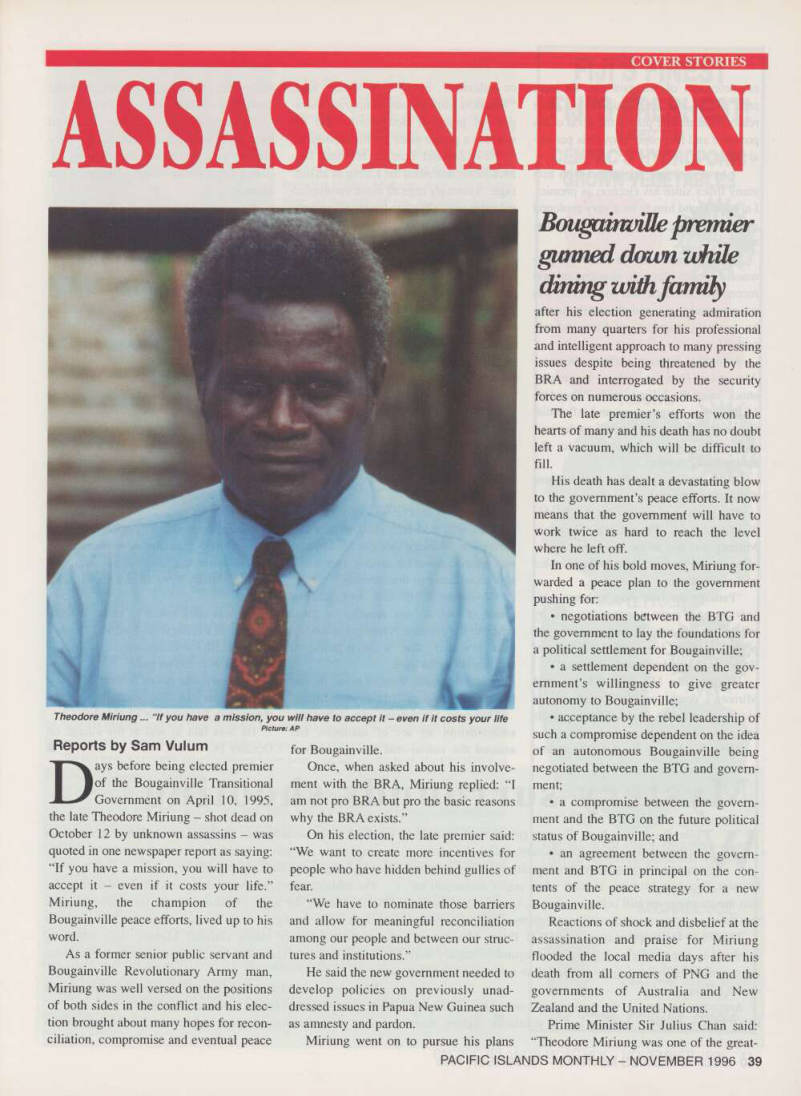
Days before being elected premier of the Bougainville Transitional Government on April 10, 1995, the late Theodore Miriung - shot dead on October 12 by unknown assassins - was quoted in one newspaper report as saying; “If you have a mission, you will have to accept it - even if it costs your life.”
Miriung, the champion of the Bougainville peace efforts, lived up to his word.
As a former senior public servant and
Bougainville Revolutionary Army man,
Miriung was well versed on the positions of both sides in the conflict and his elec tion brought about many hopes for recon ciliation, compromise and eventual peace
for Bougainville.
Once, when asked about his involve ment with the BRA, Miriung replied; “I am not pro BRA but pro the basic reasons why the BRA exists.”
On his election, the late premier said: “We want to create more incentives for people who have hidden behind gullies of fear.
“We have to nominate those barriers and allow for meaningful reconciliation among our people and between our struc tures and institutions.”
He said the new government needed to
develop policies on previously unad
dressed issues in Papua New Guinea such as amnesty and pardon.
Miriung went on to pursue his plans
BougahwiUe premier gunned down while dining unfit family
after his election generating admiration from many quarters for his professional and intelligent approach to many pressing issues despite being threatened by the
BRA and interrogated by the security
forces on numerous occasions.
The late premier’s efforts won the hearts of many and his death has no doubt left a vacuum, which will be difficult to fill.
His death has dealt a devastating blow to the government’s peace efforts. It now means that the government will have to work twice as hard to reach the level where he left off.
In one of his bold moves, Miriung for warded a peace plan to the government
pushing for:
• negotiations between the BTG and the government to lay the foundations for a political settlement for Bougainville; • a settlement dependent on the gov ernment’s willingness to give greater autonomy to Bougainville; • acceptance by the rebel leadership of such a compromise dependent on the idea of an autonomous Bougainville being negotiated between the BTG and govern ment; • a compromise between the govern ment and the BTG on the future political status of Bougainville; and • an agreement between the govern ment and BTG in principal on the con tents of the peace strategy for a new
Bougainville.
Reactions of shock and disbelief at the assassination and praise for Miriung flooded the local media days after his death from all comers of PNG and the governments of Australia and New Zealand and the United Nations.
Prime Minister Sir Julius Chan said: “Theodore Miriung was one of the great
Theodore Miriung... "if you have a mission, you will have to accept it - even if it costs your life Picture: AP
est defenders of Bougainville we have seen and he has been slain for no other reason than that he placed the good of his province and its people above his person
al safety.
“I have met and negotiated with him many times since his election as premier.
I always found him to be a very profound man, and a tough and persistent negotia tor.
“He was tireless in his search for per manent peace through negotiation and reconciliation - there was nowhere he was not prepared to go, and absolutely no one he was not prepared to sit down and talk with.”
Australia Foreign Affairs Minister Alexander Downer, while expressing shock over the killing, said: “Theodore Miriung was a courageous and influential figure who dedicated himself to the pur suit of a peaceful solution to the Bougainville conflict.
“With his passing, that will become difficult to achieve.”
The speaker of parliament. Sir Rabbie Namaliu, said: “I believe Theodore Miriung was one of the truly great hopes of peace and reconciliation in the troubled part of our nation.
“Perhaps the best way to honour his service and supreme sacrifice, is by redoubling all our efforts to achieve the peace which the long-suffering people of
Bougainville so desperately deserve.”
Bougainville MP John Momis said Miriung’s death was the “most serious blow so far to the democratic principals and process of resolving the crisis”.
The UN, through the UNDP resident
co-ordinator, Peter Witham, said; “Theodore Miriung was an untiring cham pion of peace in Bougainville and the world is a poorer place for his departure.”
New Zealand Foreign Minister Don McKinnon described the killing as an out rage: “I strongly urge all those involved to redouble their efforts to renew discussions and reach a peaceful settlement.”
Professor James Griffin, a former head of the University of Papua New Guinea’s history department, said Miriung’s influ ence as well as his legal expertise would be missed. “I think he’ll be very difficult to replace in view of his constitutional expertise and in view of his general stand ing,” said Dr Griffin, who had known Miriung for 28 years.
Although official details of events sur rounding his death were not known then, information pieced together indicated that Premier Miriung had flown to Konga on a helicopter chartered to fly South-West Interim Authority chairman Nick Peniai from Buka.
The reports said he was having dinner with his wife and four children at about 6.30 pm on Saturday, October 12, when he was gunned down by at least two assas sins under cover of the darkness.
Government officials said the full round of bullets was emptied at close range to the premier. A medical examina tion revealed that a high-powererd weapon had been used.
When this issue went to press, no one had claimed responsiblity for the killing.
However, Sir Julius, who called the assassination an act of madness, has assured the nation that the government
will use its full capacity to track down the murderers and bring them to account.
Police in Bougainville have indicated they have established some leads. They did not give further details. Miriung, 55, comes from Poma village, Nasios, Kieta district.
He was educated at the Tunuru Catholic Mission and Chabai from 1960 to 1965.
He attended the St Peter Channel Ulapia seminary in 1966 to study for priesthood but left after three years, join ing CRA Exploration. In 1969, he enrolled at the University of PNG, attained a law degree in 1973 and was admitted to the bar in 1974.
The Miriungs moved to Arawa in March 1976 where he ran a private prac tice for four months.
In the years following, he was provin cial legal officer and then provincial sec retary, before resigning to become PNG’s chief land titles commissioner. In December 1988, he was appointed acting National Court judge.
Miriung was asked by BRA leaders in 1991 to help plan the new government (Bougainville Interim Government), but left in February 1992 after a leaders’ dis pute.
He was later asked to assist in what they called the Supreme National Council under the BIG working committee prior to his election as the premier.
His body was flown to Port Moresby on October 14 for embalming and returned to Bouganville on October 17.
He was laid to rest at his village on October 18. ■