The end of the nuclear age?
p. 11 · Read in the full issue
Nuclear Issues
By lan Williams
On September 10 the United Nations General Assembly marked the end of an era in human history that future generations will find difficult to understand. Its adoption of the nuclear Test Ban Treaty put a final seal on the 2000-plus nuclear explosions that had taken place since 1945. As Australia’s UN ambassador, Richard Butler, put it, the resolution adopting the Test Ban Treaty meant the “international community established the international norm that there would be no nuclear
explosions”.
Some Pacific nations thought that Canberra’s response to last year’s resump tion of French nuclear testing in the region had been muted for reasons of Australia’s diplomatic and economic self intrest. But no one can fault Australia’s successful initiative in rescuing the Test Ban Treaty from diplomatic deadlock in Geneva, where the years-long test ban treaty negotiations had failed to obtain the consensus it needed under the rules. India had refused to go along with the final text.
In response to India’s opposition, Canberra assembled 126 co-sponsors to bring the issue back to the UN. In addition to the work of Butler, Canberra’s envoys across the globe canvassed the capitals to get sponsorship. It does not demean their effort to mention that the all-out diplo matic push did no harm to the country’s
bid for one of the two Security Council seats where it is in competition with Portugal and Sweden.
The draft treaty provided that to come into effect, it should be ratified by the 44 states, including India, which the International Atomic Energy Authority identified as states with a potential nucle ar capability. India objected on the grounds that it was discriminatory to be singled out in this way and because there was no significant progress towards disar mament by the nuclear states.
“If you want security, if you want peace, the only way to do it is the securi ty that all of us will get through the elim ination of nuclear weapons. And we do not believe that by measures that actually take the focus away from the elimination of nuclear weapons we are doing any ser vice to humanity as such,” declared India’s respresentative, Prakash Shah.
While many people sympathised with India’s position in general terms, very few thought that their objections were worth sacrificing the chance of a test ban. Many also suspected that behind India’s lofty principles were domestic realities - a shaky coalition government in New Delhi that could be outflanked on nationalist grounds by the opposition. In the end, India could only get tiny Bhutan and Libya to back its stand when, on September 10, at a historical reconvened UNGA meeting, the nations of the world
voted overwhelmingly to stop nuclear tests of all kinds. While there was argu ment about the precise legal effect, Butler referred to the first articles of the treaty: “It’s not quite tablets of stone, but it’s as near as it gets in international law.” And although not a perfect solution since, for the time being, the mechanisms for moni toring the test ban cannot come into effect, it represents a major breakthrough for the region. As Ambassador Neroni Slade of Samoa put it: “For half a century there have been far too many nuclear test explosions in the Pacific. There won’t be anymore.” For once the ritual of signing the treaty gave ij added significance. On the first day the treaty was open for signa ture, September 23, all five nuclear states signed, including President Bill Clinton for the US. As we were going to Press, Samoa was the 110th or so state whose prime minister or foreign minister affixed his signature, making it an unprecedently popular piece of political theatre. Many of the states declared that they considered
their signature legally binding, regardless
of whether India ratifies as required in the treaty, so the effect for the Pacific is clear - no country that is able to test nuclear explosions in the Pacific is going to.
The treaty outlines elaborate regimes of monitoring, including a worldwide net work of seismic, radiation and acoustic monitoring stations, to ensure compli ance. However, this cannot be set up until the treaty is ratified by all 44 potential nuclear states, including India.
New Zealander Professor Roger Clark, who was on Samoa’s legal team at the World Court, points out that apart from the tremendous moral pressure on signa tories and non-signatories alike, there is provision in the draft treaty for it to be adapted after three years, so even if India still holds outs, the signatories can imple ment its provisions regardless. He points out there will be pressure during the rest of this session of the UNGA to ensure the World Court decision on the illegality of nuclear weapons is taken into account, which may bring India on board.
“The challenge now is the disarma ment negotiations,” he concludes, which can only be helped by the test ban. ■
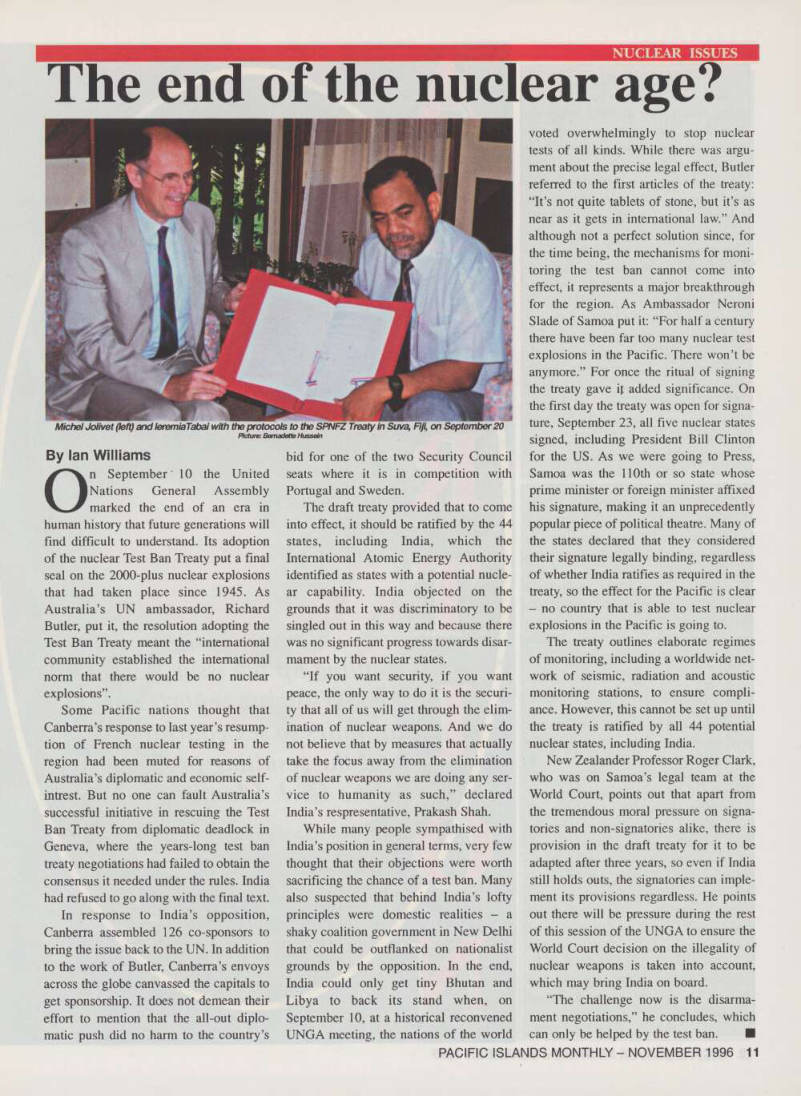
Michel Jolivet (left) and leremiaTabai with the protocols to the SPNFZ Treaty in Suva, Fiji, on September 20 Picture: Bemadette Hussein