The gay life
pp. 42-43 · Read in the full issue
Lifestyle
While challenging the tradional norms of masculinity, Western Samoa's drag queens find themselves in a world of near acceptance country
By Chris Peteru
On every street and every village, the Western Samoa drag queen community has soared in the past few years, forming a pres ence that cannot be ignored.
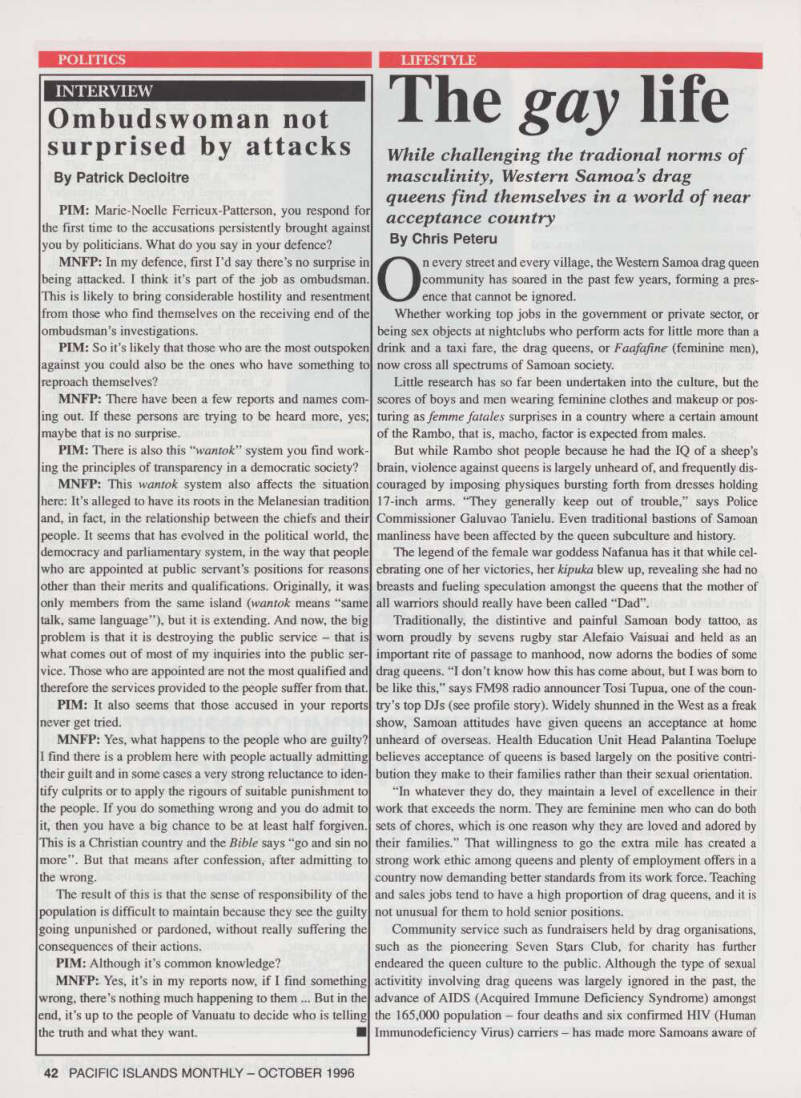
Whether working top jobs in the government or private sector, or being sex objects at nightclubs who perform acts for little more than a drink and a taxi fare, the drag queens, or Faafafine (feminine men), now cross all spectrums of Samoan society.
Little research has so far been undertaken into the culture, but the scores of boys and men wearing feminine clothes and makeup or pos turing as femme fatales surprises in a country where a certain amount of the Rambo, that is, macho, factor is expected from males.
But while Rambo shot people because he had the IQ of a sheep’s brain, violence against queens is largely unheard of, and frequently dis couraged by imposing physiques bursting forth from dresses holding 17-inch arms. “They generally keep out of trouble,” says Police Commissioner Galuvao Tanielu. Even traditional bastions of Samoan manliness have been affected by the queen subculture and history.
The legend of the female war goddess Nafanua has it that while cel ebrating one of her victories, her kipuka blew up, revealing she had no breasts and fueling speculation amongst the queens that the mother of all warriors should really have been called “Dad”.
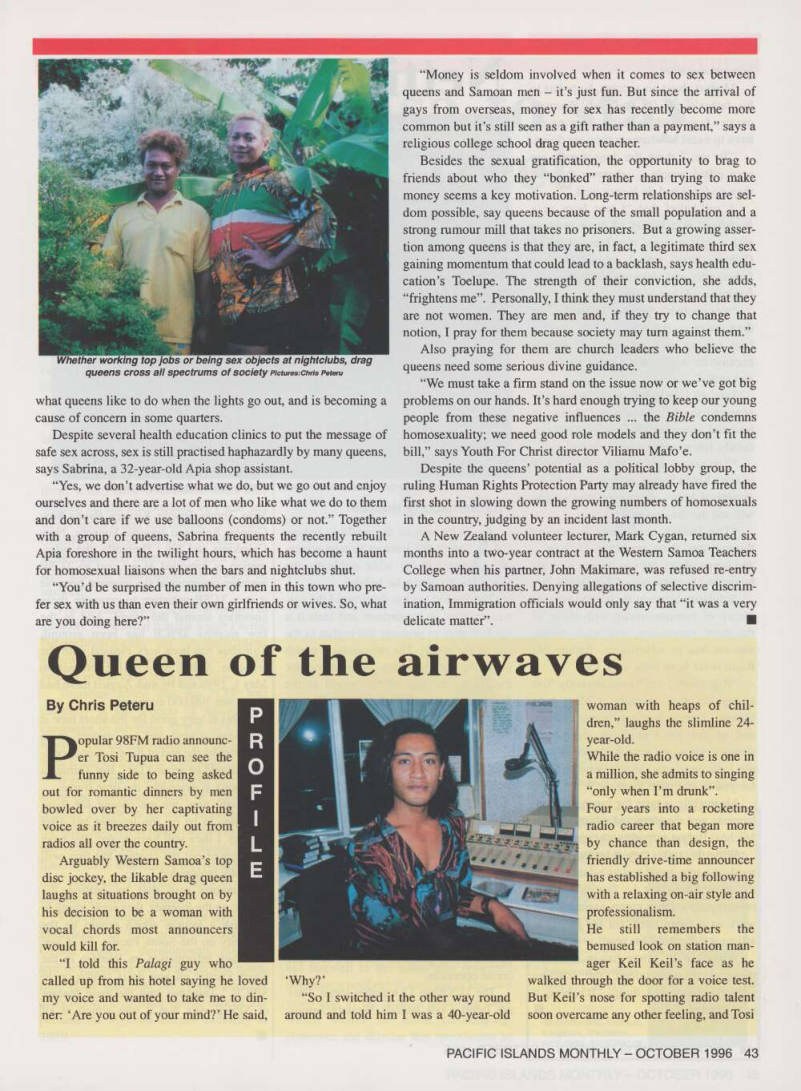
Traditionally, the distintive and painful Samoan body tattoo, as worn proudly by sevens rugby star Alefaio Vaisuai and held as an important rite of passage to manhood, now adorns the bodies of some drag queens. “I don’t know how this has come about, but I was bom to be like this,” says FM9B radio announcer Tosi Tupua, one of the coun try’s top DJs (see profile story). Widely shunned in the West as a freak show, Samoan attitudes have given queens an acceptance at home unheard of overseas. Health Education Unit Head Palantina Toelupe believes acceptance of queens is based largely on the positive contri bution they make to their families rather than their sexual orientation.
“In whatever they do, they maintain a level of excellence in their work that exceeds the norm. They are feminine men who can do both sets of chores, which is one reason why they are loved and adored by their families.” That willingness to go the extra mile has created a strong work ethic among queens and plenty of employment offers in a country now demanding better standards from its work force. Teaching and sales jobs tend to have a high proportion of drag queens, and it is not unusual for them to hold senior positions.
Community service such as fundraisers held by drag organisations, such as the pioneering Seven Stars Club, for charity has further endeared the queen culture to the public. Although the type of sexual activitity involving drag queens was largely ignored in the past, the advance of AIDS (Acquired Immune Deficiency Syndrome) amongst the 165,000 population - four deaths and six confirmed HIV (Human Immunodeficiency Virus) carriers - has made more Samoans aware of
what queens like to do when the lights go out, and is becoming a cause of concern in some quarters.
Despite several health education clinics to put the message of safe sex across, sex is still practised haphazardly by many queens, says Sabrina, a 32-year-old Apia shop assistant.
“Yes, we don’t advertise what we do, but we go out and enjoy ourselves and there are a lot of men who like what we do to them and don’t care if we use balloons (condoms) or not.” Together with a group of queens, Sabrina frequents the recently rebuilt Apia foreshore in the twilight hours, which has become a haunt for homosexual liaisons when the bars and nightclubs shut.
“You’d be surprised the number of men in this town who pre fer sex with us than even their own girlfriends or wives. So, what are you doing here?”
“Money is seldom involved when it comes to sex between queens and Samoan men - it’s just fun. But since the arrival of gays from overseas, money for sex has recently become more common but it’s still seen as a gift rather than a payment,” says a
religious college school drag queen teacher.
Besides the sexual gratification, the opportunity to brag to friends about who they “bonked” rather than trying to make money seems a key motivation. Long-term relationships are sel dom possible, say queens because of the small population and a strong rumour mill that takes no prisoners. But a growing asser tion among queens is that they are, in fact, a legitimate third sex gaining momentum that could lead to a backlash, says health edu cation’s Toelupe. The strength of their conviction, she adds, “frightens me”. Personally, I think they must understand that they are not women. They are men and, if they try to change that notion, I pray for them because society may turn against them.”
Also praying for them are church leaders who believe the queens need some serious divine guidance.
“We must take a firm stand on the issue now or we’ve got big problems on our hands. It’s hard enough trying to keep our young people from these negative influences ... the Bible condemns homosexuality; we need good role models and they don’t fit the bill,” says Youth For Christ director Viliamu Mafo’e.
Despite the queens’ potential as a political lobby group, the ruling Human Rights Protection Party may already have fired the first shot in slowing down the growing numbers of homosexuals in the country, judging by an incident last month.
A New Zealand volunteer lecturer, Mark Cygan, returned six months into a two-year contract at the Western Samoa Teachers College when his partner, John Makimare, was refused re-entry by Samoan authorities. Denying allegations of selective discrim ination, Immigration officials would only say that “it was a very delicate matter”. ■
Whether working top jobs or being sex objects at nightclubs, drag queens cross all spectrums of society pictures:Chris Peteru