On Vanuatu’s shaky grounds
pp. 39-41 · Read in the full issue
By Patrick Decloitre
Early July, Vanuatu’s ombudswom an, Marie-Noelle Ferrieux- Patterson, published a report on an alleged scam within the Vanuatu, govern ment.
Although it was persistently denied in the early days, it may well have caused yet another crisis in this 165,000-populated Island state, where the balance of power is particularly versatile.
In a damning report, Ferrieux- Patterson alleged Prime Minister Maxime Carlot, his finance minister, Barak Sope, Sope’s first secretary, George Borugu, and Reserve Bank Governor Samson Ngwele had signed letters of guarantee worth SUSIOO million (twice the country’s bud get).
She recommended Sope be dismissed and Carlot be “at least” reprimanded by the state president.
Carlot later told a Press conference the ombudswoman had “gone too far and based her report on rumours”, adding he did not intend to follow the ombudswom an’s recommendations in dismissing his finance minister. Carlot said she should have observed the Secrecy Act, accusing her and the Press of “destabilising” the country.
An Australian-based “financing con sultant”, Peter Swanson, 44, was arrested here on June 21 by Vanuatu police. He has since been released on bail, pending a trial in the capital.
The bail was granted on condition that Swanson surrender the letters of guaran tee, put up a surety of SUS9O,OOO and
hand in a Vanuatu diplomatic passport which the court heard was issued by the Foreign Affairs Department.
The Supreme Court, however, agreed to drop the first condition.
A few days after the scam was made public, Vanuatu’s opposition, consisting of former prime minister Walter Lini’s National United Party (NUP) and Serge Vohor’s faction of a divided Union of Moderate Parties (UMP) demanded that Carlot resign for being involved in the scam.
Nothing seemed to happen, though, and Carlot’s refusal to follow the ombudswoman’s allegations did not seem to shock the public.
But behind the scenes, things were actually moving: It soon became apparent that the scam had caused a rift within the
coalition partners in government, espe cially between Sope and Carlot.
On August 5, the first tangible signs started to emerge, when Carlot announced a reshuffle in his government.
The exercise consisted of swapping portfolios between four ministers.
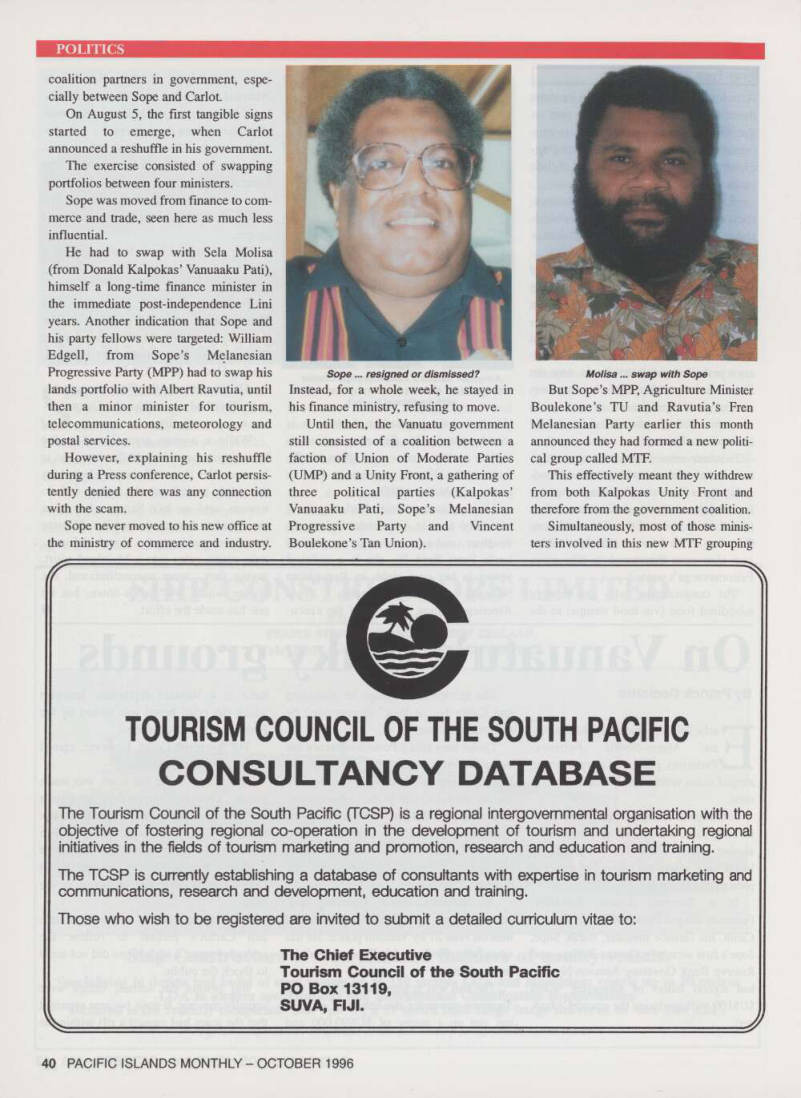
Sope was moved from finance to com merce and trade, seen here as much less influential.
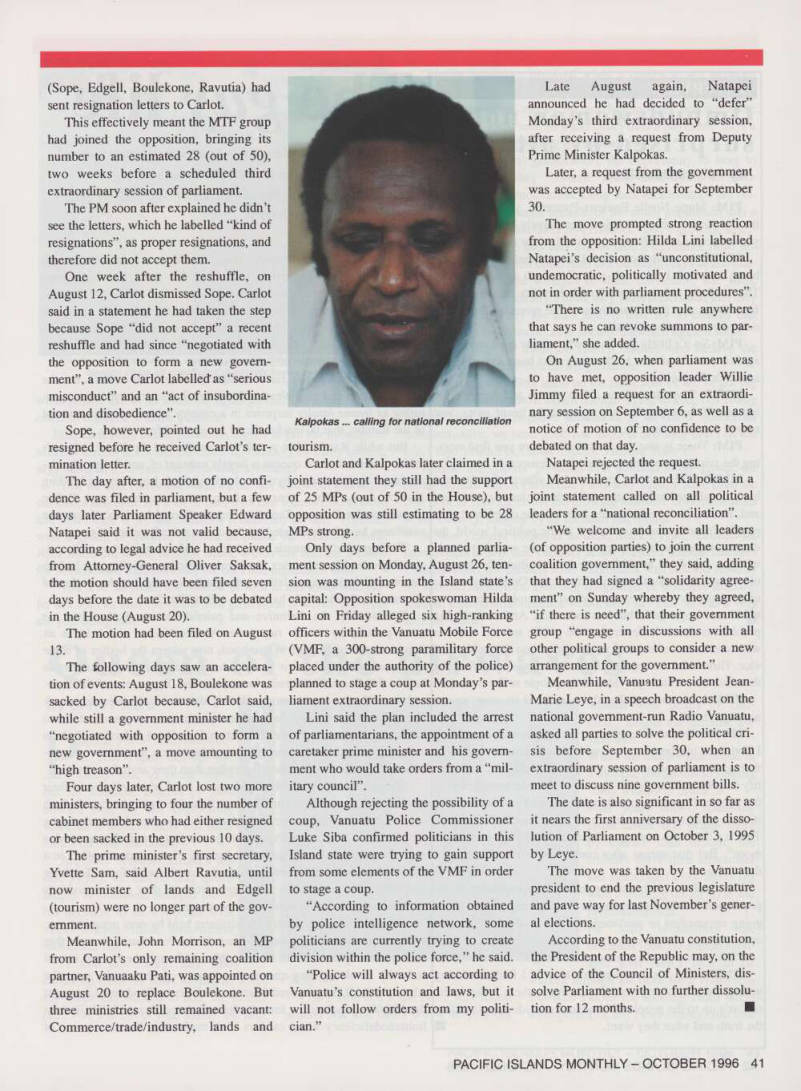
He had to swap with Sela Molisa (from Donald Kalpokas’ Vanuaaku Pati), himself a long-time finance minister in the immediate post-independence Lini years. Another indication that Sope and his party fellows were targeted: William Edgell, from Sope’s Melanesian Progressive Party (MPP) had to swap his lands portfolio with Albert Ravutia, until then a minor minister for tourism, telecommunications, meteorology and postal services.
However, explaining his reshuffle during a Press conference, Carlot persis tently denied there was any connection with the scam.
Sope never moved to his new office at the ministry of commerce and industry.
Instead, for a whole week, he stayed in his finance ministry, refusing to move.
Until then, the Vanuatu government still consisted of a coalition between a faction of Union of Moderate Parties (UMP) and a Unity Front, a gathering of three political parties (Kalpokas’
Vanuaaku Pati, Sope’s Melanesian Progressive Party and Vincent Boulekone’s Tan Union).
But Sope’s MPP, Agriculture Minister Boulekone’s TU and Ravutia’s Fren Melanesian Party earlier this month announced they had formed a new politi cal group called MTF.
This effectively meant they withdrew from both Kalpokas Unity Front and therefore from the government coalition.
Simultaneously, most of those minis ters involved in this new MTF grouping
Sope...resigned or dismissed?
Molisa...swap with Sope
(Sope, Edged, Boulekone, Ravutia) had sent resignation letters to Carlot.
This effectively meant the MTF group had joined the opposition, bringing its number to an estimated 28 (out of 50), two weeks before a scheduled third extraordinary session of parliament.
The PM soon after explained he didn’t see the letters, which he labelled “kind of resignations”, as proper resignations, and therefore did not accept them.
One week after the reshuffle, on August 12, Carlot dismissed Sope. Carlot said in a statement he had taken the step because Sope “did not accept” a recent reshuffle and had since “negotiated with the opposition to form a new govern ment”, a move Carlot labelled as “serious misconduct” and an “act of insubordina tion and disobedience”.
Sope, however, pointed out he had resigned before he received Carlot’s ter mination letter.
The day after, a motion of no confi dence was filed in parliament, but a few days later Parliament Speaker Edward Natapei said it was not valid because, according to legal advice he had received from Attorney-General Oliver Saksak, the motion should have been filed seven days before the date it was to be debated in the House (August 20).
The motion had been filed on August 13.
The following days saw an accelera tion of events: August 18, Boulekone was sacked by Carlot because, Carlot said, while still a government minister he had “negotiated with opposition to form a new government”, a move amounting to
“high treason”.
Four days later, Carlot lost two more ministers, bringing to four the number of cabinet members who had either resigned or been sacked in the previous 10 days.
The prime minister’s first secretary, Yvette Sam, said Albert Ravutia, until now minister of lands and Edged (tourism) were no longer part of the gov ernment.
Meanwhile, John Morrison, an MP from Carlot’s only remaining coalition partner, Vanuaaku Pati, was appointed on August 20 to replace Boulekone. But three ministries still remained vacant: Commerce/trade/industry, lands and
tourism.
Carlot and Kalpokas later claimed in a joint statement they still had the support of 25 MPs (out of 50 in the House), but opposition was still estimating to be 28 MPs strong.
Only days before a planned parlia ment session on Monday, August 26, ten sion was mounting in the Island state’s
capital: Opposition spokeswoman Hilda
Lini on Friday alleged six high-ranking officers within the Vanuatu Mobile Force (VMF, a 300-strong paramilitary force placed under the authority of the police) planned to stage a coup at Monday’s par liament extraordinary session.
Lini said the plan included the arrest of parliamentarians, the appointment of a caretaker prime minister and his govern ment who would take orders from a “mil
itary council”.
Although rejecting the possibility of a
coup, Vanuatu Police Commissioner Luke Siba confirmed politicians in this Island state were trying to gain support from some elements of the VMF in order to stage a coup.
“According to information obtained
by police intelligence network, some
politicians are currently trying to create
division within the police force,” he said.
“Police will always act according to Vanuatu’s constitution and laws, but it will not follow orders from my politi cian.”
Late August again, Natapei announced he had decided to “defer”
Monday’s third extraordinary session, after receiving a request from Deputy Prime Minister Kalpokas.
Later, a request from the government was accepted by Natapei for September 30.
The move prompted strong reaction from the opposition: Hilda Lini labelled Natapei’s decision as “unconstitutional, undemocratic, politically motivated and not in order with parliament procedures”.
“There is no written rule anywhere that says he can revoke summons to par liament,” she added.
On August 26, when parliament was to have met, opposition leader Willie Jimmy fded a request for an extraordi nary session on September 6, as well as a notice of motion of no confidence to be debated on that day.
Natapei rejected the request.
Meanwhile, Carlot and Kalpokas in a joint statement called on all political leaders for a “national reconciliation”.
“We welcome and invite all leaders (of opposition parties) to join the current coalition government,” they said, adding that they had signed a “solidarity agree ment” on Sunday whereby they agreed, “if there is need”, that their government group “engage in discussions with all other political groups to consider a new arrangement for the government.”
Meanwhile, Vanuatu President Jean- Marie Leye, in a speech broadcast on the national government-run Radio Vanuatu, asked all parties to solve the political cri sis before September 30, when an extraordinary session of parliament is to meet to discuss nine government bills.
The date is also significant in so far as it nears the first anniversary of the disso lution of Parliament on October 3, 1995 by Leye.
The move was taken by the Vanuatu president to end the previous legislature and pave way for last November’s gener al elections.
According to the Vanuatu constitution, the President of the Republic may, on the advice of the Council of Ministers, dis solve Parliament with no further dissolu tion for 12 months. ■
Kalpokas...calling for national reconciliation