lingering
pp. 20-21 · Read in the full issue
The Pacific’s lingering nuclear clouds
By Bernadette Hussein
Environmental issues featured prominently at the 27th South Pacific Forum in Majuro, Marshall Islands, early last month with delegates voicing concern over the dumping of hazardous wastes in the region.
It was agreed that though the atolls eyed as dumping grounds might be the property of nuclear powers, priority would have to be given to the health and lives of those living there.
But while the Forum voiced its oppo sition to the use of Palmyra as a nuclear dump site and resolved to seek commit ment from the United States to this effect, a proposal by the Marshall Islands to store nuclear waste on one of its remote atolls didn’t rate much mention.
The focus on the Marshall Islands sit uation lay on recompense for past events.
“The Forum again reaffirmed the existence of a special resposnibility toward those peoples of the former United Nations Trust Territory adminis tered by the United States, the Marshall Islands, who have been adversely affect ed as a result of nuclear weapon tests conducted during the preiod of the
trusteeship.
“This responsibility included safe resettlement of displaced human popula tions and the restoration to economic productivity of affected areas,” the Forum communique states.
Earlier this year, Palmyra Atoll (the uninhabited United States possession 1600 kilometres south of Honolulu) was being eyed by a New York-based invest-
ment company, KVR Inc, to be used as a storage site for Russian plutonium.
The Forum expressed its concern on the grounds that they did not want anoth er Marshall Islands situation and took encouragement from the US govern ment’s opposition to the proposal.
The Greenpeace organsiation congrat
ulated the Forum for taking a strong stand on an issue which, it said, was close at heart for many, and for standing by the United Nations Draft Declaration on the
Rights of Indigenous Peoples.
Article 28 of the declaration says that “states shall take effective measures to ensure that no storage or disposal of haz ardous materials shall take place in the lands and territories of indigenous peo ples”.
The Forum recalled that in 1979, when a proposal to develop a storage site for spent nuclear fuel on Palmyra had first been made, it had expressed its strong opposition. The Forum reiterated its 1979
position, strongly opposing any move to use the Pacific as a dumping ground for nuclear waste. In that regard, it will seek to ensure a firm commitment by the United States that the proposal for Palmyra Atoll not be implemented.
The Forum stressed the importance of the Waigani Convention on Hazardous Wastes which it adopted in 1995.
But it noted with concern that, despite
the long-standing regional opposition to
the use of the Pacific as a dumping ground for toxic wastes and the adoption of the Waigani Convention, new proposals for creating storage sites for nuclear wastes in
the region were emerging.
The plight of the people in the Marshall Islands, who were also affected by radioactive material, was discussed with concern as to why the US did not take the same stand on Marshall Islands as it did with Palmyra.
In a letter to US Secretary of Energy Hazel O’Leary, dated April 30 this year.
Elton Gallegly, chairman of the Congress Subcommittee on Native American and Insular Affairs, confirmed that the Marshall Islands had proposed a feasibili ty study for the disposal of low-level nuclear waste on a remote atoll.
This was despite US rejection of an earlier proposal of high-level nuclear waste in the Marshalls, regarding which O’Leary expressed a number of concerns and established a policy of neutral non support. However, Gallegly urged O’Leary to support the latest Marshallese
proposal.
But Gallegly said that, as part of the federally funded Marshalls resettlement plan, radioactive material would have to be removed from Rongelap and other atolls “in order to permit the safe return of the people of Rongelap to their home islands”.
Meanwhile the apporval of a Comprehensive Test Ban Treaty at the United Nations on September 11 “which though not perfect, was an important first step towards total nuclear disarmament” said Bunny McDiarmid of Greenpeace.
McDiarmid said this meant that the Pacific would never again be threatened by nuclear testing programmes of France or any other country However, the treaty can only take effect after the signature and ratification of all 44 countries, including India, which has so far refused to support it.
McDiarmid said it was, therefore, essential that the United States and the other four nuclear powers ratify the treaty as soon as possible and affirm their com mitment never to test nuclear weapons
again.
She said all nuclear-capable countries should publicly commit to a formal mora torium on nuclear testing until the treaty was ratified, close their test sites and ensure compensation for those who had suffered from testing programmes.
France has been one of the first coun tries to state its commitment to signing the treaty.
French President Jacques Chirac said this would allow France to finally turn the page on the nuclear arms race giving future generations the hope of a world free from the nuclear threat. ■
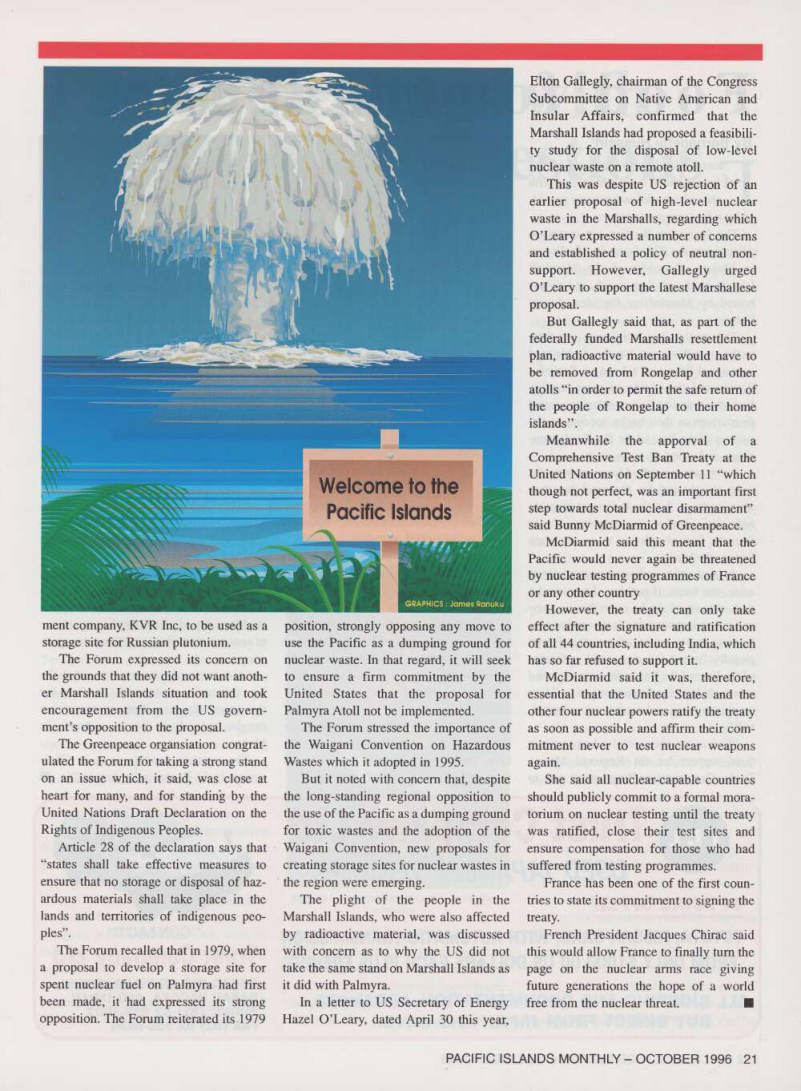
GRAPHICS: James Ranuku