The Pacific’s grand
pp. 46-47 · Read in the full issue
cultural celebration
By Chris Peteru
In any language, the seventh Pacific Arts Festival means one thing - BOOM. Held every four years since 1968, more than 3000 performing artists from 26 islands and states, are converging on Western Samoa for 15 days
(September 8-23) to celebrate their iden tity, entertain one another and party it up Pacific style.
The New Zealand Maori contingent is bringing ™ the largest numbers with Pitcairn Island the only group not repre . , I(TU . . Jb . r , K „ sented. This is an occassion planned to bring out all the best in what is known as
the Pacific Way. I have no doubt it’s going to be fun,” said Youth, Sports and Culture Minister Luagalu Lavaula Kamu.
Following the success of the 1992 fes tival in the Cook Islands is going to be hard work, director Tauiliili Uili Meredith said. But he and staff from the Ministry of Youth Sports and Culture have gone the whole nine yards to get the right results.
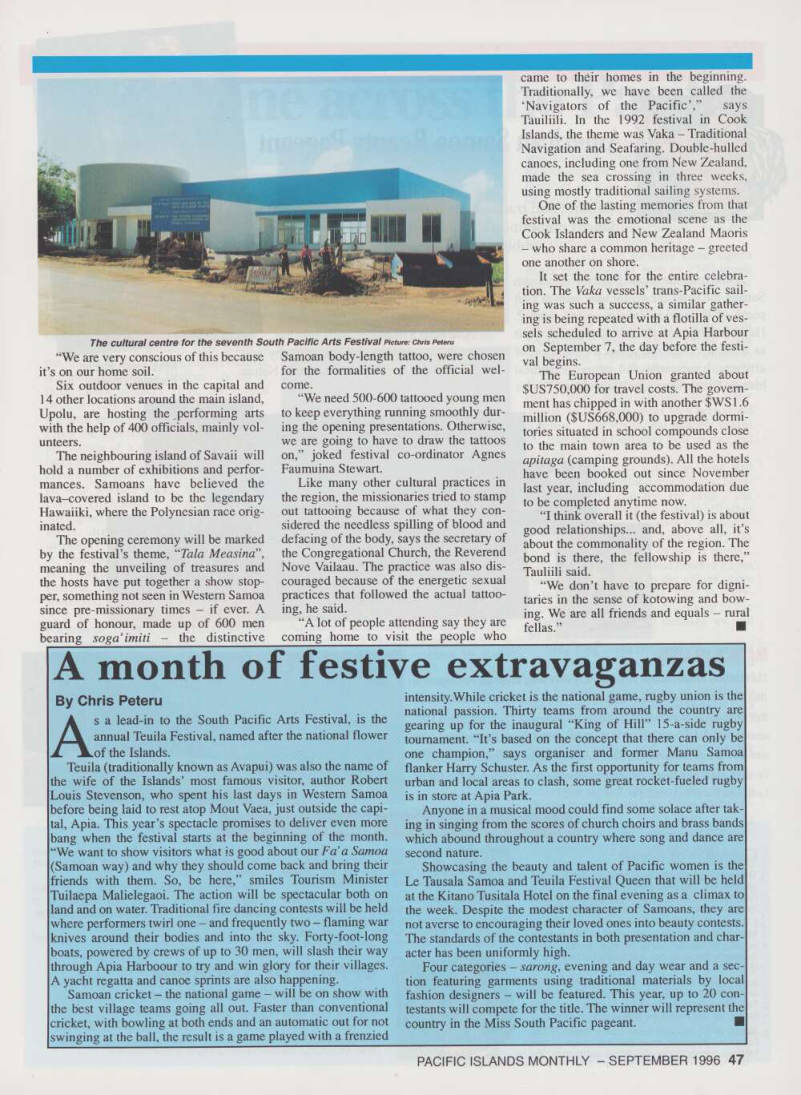
“The air is electrified and it’s a terrific feeling,” he said. A SUSI-million National Centre in the middle of the capi tal, Apia, has been built with the help of the Chinese government. Workers put in gruelling 14-hour days to have the centre ready to roll come showtime. The 1500seat theatre will house a contemporary arts exhibition. The main performance hall will handle plays and opera in the evenings. But the main performing arts venue will be on Beach Road outside the government complex. Adjacent to Apia Harbour, is the hub of the festival, a mini
village featuring handicrafts, carvings and
food preparation.
“The French Polynesians will be bringing over their firewalkers... It’s a much more comprehensive layout than we have ever had before.”
Seminars and symposiums have alsobeen organised by the region’s univer sities. The other dimension is the partici pation of children, even preschoolers, at the festival - something that has never been done before, said Tauiliili.
The spectacular fire dance, a highlight of the Teuila Festival
“We are very conscious of this because it’s on our home soil.
Six outdoor venues in the capital and 14 other locations around the main island,
Upolu, are hosting the performing arts
with the help of 400 officials, mainly vol unteers.
The neighbouring island of Savaii will hold a number of exhibitions and perfor mances. Samoans have believed the lava-covered island to be the legendary Hawaiiki, where the Polynesian race orig inated.
The opening ceremony will be marked by the festival’s theme, “Tala Measina”, meaning the unveiling of treasures and the hosts have put together a show stop per, something not seen in Western Samoa since pre-missionary times - if ever. A guard of honour, made up of 600 men bearing soga’imiti - the distinctive
Samoan body-length tattoo, were chosen for the formalities of the official wel come.
“We need 500-600 tattooed young men
to keep everything running smoothly dur
ing the opening presentations. Otherwise, we are going to have to draw the tattoos on,” joked festival co-ordinator Agnes Faumuina Stewart.
Like many other cultural practices in the region, the missionaries tried to stamp out tattooing because of what they con sidered the needless spilling of blood and defacing of the body, says the secretary of the Congregational Church, the Reverend Nove Vailaau. The practice was also dis couraged because of the energetic sexual practices that followed the actual tattoo ing, he said.
“A lot of people attending say they are coming home to visit the people who
came to their homes in the beginning.
Traditionally, we have been called the ‘Navigators of the Pacific’,” says Tauiliili. In the 1992 festival in Cook Islands, the theme was Vaka - Traditional
Navigation and Seafaring. Double-hulled
canoes, including one from New Zealand, made the sea crossing in three weeks, using mostly traditional sailing systems.
One of the lasting memories from that festival was the emotional scene as the Cook Islanders and New Zealand Maoris - who share a common heritage - greeted one another on shore.
It set the tone for the entire celebra tion. The Vaka vessels’ trans-Pacific sail ing was such a success, a similar gather ing is being repeated with a flotilla of ves sels scheduled to arrive at Apia Harbour
on September 7, the day before the festi
val begins.
The European Union granted about $U5750,000 for travel costs. The govern ment has chipped in with another SWSI.6 million ($U5668,000) to upgrade dormi tories situated in school compounds close to the main town area to be used as the apitaga (camping grounds). All the hotels have been booked out since November last year, including accommodation due to be completed anytime now.
“I think overall it (the festival) is about good relationships... and, above all, it’s about the commonality of the region. The bond is there, the fellowship is there,”
Tauliili said.
“We don’t have to prepare for digni taries in the sense of kotowing and bow ing. We are all friends and equals - rural fellas.” ■
The cultural centre for the seventh South Pacific Arts Festival picture: Chris Peteru