On the road to success
pp. 43-44 · Read in the full issue

Western Samoa Special
By Chris Peteru
Western Samoa is on a roll.
Steady economic growth, a
stable government and a wave of infrastructural and business develop ments are aimed at giving the Pacific’s
first independent state (population
165,000) a kick start into the next mille nium. Throwing the dice for a record fourth term as prime minister is Tofilau Eti Alesana. Now 72, Tofilau is the coun try’s longest-serving politician and the region’s elder statesman. He is a remark able legacy linking the past with the pre
sent. Born in neighbouring American Samoa on June 24, 1914, he entered par liament in 1959 and was on hand to wit ness Western Samoa’s move to indepen dence in 1962, after formerly being a New Zealand protectorate.
Earlier, New Zealand had captured Western Samoa in a bloodless takeover from Germany at the outbreak of the first world war. However, like the Germans, the New Zealand administration suffered from a strong dose of colonial partemal ism Samoans resented.
By 1926, the Samoans had formed an
Independence League, more widely
known as the Mau with the catch call of Samoa mo Samoa (Samoa for Samoans).
The turning point came after the death of the Mau leader and future king of Samoa, Tupua Tamesese. He and 10 sup porters were gunned down in 1929 by New Zealand troops during an unarmed protest. The incident promoted both coun tries, who had been deadlocked for years, onto the negotiating table.
Numerous talks led to agreements being hammered out over Western Samoa’s future. In 1961, a Treaty of Friendship between Western Samoa and New Zealand was signed. Full indepen dence was achieved the following year.
The period since independence has been filled with challenges unique to a small nation and a small population with limited natural resources and surrounded by thousands of kilometres of sea.
Western Samoa has had to battle hard to maintain export markets in an increasing ly competitive global market. On a posi tive note, receipts of SUS9.O4 for the last year were at their highest since 1989 and double the level for 1994 (SUS3.7I).
Latest figures have inflation steady at three per cent. Agriculture remains the dominant sector of the economy relying on copra and coconut oil for offshore earnings. As with many Pacific nation emigrants, remittances constitute an important source of income. Recently,
consecutive cyclones destroyed commu
nications and infrastructure and flattened entire villages. The cost in damage was estimated to be in excess of SUSIOO mil lion. Then a taro fungus wiped out the main diet staple and export crop. But care of some austere financial policies by Finance Minister Tuilaepa Sailele
Malilegaoi plus an emphasis on develop
ing the private sector helped Western
Samoa bounce back with renewed vigour.
“The results of these policies can be seen everywhere. You just have to look around you,” enthuses Tuilaepa.
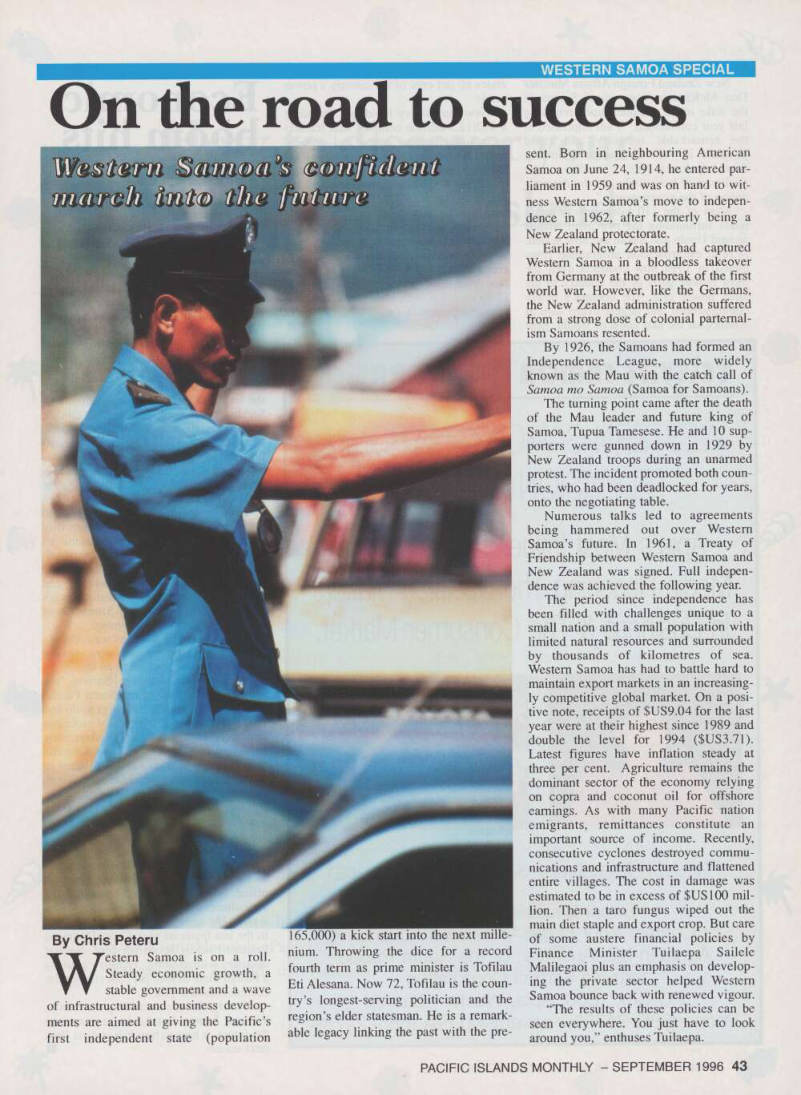
Wesrern Samoa's confident march into the future
New Zealand Foreign Affairs Minister Don McKinnon, who visited Samoa in the wake of the cyclones, upon returning last year commented; “I am impressed at the remarkable recovery and rapid progress in Western Samoa following those cyclones. It’s a credit to the resilience of her people and the determi nation of the government...”
Most of the 110 kilometres of main roads surrounding the two main islands around Upolu and Savaii are now sealed.
A rural electrification programme com pleted in 1995 now connects even the most remote parts of the country to the
main power grid. The country’s newly
commissioned and largest hydro dam at Afulilo, on the east coast of Upolu, gen
erates 60 per cent of the country’s power needs.
New multistorey buildings, including a SUS 12.5-million complex that features a Samoan meeting house and concen trates all government departments, has gone up on the seaward side of the capi tal, Apia, a symbol of progress and the emerging cosmopolitan character of a once dusty and tired-looking town.
A new SUSI4.4-million campus for the National University of Samoa, built with the assistance of the Japanese gov ernment, is due for completion in August next year. The campus will house up to 8000 students, with state-of-the art elec tronic equipment, a gymnasium and teaching facilities. ■