fiscal problems
pp. 26-27 · Read in the full issue
Economy
Nauru attacks its fiscal problems
By David North
Poverty is more dramatic when it hits the once rich, as opposed to the per
petually poor.
There is (perhaps wrongly) more inter est when the millionaire sells his last yacht, or the ageing actress has to pawn her last diamonds, than when the peasant family, yet again, eats only one meal a day.
So it is with Nauru. Once touted as the nation with the world’s greatest per capita income, the phosphate island falls into the ex-millionaire category.
The symbol of Nauru’s financial crisis is not a yacht or diamonds but the loss of its own version of the White House. Nauru quietly decided a few months ago to tear down the State House, the president’s res idence, as well as the government houses for the chief justice and the speaker of par liament.
Why? So that the Nauru Phosphate Corporation can mine the phosphate rock beneath the houses; the Island needs the money and is rapidly running out of phos
phate.
What Nauru is doing
President Lagumot Harris and his reform allies, notably Education Minister Kennan Adeang, narrowly won control of parliament last November, promising that they would try to straighten out the Island’s tangled and wasteful finances. (Nauru’s president, like the one in the Marshall Islands, carries that US-sound ing title, but is chosen, in the Westminster manner, by a majority of the members of
parliament.)
The Harris government began money saving measures immediately, but did not have to face up to a new budget until June.
Meanwhile, confidence in the local econ omy had dwindled so badly that currency disappeared, presumably to be hidden in island mattresses or stashed in off-island bank accounts.
The Harris budget was a blockbuster, a pail of cold water tossed into the face. It included, among other things; • No wage increases' for government workers for two years; • considerable reduction in the “over staffed Works Department”;
• drastic cutbacks in hiring of new gov ernment staff; • privatisation of numerous, previously subsidised government agencies, such as the radio and television stations, the gov ernment printing office and the computer bureau; • fewer off-island hospitalisations for islanders; and • (a couple of easy ones) fewer govern ment jobs for expatriates and fewer con sulates overseas.
Earlier the Harris government had re organized Air Nauru, laying off some staff as it converted from a two-plane to a one plane operation. It was only three years ago that Nauru borrowed SUSBO,OOO,OOO to buy two Boeing 747-400 s for its waste ful airline; it made no downpayment, bor rowing 100 per cent of the costs. (See “Where Has the Money” PIM, Aug ‘93) The government now plans to bring more off-island physicians to the Island, while reducing the flying of patients to off-island hospitals. This makes sense.
While a visiting physician is expensive, he or she can treat many people.
The off-shore treatment (with a com
panion sometimes going along), on the
other hand, can help only one person.
Many of Nauru’s citizens, unfortunately.
have picked up the worst of the West’s eat ing habits; there is widespread obesity and a remarkable amount of diabetes, which in its advanced stages can lead to amputation of legs and arms Not spelled out by the government, at least not yet, is the probable impact of the fiscal cutbacks on Nauru’s long-standing and ambitious off-shore education scheme, the sending of many young peo l pie to universities and vocational schools in Australia. This practice may have to be reduced as well.
Speaking of young people and airplane
trips, it will be interesting to see if Nauru’s enthusiastic funding of its sports teams some competent golfers and a world-class weight-lifter - will be hurt by the new budget. These athletes usually have to go to distant sites to compete, running up the
government’s already substantial travel
bills.
What Nauru is saying
The planned reduction in government expenditures was announced by one of the most painfully honest Press releases I have seen in the last four decades. A three page fax, emanating from the 50th floor of Nauru House in Melbourne, Australia, had
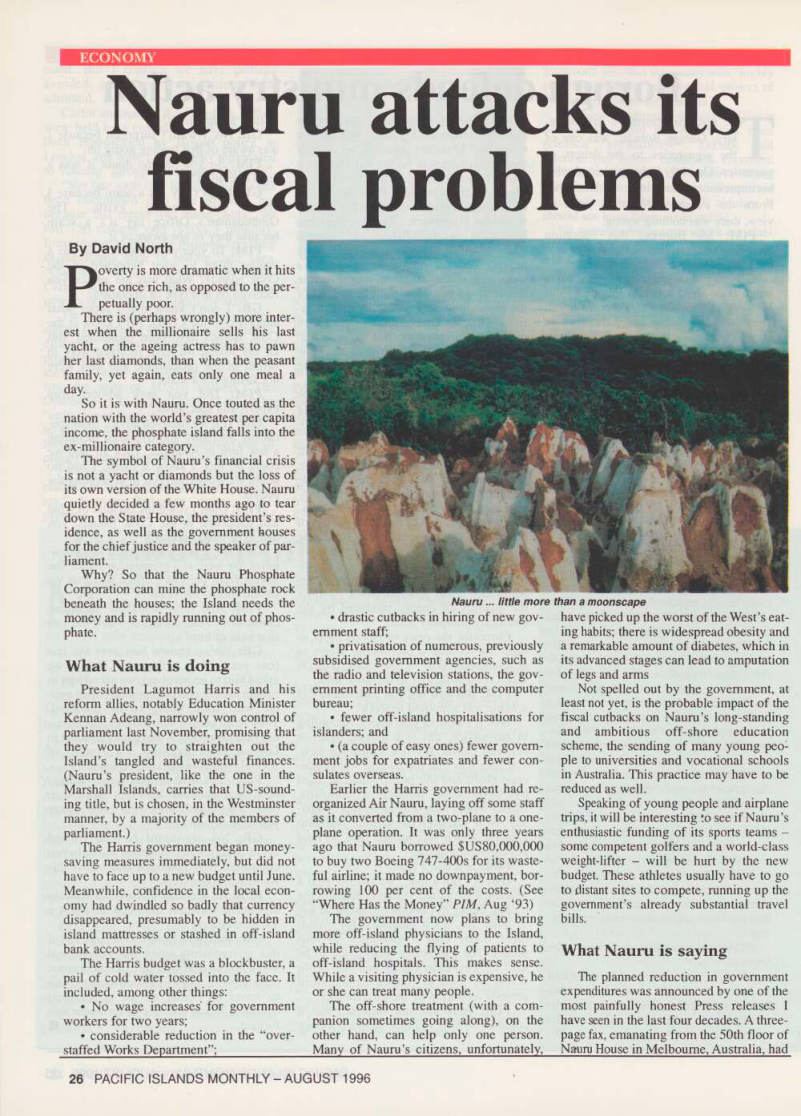
Nauru ... little more than a moonscape
this to say about the island government: “... greatly overstaffed public service with high salary bills and little funding for maintenance of buildings and equipment.
The departments lacked clear objectives and performance criteria.
“When the Harris government came to power, it found substantial unsecured loans with the Bank of Nauru both public and private. There was a critical cash-flow crisis on the island. Much of the country’s investment had been collateralised to meet government debt...”
What Nauru is not saying Meanwhile, honest as the Press release was, it barely scratched the surface of the financial problems of Naum.
For example, it mentioned these reforms: “Visitors to pay user-charge fees for medical services” implying that medi cal services, in the past, have been free for off-islanders who became sick on the island. It spoke of “amalgation of hospi tals on the island”.
Naum, for reasons not clear to me, an island with 8000 inhabitants in a compact area, had two hospitals.
The Press release said that were to be “significant increases in import duty for alcohol, tobacco and second-hand cars”.
When American television viewers last saw the Island described on television, CBS-TV commentator Morey Safer was seen waving a cocktail glass and saying that “Naum has the cheapest liquor in the world”.
It is not that Naum produces the hard stuff efficiently. (Nauru produces nothing but phosphate.) What happens is that the stuff is imported, and then barely taxed.
Further, Nauru may be the only place in the world where there is no income tax and no sales tax.
The government, in short, can mend its balance sheet by cutting waste and bloat, and by imposing a few taxes. None of this, of course, is very popular among the vot ers.
In addition to the fast-disappeared phosphate that once created the Island’s prosperity, Naum has three other major
financial problems:
1. Although the figures sound horrify
ing, the least of Naum’s problems has been that outsiders, ranging from accoun tants in Melbourne to international con men, have stolen money from the Island’s inept financial managers in the past. Three years ago Nauru lost SUS 10-20,000,000 to conmen selling “Prime Bank Notes”, in a swindle something like the one that hit the Cooks recently.
2. A continuing, more significant prob
lem has been foolish investments of the phosphate moneys, that were supposed to
guarantee prosperity for Nauruans even after the last of the phosphate was sold.
Nauru’s leaders, traditionally, distrusted stocks and bonds so they bought real estate, such as hotels and the tower in Melbourne. Some, such as the holdings in Honolulu, turned out well, others were disasters.
They then turned to the Tokyo stock market, just as it started to collapse, and lost a bundle there. And, about three years ago, Nauru decided to mount a musical
comedy in London, which just happened
to be the property of Duke Minks, a fast talking financial adviser to then Nauru
Government. Nauru dropped SUS 3 mil
lion on the musicals which dealt with the relation between the painter Leonardo Da Vinci and his most famous model, the Mona Lisa.
Kelly Emiu, then secretary of the cabi net, and the chief “Leonardo” enthusiast, kept his job after the musical bombed but is not on the payroll of the Harris govern ment. 3. The most serious of Nauru’s finan cial problems, as the new government readily admits, is waste.
The government spends enormous sums on overseas travel; all of its food and water have to be imported; there are too many politicians and civil servants on the payroll - with a compact island of 8000 people, Nauru had indulged in the luxury of two governmental structures, the national government and a municipal one, each with its own elected leaders, execu tive staff and hangers-on.
Meanwhile, though most of the island is a moonscape, ravaged by the surface mining for phosphate, Nauruans have not been doing the physical work needed to restore the landscape to its earlier condi tion when it was called Pleasant Island.
In recent decades, Nauru could have used some of its wasted money to pump sand and dirt from the bottom of the sur rounding ocean onto its desolate shore, but that did not happen. Nor did Nauru use the presumably empty holds of the arriving phosphate ships to bring in top soil from Australia.
The new government promises that rehabilitation of the Island remains a pri ority but, if done at all, it will probably be done by off-island contractors using off island technologies and off-island work ers.
The significant news, however, is that Nauru has finally made an effort to face the grim fiscal reality it has dodged for years.
Maybe, just maybe, the Harris govern
ment can avoid bankruptcy and the need to evacuate the Island, on the grounds that there is neither an Island left, nor any money remaining to support human life on it. ■