ACP-EU ties after
pp. 8-9 · Read in the full issue
The search for ACP-EU ties after Year 2000
Welcome to Apia, Western
Samoa, the host for the six
monthly meeting of the
Council of Ministers from 70 African, Caribbean and Pacific (ACP) states and the joint sessions of the ACP-European Union Council of Ministers.
A member of the South Pacific Forum, Western Samoa is only the second of the eight ACP Pacific states that has hosted the event since the ACP-EU marriage was sealed in a convention signed at Lome, the capital of the African nation of Togo in 1975. Fiji was the first in the region to host the meeting.
The Apia meeting was particularly sig
nificant. It put in train a process which, one day, will give birth to a new ACP-EU relationship. It is an important relation
ship.
There is little doubt this relationship will continue beyond the Year 2000 when all financial arrangements under the Lome Convention terminate.
But important as it may seem, every one at the Apia meeting had acknowl edged that the ACP-EU arrangements under Lome is a relationship in transition.
The European Union has made it clear that while there is still a need to maintain ties with the ACP member states, any new arrangement will not necessary take the form of Lome. So what can the Pacific
expect?
At this stage, no one really knows.
Indeed, that is the crux of the question being hotly debated in the three world regions - Africa, the Caribbean and the Pacific.
Important as it is, whatever form this new relationship takes will, no doubt, be dictated by globalised economic events over which ACP countries have very little control.
For us in the Pacific, the work has begun. The, South Pacific Forum Secretariat is developing a series of policy papers to help the eight Pacific states of the ACP Group in their search for a frame work for this new relationship.
The eight - Fiji. Kiribati. Papua New Guinea, Solomon Islands, Tonga, Tuvalu, Vanuatu and Western Samoa - are also
members of the South Pacific Forum.
The Secretariat’s Economic Development Division will produce the five policy papers. These will cover a number of areas such as: • The impact of Lome Assistance on the budget of the Individual Pacific ACP states; • an analysis of the conse quences of declining trade preferences in both the tree crop and the tuna-canning sector; • the effect of the Lome Commodity Protocols; and • an analysis of the impact of possible changes to the Stabcx regime and alternative aid modalities.
These arc being put together in the hope that it will give the EU a clear over view of the economic importance Pacific members of the ACP Group attach to their
EU relationship.
Senior ministers from Fiji, Kiribati.
Papua New Guinea, Solomon Islands, Tonga, Tuvalu, Vanuatu and Western Samoa who attended the Apia meeting had expressed deep concern that any decision to terminate Lome without a successor would adversely affect the region eco
nomically.
“It is important to raise public aware ness within the region as to the devastat ing impact, economically, if a broad-based
successor to Lome is not agreed on,” according to the record of their special
meeting in Apia.
“Given the importance of this issue, the 27th South Pacific Forum to be held in the Marshall Islands should also be made aware of developments...”
In the crusade to find a successor to Lome, the ministers have thrown their support behind a decision made in Mauritius last year that an ACP Leaders Summit be held next year to discuss a new relationship between the 15 member states of the European Union and the 70 African, Caribbean and Pacific states.
The Apia meeting has endorsed an offer by the African country of Gabon to host the summit cither in August or September next year.
The idea is that since the ACP-EU rela tionship is so crucial, the ACP countries want to continue it along the Lome line.
Hence, the proposed ACP Leaders Summit to discuss it at the highest politi cal level.
For its part, the European Union will release in October a Green Paper, which is expected to outline its position on ACP
EU post-Lome relationships.
What is the Lome Convention?
Lome is the capital of the African nation of Togo. In 1975 a convention was signed there - hence the Lome
The Forum
Alfred
Sasako
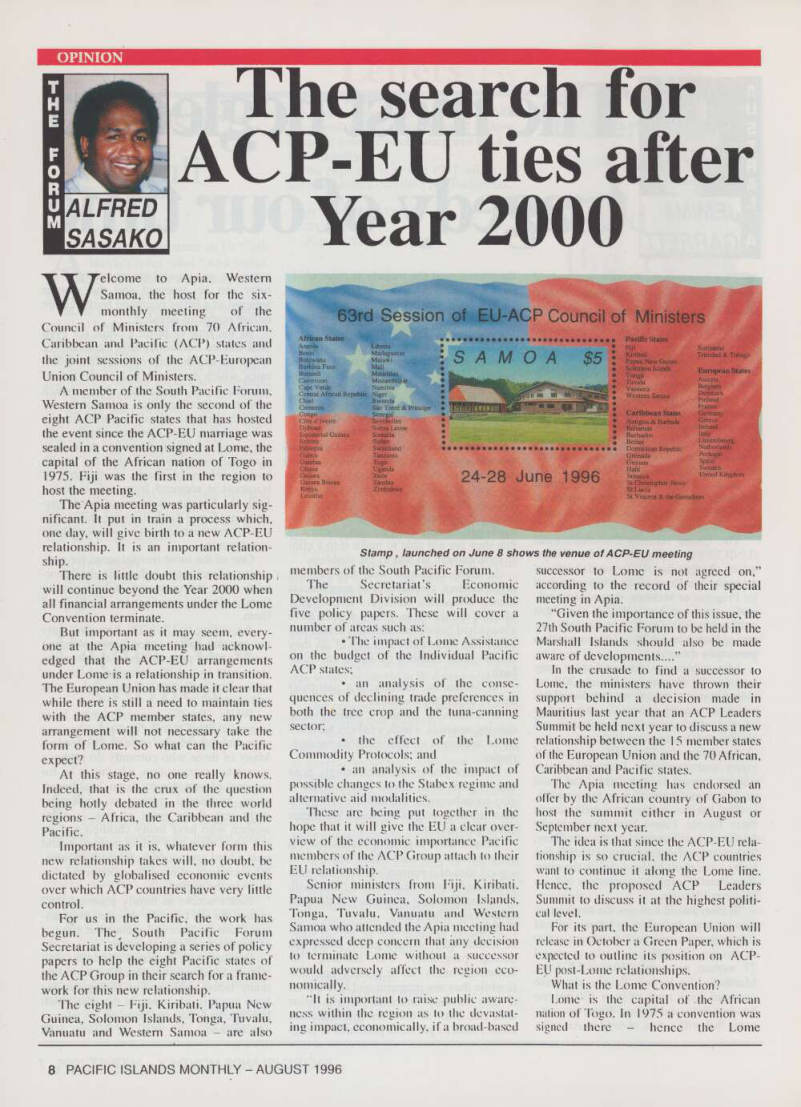
Stamp, launched on June 8 shows the venue of ACP-EU meeting
Convention - which guides the develop ment relationships between the ACP and the European Union.
In the 21 years since, the 70 ACP coun tries have benefited enormously from the substantial financial assistance provided under Lome. With a population of 500 million people and growing, the ACP countries are concerned that any decision to terminate Lome without a successor will deal a heavy blow to their economies.
Speaker after speaker in the joint ACP Council of Ministers meeting had acknowledged that ACP members must now face the new economic realities of
today.
“We live in an increasing globalised economy where reciprocity is the order of the day. It is the nature of that (new) rela tionship that we must identify,” one Caribbean official said.
Others said there was a need for the ACP to remain as a group.
“We should seek a mechanism for the solidarity of the ACP Group to ensure the efficient implementation of EU-funded programmes,” one other speaker said.
Still others have argued that the col lapse of the export commodity prices which account for up to 90 per cent of some ACP members’ overall export earn ings have worked against them. This has resulted in a combined SUS2O-billion debt for the ACP group. Some coyntries now
spend SUSIO billion a year in interest repayment alone. They argue that such debt, caused by events beyond their con trol, should be written off.
The ACP group lauded reports that the World Bank and the International Monetary Fund (IMF) have hatched a SUS7.7-billion debt-alleviation plan for the world’s poorest nations.
“The plan is in respect of an amount between SUSS.6 billion and SUS 7.7 bil lion. Among the beneficiaries of this debt alleviation plan are 17 countries which are members of the ACP group,” the co-pres ident of the ACP Council of Ministers, S K Syamujaye, said.
But other speakers are less convinced.
They argue that the challenge facing the ACP group is to create an internal climate conducive to attracting foreign invest ment.
“We cannot talk about trade expansion and industrialisation without foreign investment. I think how we attract foreign investment is the challenge that we must address,” a Pacific official concurred.
What do Pacific ACP members get out of the Lome arrangement?
The short answer is that we have bene fited substantially, both financially and in kind, over the past 20 or so years.
For instance, the eight Pacific ACP states receive up to four per cent of total EU funding to ACP countries.
Statistically, it is the highest per capita aid allocation in the world.
Under the second financial protocols of Lome IV - the funding arrangement which takes us to 2000 - the eight Pacific ACP States can expect up to SFI7O mil lion (SUSII9) over the next five years.
This is part of a SF2S-billion (SUS 17.5-billion) funding package to be made available to the ACP countries under the second financial Protocols of Lome IV.
For ACP members, the unexpected delay in ratifying the instrument has been
frustrating.
It means that these much-needed funds will not be released until such time as two thirds or 48 of the 70 ACP members have done so.
Solomon Islands is the only Pacific ACP country that his ratified along with six other ACP members while Denmark is the only member of the 15-strong European Union that has ratified the instrument.
The joint ACP-EU Council of Ministers is scheduled to meet again in Luxembourg in November.
This will certainly discuss the EU posi tio, as outlined in their Green Paper, regarding the future of the ACP-EU selec tion beyond the present Lome Convention which comes to an end five years from now. ■