In the tropic of cancer
pp. 20-23 · Read in the full issue
The Marshall Islands proposes a feasibility study on the disposal of nuclear waste on one of its 6 remote 9 atolls
By Sophie Foster
For years, international commenta tors have played with the North/South mentality - the idea that countries in the Northern Hemisphere feed on less advanced southern nations, such as those in the Pacific. The Pacific, however, has expanded the concept with developing nations taking sides in the nuclear debate, depending on whether they are north of the Equator, such as the Marshall Islands and Palmyra Atoll, or south of it, such as the signatories to the Rarotonga Treaty.
And if a proposal by the financially stricken Marshall Islands goes ahead, the North Pacific may be involved in the pas sage of nuclear waste through its waters and its storage on “an uninhabited, geo logically stable, and geographically iso lated island”.
As a member of the South Pacific Forum, which made clear its anti-nuclear stance when negotiating the Rarotonga Treaty, the Republic of the Marshall Islands will be breaking rank.
The RMI refused to sign the Rarotonga Treaty earlier this year, justifying its stance with the need to export waste accu mulated during its nuclear history.
But in a letter to US Secretary of Energy Hazel O’Leary, dated April 30 this year, Elton Gallegly, chairman of the Congress subcommittee on Native American and Insular Affairs, confirmed the Marshall Islands had proposed a feasi bility study for the disposal of low-level nuclear waste on a remote atoll.
This was despite US rejection of an
earlier proposal for disposal of high-level
nuclear waste in the Marshalls, regarding which O’Leary “expressed a number of concerns and the administration estab lished a policy of neutral ‘non-support’”.
However, Gallegly urged O’Leary to
support the latest Marshallese proposal.
“Having given careful thought to the merits of a feasibility study for the dis posal of low-level radioactive waste and the need to find solutions enabling actual and safe resettlement of displaced Marshallese communities, we urge the Administration to adopt a favourable pol icy toward that proposal,” he said in the letter.
But, he said, as part of the federally funded Marshalls resettlement plan, radioactive material would have to be
removed from Rongelap and other atolls “in order to permit the safe return of the people of Rongelap to their home islands”.
Gallegly said it was with resettlement “and other considerations in mind” that the subcommittee approved the feasibility study, stressing that this did not mean the establishment of a radioactive waste dis posal facility in the Marshalls had been
approved.
“We emphasis that the issue is not one of whether to support the establishment of
a nuclear waste disposal facility; the fea sibility of such a project is precisely what the study proposes to determine in a pre liminary way,” he said in the letter to O’Leary.
Gallegly said the Congress subcom mittee was not seeking a commitment of funds for the project nor technical assis tance, but a “policy of support in princi ple”. America had a special responsibility to the Marshallese people, he said, and it was doubtful the proposed study would go ahead without US support. But with the
US still caught up in the possibility of storing radioactive waste in Nevada’s Yucca Mountains, it was unclear whether O’Leary would support the Marshallese proposal. So, far the US Department of Energy has spent SUS 6.3 billion on the Yucca Mountain study with a further SUS3-billion injection planned to make it safe for nuclear waste storage.
One of the most vocal opponents of the Marshall Islands scheme so far has been Greenpeace, who released a report earlier this year called “Pacific Paradise, nuclear nightmare” - a critique of the proposal to use the Marshall Islands as a nuclear waste dump .
The report said it was “an irony of trag io proportions” that the Marshallese, who understood more than most the long-term
problems associated with radioactivity,
were now suggesting storage of waste to make the most of a bad situation.
“While the short-term economic
imperative which has driven the Marshalls to consider offering itself as a nuclear waste dump may be understandable, it makes no sense in the longer term - or in environmental and economic terms - to take such a risk.
“Sending the world’s nuclear waste to the Marshalls will not solve the problem.
It will simply shift it, at great risk, to another part of the planet,” the report said.
Greenpeace was critical of the earlier proposal to store high-level waste (HLW) and spent nuclear fuel (SNF) in the Marshalls.
“Plutonium 239, a major constituent of SNF and still present in HLW has a half life (time taken before half the material disintegrates) of 24,000 years.
It is generally considered that the mate rial remains dangerous after 10 half-lives, or approximately 250,000 years - 12,000 human generations,” the report said.
Several significant legal and policy ques
tions arose regarding whether the Marshalls could use one of its “nuclear damaged islands” for the long-term stor age and permanent disposal of waste, the report said.
The Convention for the Protection of the Natural Resources and Environment of the South Pacific Region (SPREP), which the RMI signed on November 25, 1986, “would seem to ban such a proposal alto
gether”, Greenpeace said.
And the Basel Convention on the Control of Transboundary Movements of Hazardous Waste and their Disposal (1989), to which the RMI was a party, cast doubt on the viability of the proposal.
International consensus was that a pro posal such as nuclear-waste storage in the RMI should be “positively discouraged”, the Greenpeace report said. Under the Lome IV Convention, which opened for signature on November 27, 1989, North/South waste transfers have been
prohibited.
The inconsistency of the Marshall Islands’ proposal with international agree ments was highlighted by the Lome IV, in which African, Caribbean and Pacific States agreed to prohibit imports of haz ardous wastes from any country. It was also agreed that introducing nuclear wastes into the marine environment was unacceptable, as highlighted by the London Dumping Convention of 1972 (The Convention on the Prevention of Marine Pollution by Dumping of Wastes and Other Matter).
“Low-lying atolls such as those in the RMI are not suitable for storage or dispos al because they are an integral, ecological component of the oceans and marine envi ronment,” the Greenpeace report said.
The programme of action from the Earth Summit in Rio (1992) declared that countries should “not promote or allow the storage or disposal” of radioactive wastes near the marine environment unless it could be scientifically proven that there was “no unacceptable risk”.
But because of the uncertainty sur rounding nuclear-waste management in even the most advanced nations, the Marshalls would not be able to justify its proposal that a remote atoll be used as a disposal site, the report said.
The RMI would also be at odds with signatories to the South Pacific Nuclear Free Zone Treaty, who are “determined to keep the region free of environmental pol lution by radioactive wastes and other matter”.
By far, however, the most opposition to the RMI proposal may be expected from
Continued on Page 23
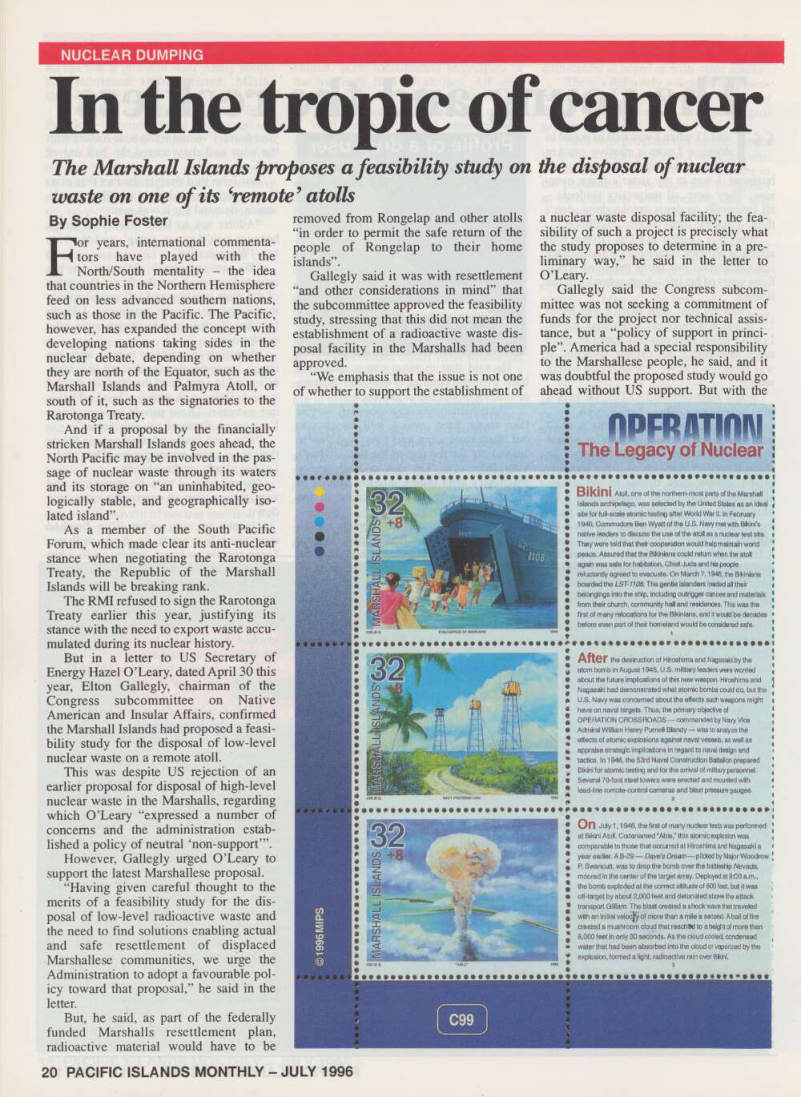
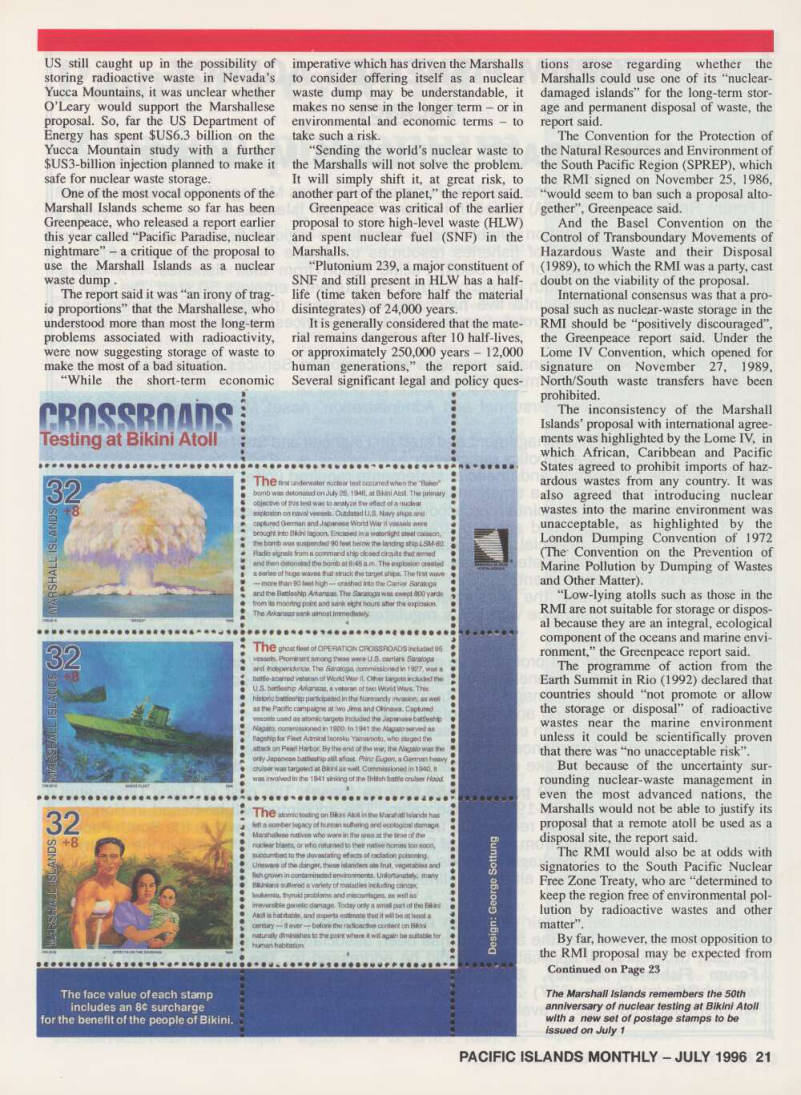
The Marshall Islands remembers the 50th anniversary of nuclear testing at Bikini Atoll with a new set of postage stamps to be issued on July 1
From Page 21
the Waigani Convention, which was being actively negotiated by members of the South Pacific Forum to ban the import
of hazardous waste into the region.
If the Marshall Islands goes ahead with its nuclear-waste dump proposal, it will be outnumbered, outlawed and out cast by Forum Island countries who, as signatories to the SPNFZ Treaty, are
legally bound “to ensure, so far as lies within their power, that the bounty and beauty of the land and sea in their region shall remain the heritage of their peoples and their descendants in perpetuity to be enjoyed by all in peace”. ■