Breaking the
pp. 26-27 · Read in the full issue
Region
Breaking the silence
By Chris Peteru
Sexual abuse and domestic violence against women and children in Western Samoa is a social problem the Mapusaga O Aiga (MOA) or Family Haven is keen to break the silence about.
While cultural values are linked to the lack of public debate about sexual abuse, rape, incest and domestic violence, a recent national symposium organised by MOA and the Women’s Affairs Ministry and the release of a report on the issues have begun the process of change .
The group’s chairperson and lawyer, Maiava Visekota Peteru, says the issue is a universal one that cuts across cultural ties and social status and threatens all families.
“The problem evokes the most natural responses of fear within us all, or denial
that these things happen, especially when,
in most cases these occur within our homes, by those we know or to those we love.”
The report, funded by the New Zealand government, is the first by a Samoan research team. The study involved 257 women in four villages on Upolu and Savaii, the two main islands.
Overall, it confirmed that domestic and sexual violence existed in Samoa, but
found police and justice department statis
tics “inadequate” and recommended even more research.
Almost 30 per cent of women surveyed said they had been victims of bashing or sexual abuse. Consistent with similar stud ies overseas was that the majority of the offenders were men the victims knew, that is, the spouse, partner or one of their male friends.
Angry moods by the spouse or partner caused 53 per cent of the attacks, followed by drunkenness (28 per cent), jealousy (nine per cent) and sexual dissatisfaction (five per cent). The report noted that under Samoan law, spousal rape is non-existent.
“This renders those women who are sexually abused within violent marriages helpless in the face of the law, and makes women who are trying to escape particu larly vulnerable in the period prior to obtaining a separation order.”
What stunned many was that a mere three per cent of women violated reported
the incident to the police. But ironically, the majority of officers questioned sup ported the idea of reporting incidents of violence.
The high levels of alcohol-related bru tality amongst Samoans at home could repeat itself overseas, believes Jonathan Pouli-Lefale, a Care and Protection Co ordinator with the New Zealand Children and Young Persons Service.
He said: “A Samoan chief presenting a paper on alcohol abuse and domestic vio lence at a social workers seminar stated: “‘Some women do deserve to be beaten
But why beat your wife? They are useful But if the wife is in the wrong she should be beaten
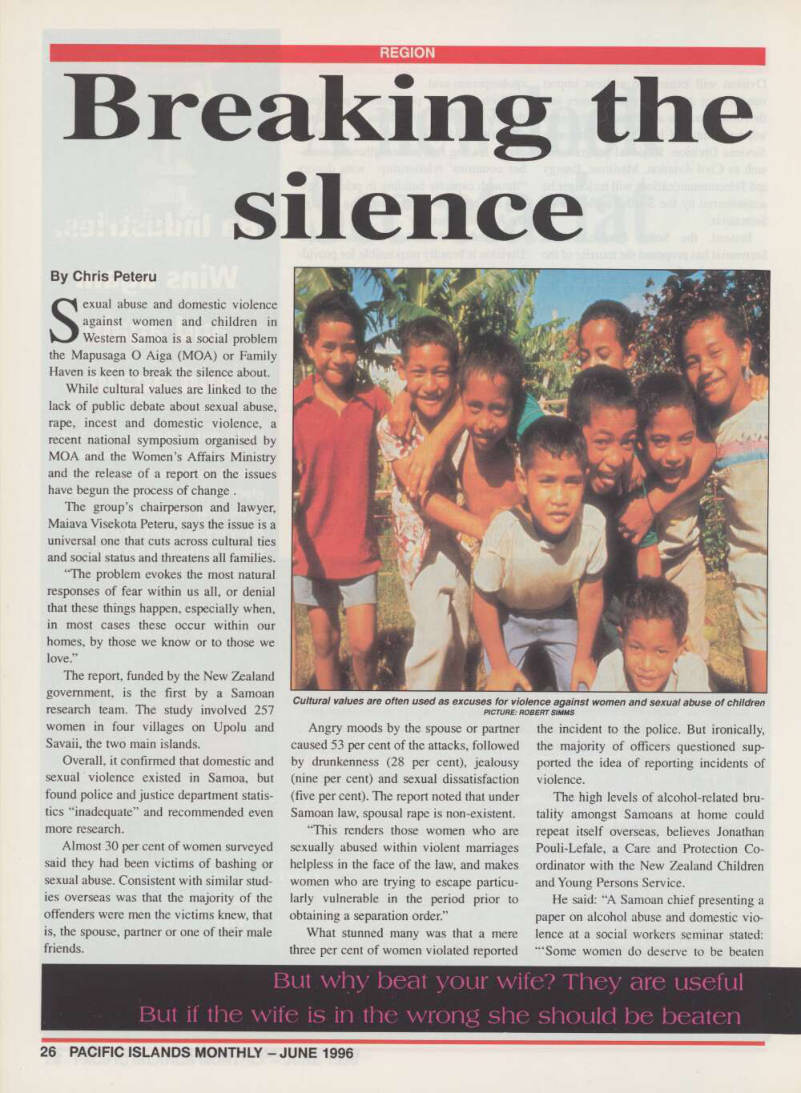
Cultural values are often used as excuses for violence against women and sexual abuse of children
Picture: Robert Simms
up, because they keep on nagging every time the husband has a few drinks. The husband works hard during the day, and he is entitled to have a few beers after work.”” Most abuse cases could be pinned down to three main causes; poor socio economic conditions, a lack of communi cation skills and “the neglect of women fulfilling the wife role, resulting in deser tion”.
As a result, abuse by men in those situ ations was unconditional and brutal.
He described how: ■ In February, an eight-year-old was referred to him when she ran away from home because she was frightened of her father. She said he came into her room and molested her and her three sisters every night. The father insists they are his prop erty and he can do whatever he likes; ■ An affluent middle-aged woman sought help from a husband who treated her like a “boarder”, put limits on who she could visit, and where she went. She was not allowed to leave him for any reason; ■ A 28-year-old woman returned home late one evening while awaiting final examination results. Flushed with her suc cess (which meant a salary increase) she was taken aback by her husband’s disbe lieving attitude. She was kicked in the stomach (she was six weeks pregnant) and was punched with a closed fist in the right eye, resulting in blurred vision and long
term discolouring.
Shamima Ali, co-ordinator of the Fiji Women’s Crisis Centre, said it was crucial to dispel myths and biases that suggested violent behaviour against women was all
right.
Some of the more common excuses was that violence against women was the woman’s fault, that women provoke vio lence by the way they dress or by going out at night, and that men have full rights over the bodies of their wives.
She described the inadequacy of restraining orders, the use of a woman’s sexual history as a mitigating circum stance in rape cases, and that rape within a marriage was not seen as a crime, which is also the case in Western Samoa.
Local Department of Justice records between 1990-1995 point to an average of nearly 50 sex crimes each year, but less than half of the charges laid lead to con victions.
In some instances, charges were with drawn after an ifoga (a traditional apolo gy according to Samoan custom) was per formed by the family of the perpetrator to the victim’s family.
Interestingly, Police Commissioner Galuvao Tanielu says a lack of parental care was the main cause of abuse against children.
“It is important that the family unit is strong to contain instances of sex abuse and domestic violence.
“We were prepared to take some stick from people at the symposium saying the whole deal was a non-issue, but as it hap pened, instead of it being swept under the carpet, the findings were accepted and it’s been a major step to bringing violence against women and children out in the open.”
More people were now using the facil ity for counselling and advice.
Establishing networks with govern ment and non-govemment organisations to share resources and discuss strategies have been other pluses, she said.
Plans are at hand to work on recom mendations from the meeting, involving counselling in schools, lobbying for hard
er-hitting legislation and raising the level
of public education to make changes to deal with violence and abuse.
While the first steps have been taken, MOA is aware that being agents for change is an on-going struggle.
When research for the report began last year, The Samoa Observer newspaper ran a survey on whether domestic violence was a problem.
“No, it is not really a problem,” replied Lotoalii Sa, a high chief from Fagaloa.
“But why beat your wife? They are useful for doing the chores. But if the wife is in the wrong she should be beaten and if she is in the wrong again, she should be kicked out of the house.” ■
g