dancing
Culture
Diverse dancing
By Liz Thompson
Sent to pick up a group of young men and women who were taking part in the National Cultural Councils Dance Workshop, the driver was told to look for head-dresses, drums and musical instruments. In a large group they moved through the doors of the arrivals lounge obviously excited at arriv ing in Port Moresby, the capital of Papua New Guinea and laden with all of the above. For some it was their first time in a plane or away from their local village environment. Piling into the back of a pick-up truck they headed towards Waigani, to the small build ing which would be their home, practice and performance space for the next two months.
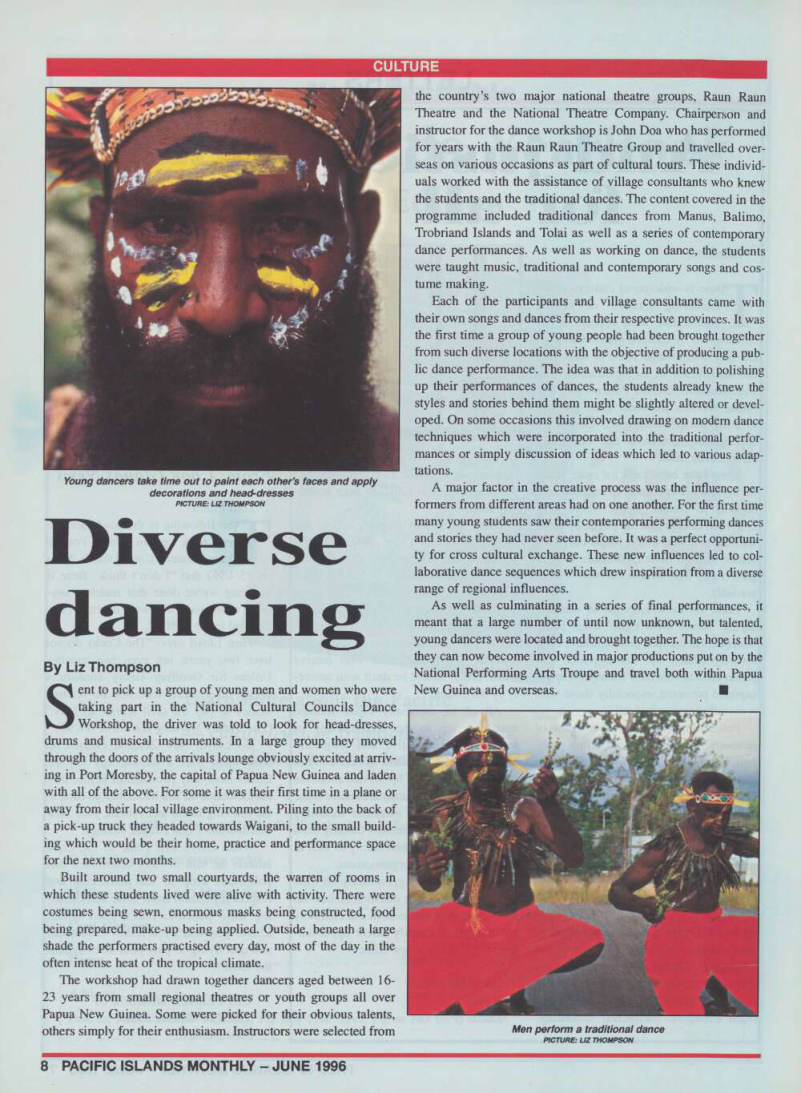
Built around two small courtyards, the warren of rooms in which these students lived were alive with activity. There were costumes being sewn, enormous masks being constructed, food being prepared, make-up being applied. Outside, beneath a large shade the performers practised every day, most of the day in the often intense heat of the tropical climate.
The workshop had drawn together dancers aged between 16- 23 years from small regional theatres or youth groups all over Papua New Guinea. Some were picked for their obvious talents, others simply for their enthusiasm. Instructors were selected from
the country’s two major national theatre groups, Raun Raun Theatre and the National Theatre Company. Chairperson and instructor for the dance workshop is John Doa who has performed for years with the Raun Raun Theatre Group and travelled over seas on various occasions as part of cultural tours. These individ uals worked with the assistance of village consultants who knew the students and the traditional dances. The content covered in the programme included traditional dances from Manus, Balimo, Trobriand Islands and Tolai as well as a series of contemporary dance performances. As well as working on dance, the students were taught music, traditional and contemporary songs and cos
tume making.
Each of the participants and village consultants came with their own songs and dances from their respective provinces. It was the first time a group of young people had been brought together from such diverse locations with the objective of producing a pub lic dance performance. The idea was that in addition to polishing up their performances of dances, the students already knew the styles and stories behind them might be slightly altered or devel oped. On some occasions this involved drawing on modem dance techniques which were incorporated into the traditional perfor mances or simply discussion of ideas which led to various adap tations.
A major factor in the creative process was the influence per formers from different areas had on one another. For the first time many young students saw their contemporaries performing dances and stories they had never seen before. It was a perfect opportuni ty for cross cultural exchange. These new influences led to col laborative dance sequences which drew inspiration from a diverse range of regional influences.
As well as culminating in a series of final performances, it meant that a large number of until now unknown, but talented, young dancers were located and brought together. The hope is that they can now become involved in major productions put on by the National Performing Arts Troupe and travel both within Papua New Guinea and overseas. ■
Young dancers take time out to paint each other’s faces and apply decorations and head-dresses
Picture: Liz Thompson
Men perform a traditional dance