Spirits of the
pp. 57-58 · Read in the full issue
Yachting
Spirits of the ancestors
By Sally Andrew
The old chief granted us permission to visit an uninhabited outer island belonging to the village. With the tide just an hour off low water, we conned our way around the coral heads and gin gerly motored into the anchorage.
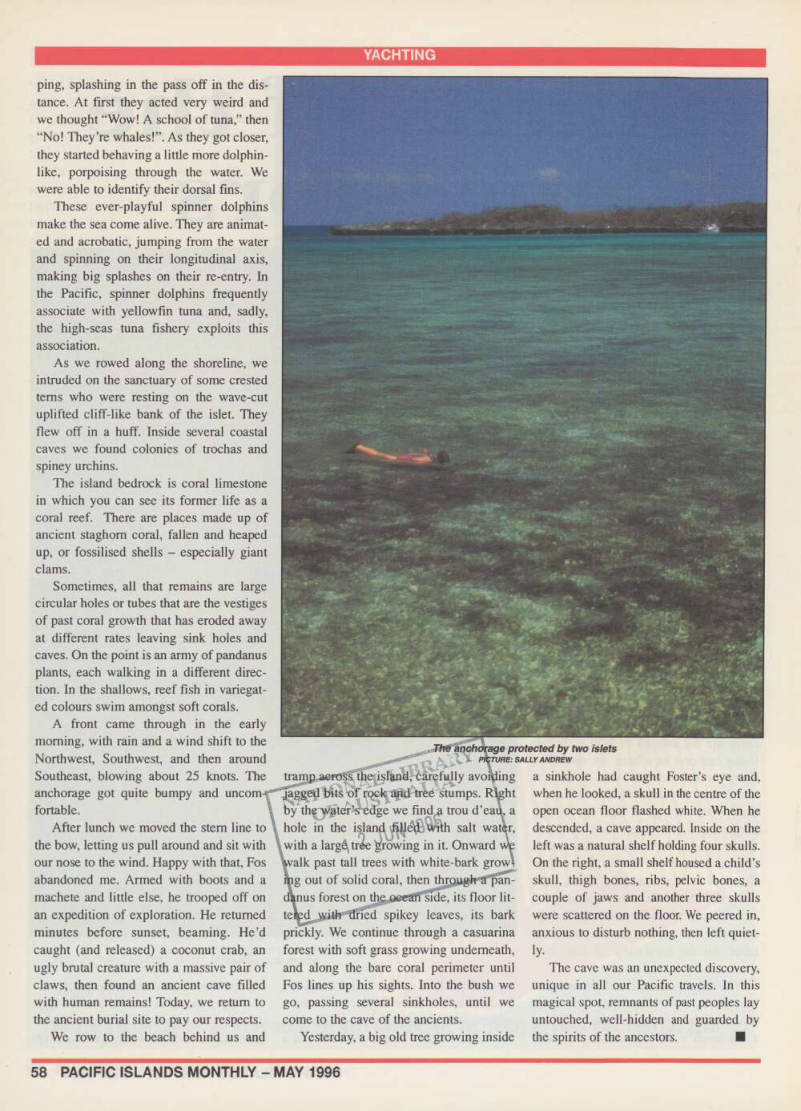
It seemed a magical spot, protected by two islets formed from raised ancient reefs where the limestone has been undercut by wave action. Dazzling white sandy beach es nestle between uplifted blackened coral.
Ashore are scrub, pandanus and coconut trees but no signs of human occupation, past or present.
In calm conditions we rowed our dinghy around the island to the Northeast, exploring beaches and coastal caves, tak ing a wave-cut shortcut across one of the island’s extremities. Using a glass-bot tomed bucket, we peeked in at the subsur face world of changing shapes and colours and moods. Above the water, limestone cliffs record a prior history of subterranean life - the outlines of huge giant clams and diverse corals of past eons are etched in sculptures now raised out of the sea.
Sandy beaches inside some of the sea caves are big enough to land a dinghy.
Using one cave as a base, we snorkelled along the shoreline and were amazed to find dozens of giant wavy-lipped clams -
some with bluey-green lips, brown lips,
purple lips - each bigger than a football.
We saw four or five about two feet across, at least a dozen that were a foot across.
Clams of this size are rarely found, espe cially in such shallow water, since they are often considered a great delicacy. Perhaps the chief had placed an environmental taboo on the harvesting of this food source.
The biggest sea cave had a grand arch over the entrance. It was high tide, so we scrunched down low in the dinghy, hoping a big swell would not choose the same
moment to lift us up and squish us against the roof of the arch. Inside, we found a subterranean passageway through which the ocean surged, pockets of sand and a
skylight which illuminated the beach, While rowing around the island, a large group of high-spirited long-snouted dol phins leapt out of the water, spinning, slap
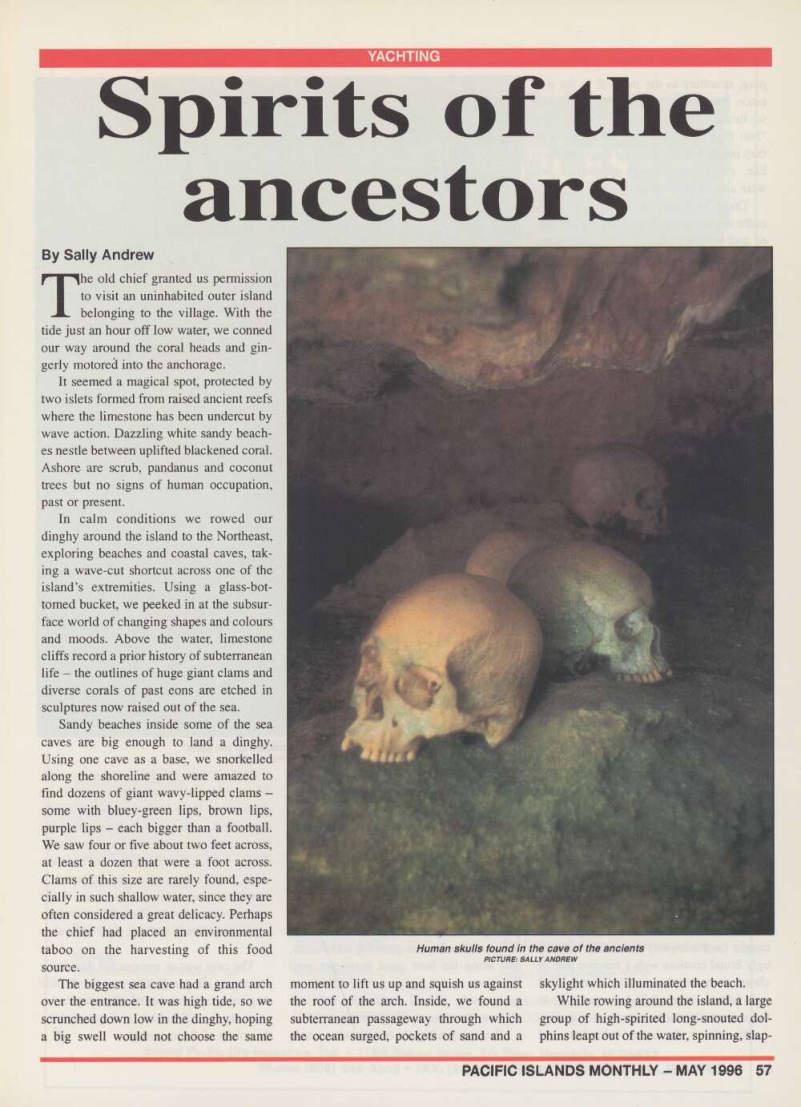
Human skulls found in the cave of the ancients
Picture: Sally Andrew
ping, splashing in the pass off in the dis tance. At first they acted very weird and we thought “Wow! A school of tuna,” then “No! They’re whales!”. As they got closer, they started behaving a little more dolphin like, porpoising through the water. We were able to identify their dorsal fins.
These ever-playful spinner dolphins
make the sea come alive. They are animat ed and acrobatic, jumping from the water and spinning on their longitudinal axis, making big splashes on their re-entry. In
the Pacific, spinner dolphins frequently
associate with yellowfin tuna and, sadly,
the high-seas tuna fishery exploits this
association.
As we rowed along the shoreline, we intruded on the sanctuary of some crested terns who were resting on the wave-cut uplifted cliff-like bank of the islet. They flew off in a huff. Inside several coastal caves we found colonies of trochas and
spiney urchins.
The island bedrock is coral limestone in which you can see its former life as a coral reef. There are places made up of ancient staghorn coral, fallen and heaped up, or fossilised shells - especially giant clams.
Sometimes, all that remains are large circular holes or tubes that are the vestiges of past coral growth that has eroded away at different rates leaving sink holes and caves. On the point is an army of pandanus plants, each walking in a different direc tion. In the shallows, reef fish in variegat ed colours swim amongst soft corals.
A front came through in the early morning, with rain and a wind shift to the Northwest, Southwest, and then around Southeast, blowing about 25 knots. The anchorage got quite bumpy and uncom fortable.
After lunch we moved the stem line to the bow, letting us pull around and sit with our nose to the wind. Happy with that, Fos abandoned me. Armed with boots and a machete and little else, he trooped off on an expedition of exploration. He returned minutes before sunset, beaming. He’d caught (and released) a coconut crab, an ugly brutal creature with a massive pair of claws, then found an ancient cave filled with human remains! Today, we return to the ancient burial site to pay our respects.
We row to the beach behind us and
tramp across the island, carefully avoiding jagged bits-of rock and tree stumps. Right by the we find a trou d’eau, a hole in the island* salt water, with a larg&tr^egrowing in it. Onward we walk past tall trees with white-bark grow\ ipg out of solid coral, then through a pan dknus forest on the oceaffside, its floor lit telpd with dried spikey leaves, its bark prickly. We continue through a casuarina forest with soft grass growing underneath, and along the bare coral perimeter until Fos lines up his sights. Into the bush we go, passing several sinkholes, until we come to the cave of the ancients.
Yesterday, a big old tree growing inside
a sinkhole had caught Foster’s eye and, when he looked, a skull in the centre of the open ocean floor flashed white. When he descended, a cave appeared. Inside on the left was a natural shelf holding four skulls.
On the right, a small shelf housed a child’s skull, thigh bones, ribs, pelvic bones, a couple of jaws and another three skulls were scattered on the floor. We peered in, anxious to disturb nothing, then left quiet ly- The cave was an unexpected discovery, unique in all our Pacific travels. In this magical spot, remnants of past peoples lay untouched, well-hidden and guarded by the spirits of the ancestors. ■
The anchorage protected by two islets