Nandan does Fiji
pp. 39-40 · Read in the full issue
Profile
Nandan does Fiji proud
By Mere Momoivalu
Satya Nandan, the Special
Representative at Fiji’s Mission to the United Nations in New York has a CV or Curriculum Vitae that reads like a couple of pages out of the Guiness Book of Records - in the context of international affairs.
It is a distinguished track record of an internationalist who is arguably one of the
world’s foremost experts on the, treaties and laws on the sea and its resources.
Nandan recently capped
his 30-year career as a lawyer, civil servant and diplomat when he bagged the top job at the new International Seabed
Authority in Kingston,
Jamaica, in the face of stiff competition from a former African president and two other tough contenders from the Caribbean.
Nandan’s foray into the international scene and involvement with the Laws of the Sea started as early as 1970 when he led Fiji’s delegation to the Seabed Committee, the preparatory committee for the UN Conference on the Law of the Sea, as then Fiji counsellor and later special ambassador to the UN.
This was followed by a European stint in Brussels as ambassador to the European Economic Communities (EEC), serving France, Italy, Luxembourg and the Netherlands in that capacity, and at which he was chair and spokesperson for the African, Caribbean and Pacific Group of ambassadors in negotiations with the EEC for the Lome Convention on trade aid and
development co-operation.
Nandan returned to the capital, Suva as Foreign Affairs secretary only to retrace his path to New York after three years, to
greater recognition as Under-Secretary- General (USG) for Ocean Affairs and the Law of the Sea, and Special Representative of the Secretary-General for the Law of the Sea, also heading the secretariat which ser viced the preparatory committee for the ISA and the International Tribunal for the Law of the Sea.
It was at this juncture that he initiated dialogue and worked out the compromise agreement on outstanding issues relating
Nandan’s appointment is a loss to the Pacific but a definite gain for the international community
to the deep seabed mining provisions in Part 11 of the 1982 UN Convention on the Law of the Sea, adopted by the UN General Assembly in July 1994, and which subsequently led to the support of the treaty by industrialised countries, in partic ular the main maritime powers, removing the obstacle to their participation as parties to the convention.
In 1992, Nandan took a year off as a fellow at the United States Institute of Peace in Washington D.C. focusing on decision-making in multi-lateral negotia tions.
In 1993, he returned to the Fiji Mission in NY and was chosen to chair the UN Conference on Straddling Fish Stocks and Highly Migratory Fish Stocks, for which he conducted negotiations and wrote the agreement on the implementation of the provisions of the 1982 UNCLOS relating to straddling fish stocks and highly migra tory fish stocks.
The legally binding treaty was adopted last year.
And yet, with all these impressive achievements behind him, Nandan is amazingly unassuming and quietly spo ken.
There are few, if any, who are critical of Nandan’s outstanding service nationally, regionally and internationally.
The only obvious issue has been a post- Coup and pro-indigenous Fijian observa tion about Nandan’s overseas postings appearing to be (in some quarters of
Government) a pro longed stay away from home.
Earlier in the race last year, there was some uncertainty about whether Government would support Nandan, with his contract with it
expiring late last year attracting some neg ative feedback.
But Nandan’s chances firmed-up when Government gave him its blessings and with his colleague, Fiji’s Permanent Representative, Poseci Bune, went all-out on an intensive campaign and lobbying trail.
Maximising Fiji’s March chairing of the UN Asia Group and its close links with the SOPAC (South Pacific) Group at the UN, Fiji garnered full support from both the Western and Eastern blocs (with the exception of Russia), snatched votes from a few African Francophone countries and managed to split the Caribbean votes.
According to ambassador Bune, Nandan won over formidable rival, Joseph Warioba, former president of Tanzania, who conceded defeat “magnanimously” at the last-minute making way, in usual UN convention, for Nandan’s unanimous elec tion by consensus.
Fiji’s winning position had become evi dent earlier, after Cuba’s Louis Preval and
Jamaica’s Dr Kenneth Rattray pulled out of the race the day before.
Nandan becomes the first Secretary- General of the Kingston-based UN agency which has been mandated to regulate the mining of the seabed under the mandate of
Unclos.
In a speech of appreciation to the coun cil in Kingston, Bune said while Nandan’s appointment would be a loss to Pacific Island countries, it would be a distinct gain for the international community.
Similar sentiments were expressed around the region.
In Suva, senior Agriculture Ministry official, Peniasi Kunatuba, who has worked closely with Nandan on various fisheries issues and recently on straddling stocks, noted his involvement in negotia tions on maritime boundary delimitation from Europe in the North to various African countries in the South, and region ally between Fiji and Wallis and Futuna.
It was, Kunatuba told PIM, through Nandan’s personal insistence, that Fiji increased its exclusive economic zone (EEZ) by about 45,000 square kilometres
Foreign Affairs Minister, Filipe Bole said Nandan’s appointment was a great honour for Fiji, the region and the interna
tional community.
Fiji Prime Minister, Sitiveni Rabuka, used the signing of the South Pacific Nuclear Free Zone Treaty (SPNFZ) at the South Pacific Forum headquarters in Suva as an opportunity to underscore the suc cess of what he termed “one of its (Fiji’s) illustrious sons” in the presence of region
al leaders.
Forum Fisheries Agency (FFA) direc tor, Victoria Uherbelau in a statement, said Nandan’s new appointment was a natural and welcome progression given his involvement with the Law of the Sea.
“It is very gratifying that this position is to be held by a representative of the region who is sensitive to the particular needs and concerns of developing island states,” the director added. ■
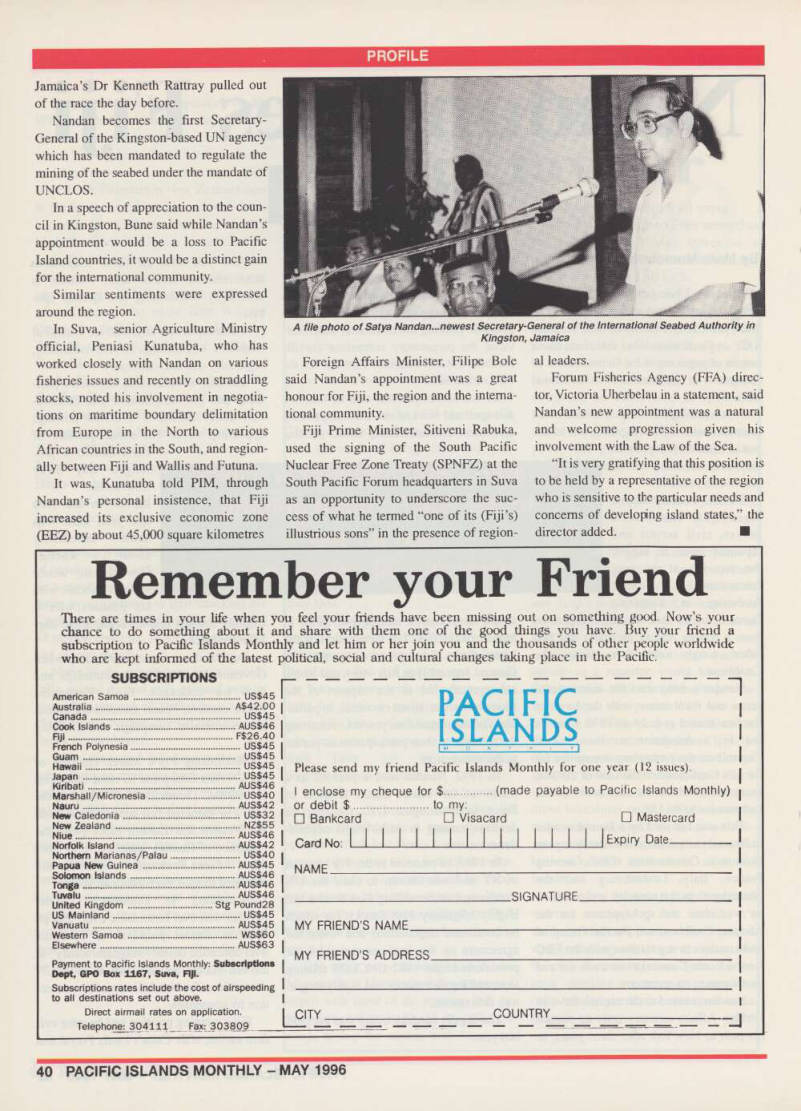
A file photo of Satya Nandan...newest Secretary-General of the International Seabed Authority in Kingston, Jamaica