The island
pp. 18-20 · Read in the full issue
Special Report
The island silence
By Sophie Foster
A comprehensive United Nations
report detailing the incidence of
Acquired Immune Deficiency
Syndrome (AIDS) in the Pacific has warned the spread of the epidemic is more serious than current statistics have led the region to believe.
The recently released report called “Time To Act: The Pacific Response to HIV and AIDS” says there could be up to 100 unreported cases for every known case of HIV in the region.
And because AIDS can take up to 10 years before becoming fully-blown, people can unknowingly infect others including their partners and children.
“That the number of known cases is still quite low in most Pacific island coun tries therefore means little. Furthermore, even small numbers in small populations add up to a problem,” the report says.
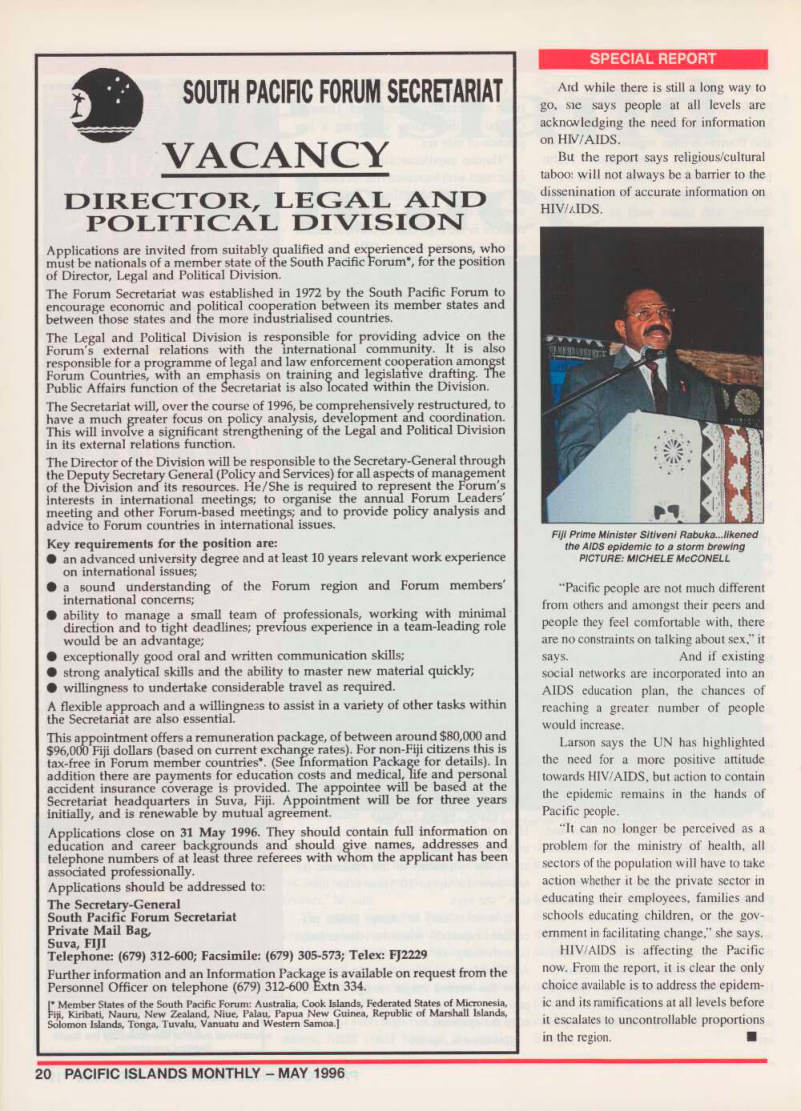
Fiji’s Prime Minister Sitiveni Rabuka, who launched “Time to Act” in Suva in April, says AIDS is not just a threat to life, but to the whole make-up of development prospects of a nation.
“The HIV/AIDS epidemic, is a clear enough signal that there is a storm gather ing force; a storm that can become a dev astating hurricane such as we have never
before experienced and a storm which, if we do not take the necessary precautions, we will not live through or live to regret forever,” he said.
The report warns that Pacific Islanders are particularly vulnerable because of high incidences of high-risk behaviour such as unprotected sex, often having more than one partner and social and cultural taboos surrounding AIDS.
It says if such high-risk behaviour con tinues, AIDS could become the leading
cause of death in some Pacific countries in the next 10 years.
For the first time in its history, humankind has had to deal with an epi demic which has had spin-offs affecting the economic, social and political life of nations, the report says.
“A moderate to severe HIV epidemic could reverse much of the progress in human development that Pacific Island countries have made over recent decades,” it says.
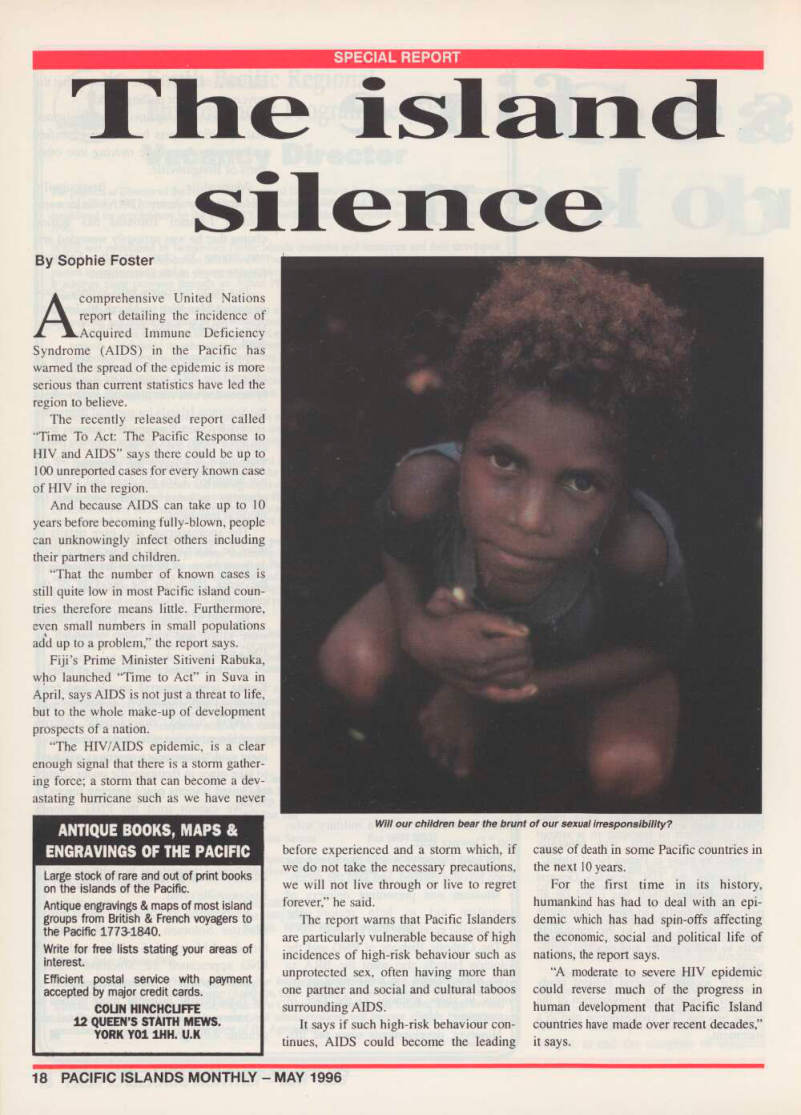
Will our children bear the brunt of our sexual irresponsibility?
The slow-growing economies of the Pacific provide conditions of economic hardship in which have enabled AIDS to also flourish in other regions of the globe.
South Pacific Commission Health Information Officer Steven Vete says it is important to target decision-makers when dealing with issues such as HIV/AIDS education.
“Efforts to introduce sex/family life/life skills education in schools; to make con doms readily available; to discuss sex and
sexuality issues more openly; to recognise
the linkages between poverty, inequality in relationships, ignorance, discrimination, abuse of human rights and the spread of HIV and STDs have all been blocked by those decision-makers who hide behind reasons such as ‘it is against our reli gion/culture/tradition to talk about such things’,” he says.
But to quote a South Pacific Commission AIDS education pamphlet: “HIV/AIDS does not respect tradition, cul ture or religion”.
The UN report says the attitudes of youth, the low status of women and promiscuous male behaviour affects the spread of AIDS.
Of particular interest to the UN study, is the impact of AIDS on women who, it says, shoulder the burden of the epidemic.
They are less able to control its spread because their lives are often controlled by their social and cultural circumstances.
In the Pacific, social and cultural taboos mean some youth are misinformed or lack access to safe sex information; the opin ions of most women are not given consid eration, and sexual promiscuity amongst males is often rampant.
The report says the spread of AIDS in the Pacific has been mostly through het erosexual transmission, with women and children often being the innocent victims of male promiscuity.
“The pattern of infection in at least two Pacific countries indicates a concentration in high-status men on the one hand, and women with only one sexual partner (often their husband or long-term sexual partner).
“In the early phase, the epidemic of HIV/AIDS may be described as a epidem ic of affluence for men, and of double sex ual standards affecting women,” the report says.
Of immense concern to the UN are rates of Sexually Transmitted Diseases (STDs) in the region, signifying a low practice of safe sex.
“Human papilloma vims, an STD, is associated with increased risk of cancer of the cervix, which is almost epidemic in some Pacific countries including Fiji. The concern is the high rate of cervical cancer signals a predisposition to HIV infection,” the report says.
Many Pacific Island countries have high STD rates relative to Australia and New Zealand, including Fiji, PNG and the Marshall Islands, but there is concern gov ernment statistics show only a fraction of the total cases because many cases are untreated or treated by private doctors who are not required to report them.
Most Pacific women do not have a choice in terms of use of safe sex methods, with the decision often being made by their spouses.
High rates of domestic violence in the
region signify women are still unequal
partners in relationships.
The report says such cultural and social inequalities will need to be addressed if there is to be any significant progress made in the fight against the spread of HIV/AIDS in the region.
UNICEF social mobilisation officer, and one of the co-ordinators of the report, Heidi Larson says its idea was conjured up about three years ago, but it was only in the past year-and-a-half that most of its collation and compiling was done.
The main problem those working on the report encountered was the attitude towards HIV/AIDS which manifested itself in a lack of data and facilities, Larson says.
“People haven’t really recognised
HIV/AIDS as a problem in the Pacific, but in a lot of countries where the epidemic starts, the symptoms of the epidemic do not show for up to 10 years after infec tion,” she says.
It is never easy to change public per ceptions especially when the issue at stake is something as personal and taboo as AIDS and sexual activity, but Larson says there has been a major change over the past five years in willingness to acknowl
edge the epidemic.
(Continued on page 20)
Ard while there is still a long way to go, sie says people at all levels are acknowledging the need for information
On Hiv/Aids.
Bit the report says religious/cultural taboo; will not always be a barrier to the dissenination of accurate information on
Hiv/Aids.
“Pacific people are not much different from others and amongst their peers and people they feel comfortable with, there are no constraints on talking about sex,” it says. And if existing social networks are incorporated into an AIDS education plan, the chances of reaching a greater number of people would increase.
Larson says the UN has highlighted the need for a more positive attitude towards HIV/AIDS, but action to contain the epidemic remains in the hands of Pacific people.
“It can no longer be perceived as a problem for the ministry of health, all sectors of the population will have to take action whether it be the private sector in educating their employees, families and schools educating children, or the gov ernment in facilitating change,” she says.
HIV/AIDS is affecting the Pacific now. From the report, it is clear the only choice available is to address the epidem ic and its ramifications at all levels before it escalates to uncontrollable proportions in the region. ■
Fiji Prime Minister Sitiveni Rabuka...likened the AIDS epidemic to a storm brewing