change
pp. 42-45 · Read in the full issue

A decade of change
By Liz Thompson
the road being built to connect Wamena with Jayapura, the countries capital, is closer to completion. Massive change has come to the people of Irian Jaya since it was taken over by Indonesia in 1963. Irian Jaya promised to provide a large, relative ly unpopulated country into which mil lions of Indonesians could be moved from their chronically overcrowded country.
Today, 25 per cent of the population in Irian Jaya is Indonesian and the numbers are rising. It was thought that Irian Jaya also held enormous potential for the exploitation of natural resources particu larly timber, gold and copper. This assumption proved correct and Freeport Copper Mine alone, built on the land of the Amungme people, who have received little or no compensation, has the highest published gold reserves in the world. It is estimated to contain SUS3O billion worth of copper and in 1994 extracted 150 mil lion tonnes of ore. The massive potential for resource exploitation in Irian Jaya has only just begun.
But not without conflict, only a few months ago 16 Amungme were killed by Indonesian military close to the mine site.
The incident related to growing discontent amongst local landowners in relation to the environmental damage which is taking place and their paltry share of the profits.
OPIC, the American insurance company which insures the mine, has subsequently pulled out, which is not a positive message to potential investors and has caused both
As though we had entered suddenly, another world.
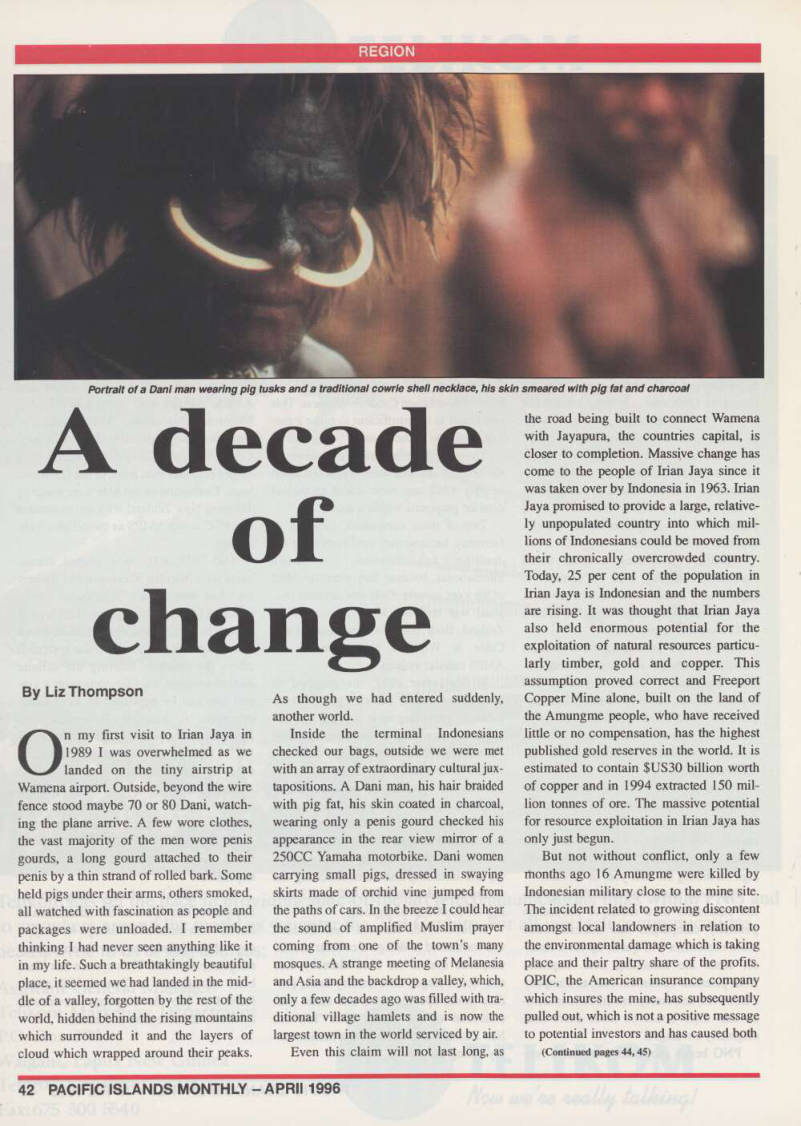
Inside the terminal Indonesians checked our bags, outside we were met with an array of extraordinary cultural jux tapositions. A Dani man, his hair braided with pig fat, his skin coated in charcoal, wearing only a penis gourd checked his appearance in the rear view mirror of a 250 CC Yamaha motorbike. Dani women
carrying small pigs, dressed in swaying
skirts made of orchid vine jumped from the paths of cars. In the breeze I could hear the sound of amplified Muslim prayer coming from one of the town’s many mosques. A strange meeting of Melanesia and Asia and the backdrop a valley, which, only a few decades ago was filled with tra ditional village hamlets and is now the largest town in the world serviced by air.
Even this claim will not last long, as
On my first visit to Irian Jaya in 1989 I was overwhelmed as we landed on the tiny airstrip at Wamena airport. Outside, beyond the wire fence stood maybe 70 or 80 Dani, watch ing the plane arrive. A few wore clothes, the vast majority of the men wore penis gourds, a long gourd attached to their penis by a thin strand of rolled bark. Some held pigs under their arms, others smoked, all watched with fascination as people and packages were unloaded. I remember thinking I had never seen anything like it in my life. Such a breathtakingly beautiful place, it seemed we had landed in the mid dle of a valley, forgotten by the rest of the world, hidden behind the rising mountains which surrounded it and the layers of cloud which wrapped around their peaks.
(Continued pages 44,45)
Portrait of a Dani man wearing pig tusks and a traditional cowrie shell necklace, his skin smeared with pig fat and charcoal
the company and government consider able embarrassment. No doubt after Papua New Guinea’s recent experiences in Bougainville, in which the Bougainville Revolutionary Army managed to forcibly close down the Bougainville Copper Mine and as landowner groups attempt to take BHP to court over the pollution of the Fly River from OK Tedi mine, there is escalat ing anxiety in the face of grassroots dis content. The OPM (Operation Papua Merdeka) a freedom fighting movement which is struggling to gain Irianese inde pendence from Indonesia recently took 11 hostages and made demands for millions of dollars. Their actions resulted in huge media coverage which put Irian Jaya, real ly for the first time, on the international map and into the minds of the world com munity.
It was from Wamena in the Baliem Valley that the hostages were taken. A heavily militarised zone at any time, it was flooded with Indonesian military. To date, the Baliem has not been a focus for trans migration programmes nor resource exploitation but both look set to take place in the not too distant future. Until now the Dani, one of the main tribal groups in the Baliem have been effected mostly by mis sionaries, government policies and tourism. These influences alone have been
significant.
After a visit to Irian Jaya in the sixties Robert Gardener, who established the Centre for Anthropological Film Research at Harvard University, was prompted to remark that, “By the year 2000 human society promises to vary little from conti nent to continent. Transportation and com munication will link the remotest valley and furthest plateau with centres of tech nology. Deserts will be watered, marshes drained, and the cultures that developed in response to isolation or hardship will have
disappeared”.
It wasn’t until 1986 that tourists were even allowed into Irian Jaya and even then it was restricted to certain areas, the Baliem Valley being one of them. But, even when I first visited Irian Jaya in 1989 the processes at work were already painfully obvious. There was the distinct sense of a strange time warp, as if the peo ple and their cultural traditions existed within a bubble which was preparing to
burst. The Dani, like most tribes in Irian, had existed as a stone age culture for mil lennia, now they no longer live in isola tion. In the six years between my first visit and the most recent in 1995 I have been struck by the enormity of the changes they face.
The Dani men who wore gourds looked dignified and strong, their bodies fit from gardening. Their hair was twisted into tiny braids with pig fat and around their neck they often wore a beautiful collar made of cowrie shells woven onto a rolled bark base. Believing these gourds to be a sign of primitive culture, the Indonesian gov ernment introduced ‘Operation Kroteka’.
Kroteka means gourd and the operation was to ban the traditional form of clothing.
Initially, it proved unsuccessful and the project was abandoned. However as out side influences have increased and the Dani are exposed to a larger numbers of visitors, missionary influence, television and print media they have begun to aban don their gourds as a matter of preference, replacing them with shorts and tom T shirts. In 1989, over half the men in Wamena were dressed traditionally.
Today, it is rare to find a Dani who isn’t wearing clothes. Those that wear gourds do so almost exclusively in the hope that a tourist may take their photograph. When
this happens the subject demands Rupiah
1500.1 recently saw several tourists being forcibly held until they agreed to pay.
The dirt tracks being bulldozed through the valley only six years ago are now all laid with bitumen. The bus station in Wamena is fdled with local buses which carry you to places it took me days to walk to in 1989. When the road joins Wamena with the capital and the area becomes accessible by road, the number of migrants will no doubt increase dramati cally. Already the number of tourists has escalated, and with increasing demand for tour guides, young Dani men come into Wamena looking for work. Yali tribesmen, who come from a different area of the Baliem, are also converging on Wamena.
Moving from their own homelands they are forced to buy land from the Dani whom the area belongs to. One Yali guide told me that when the road connected Wamena with Jayapura he hoped the value of the land he had bought would escalate.
He is no doubt right to assume that he has bought potentially valuable real estate.
This is a very different approach to that in which people are the custodians of land which is handed down from one genera tion to another for centuries.
Integrally bound up in the land was a rich tradition of spiritual beliefs. Much of this spirit world was believed to exist in the natural environment as well as in the power of ancestor spirits. Today, missions have been established in the remotest areas, air strips have been cut into the sides of the mountains and the word of God is reaching deep into peoples minds.
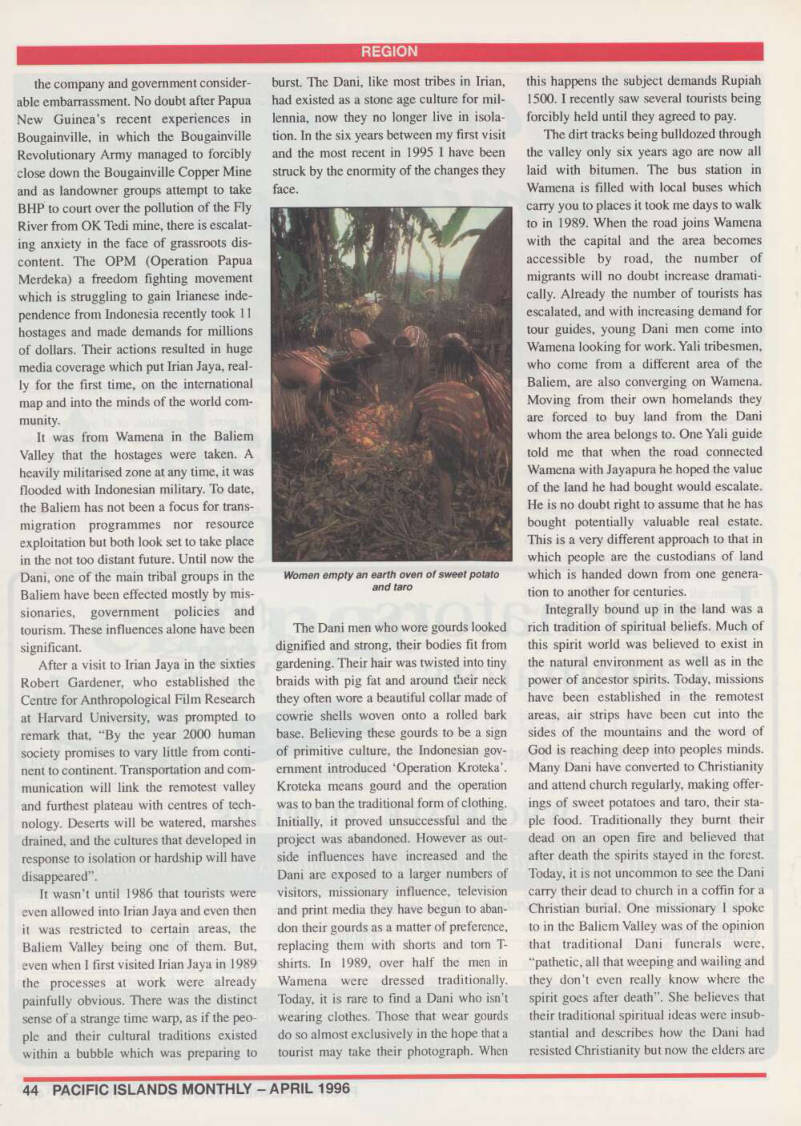
Many Dani have converted to Christianity and attend church regularly, making offer ings of sweet potatoes and taro, their sta ple food. Traditionally they burnt their dead on an open fire and believed that after death the spirits stayed in the forest.
Today, it is not uncommon to see the Dani carry their dead to church in a coffin for a Christian burial. One missionary I spoke to in the Baliem Valley was of the opinion that traditional Dani funerals were, “pathetic, all that weeping and wailing and they don’t even really know where the spirit goes after death’’. She believes that their traditional spiritual ideas were insub stantial and describes how the Dani had resisted Christianity but now the elders are
Women empty an earth oven of sweet potato and taro
dying, the younger generation are convert ing more readily. They are she believes, “rejecting the fetishistic objects” that had previously been worshipped and in her opinion the Dani have “come a long, long
way”.
The church has preached for an end to ritualised warfare which was an integral aspect of Dani culture and was often con ducted to appease the ancestral spirits. It was far from the war experience we know of today. It began in the morning and ended at dusk which both sides retiring behind their own line and hurling abuse at one another, often with a great deal of laughter. The weapons were bows and arrows and the emphasis tactics not death, it was rare that people were killed. If they were injured a special person was called in to sing their soul, thought of as ‘the seeds of singing’ back into place, as it may have been dislodged. Ritualised warfare has all but disappeared. Large watchtowers used to stand just outside most village hamlets and provided a vantage point for warriors to check on approaching enemies. In 1989 most of these watchtowers had fallen into
a state of disrepair. In 1995, I returned to Elegeima Village where I had previously stayed and the watchtower was now sup porting the washing line.
One tour company which takes groups trekking through the valley has the slogan, ‘Baliem Valley, the place where time stands still’ painted on the side of it’s many tour buses. No doubt it is an enticing advertising tool but the reality is far from it’s claim. Time is not standing still in the Baliem valley, the culture and traditions of the people are changing at an alarming rate. What is remarkable not only in the experience of the Irianese but many remote indigenous groups is the speed with which, in the 20th century, their lives have changed. As Robert Gardener sug gests technology has linked “the remotest valley and furthest plateau with centres of technology”. With it has brought a mass of new influences. Stone-age cultures like the Dani’s have moved in only a few decades
through experiences which spanned cen
turies in the West. Middle-aged Dani who grew up deeply entrenched in traditional animistic beliefs, ritual warfare and had no
knowledge of a world outside their own valley, now go to church every Sunday, have a job and mingle with international tourists whose addresses they collect in precious books in the hope of one day vis iting their countries.
As the Irianese struggle to come to grips with the changes they harbour mixed feelings. Some welcome development, the young Dani guides who wear Walkmans and jeans and lust after things modem, others continue to reject the Indonesian administration and all its trappings. As the Baliem Valley and the Dani become sub ject to the impact of transmigration pro grammes and the relocation of Indonesians on their land and to resource exploitation, their lives and culture will be even more deeply affected. There is no doubt that resistance, particularly in the form of the OPM will be maintained and, despite the organisations lack of funding and internal communications network, this organisa tion which struggles for independence, is a powerful symbol of a state of mind which is not easily silenced and will not disap pear. ■