in digital radio
pp. 34-36 · Read in the full issue
A new generation in digital radio
Telecommunications have become an integral part of society in the Pacific Islands. The ability to freely communicate with close neighbours and the rest of the world is an important build ing block of the island economy.
The Pacific Islands present a unique set of challenges to service providers. Rugged inland terrain, communities separated by sea and a relatively small population, make the provision of even basic telecommuni cations services difficult and costly.
Private organisations wishing to provide to their own networks face similar barriers.
To date, most available technologies have poorly addressed the Pacific Island environment. Copper cable and fibre optic technologies are often inappropriate for interconnecting islands and are too costly for rugged inland terrain. Multiple access radio systems typically require a sizeable number of users, mains power and have limited range. They are not well suited to heavy usage by individual subscribers or payphones which tie up common system resources. Satellite communications are low capacity and very expensive, suiting only the most remote users. Digital microwave radio systems overcame most of these problems but so far, most systems have required external equipment to form a complete network, often from different manufacturers.
Marine-Air Systems (MAS) have a long history in the Pacific Islands, provid ing Peacesat and aeronautical communica tions systems to many countries. MAS have recognised the needs of Pacific Island nations by introducing a range of digital microwave radios ideally suited to cus tomer access networks and cellular or PMR network linking. Both the DXR 200 and the new DXR 100 are designed and manufactured in New Zealand.
MAS have DXR 200 systems installed in Fiji, Papua New Guinea, Vanuatu and the Solomon Islands, in addition to more than 30 countries worldwide. A common time-zone and close proximity make a New Zealand supplier particularly attrac tive to Pacific Island customers.
“Most available technologies haVe poorly addressed the Pacific. n
Dxr 200
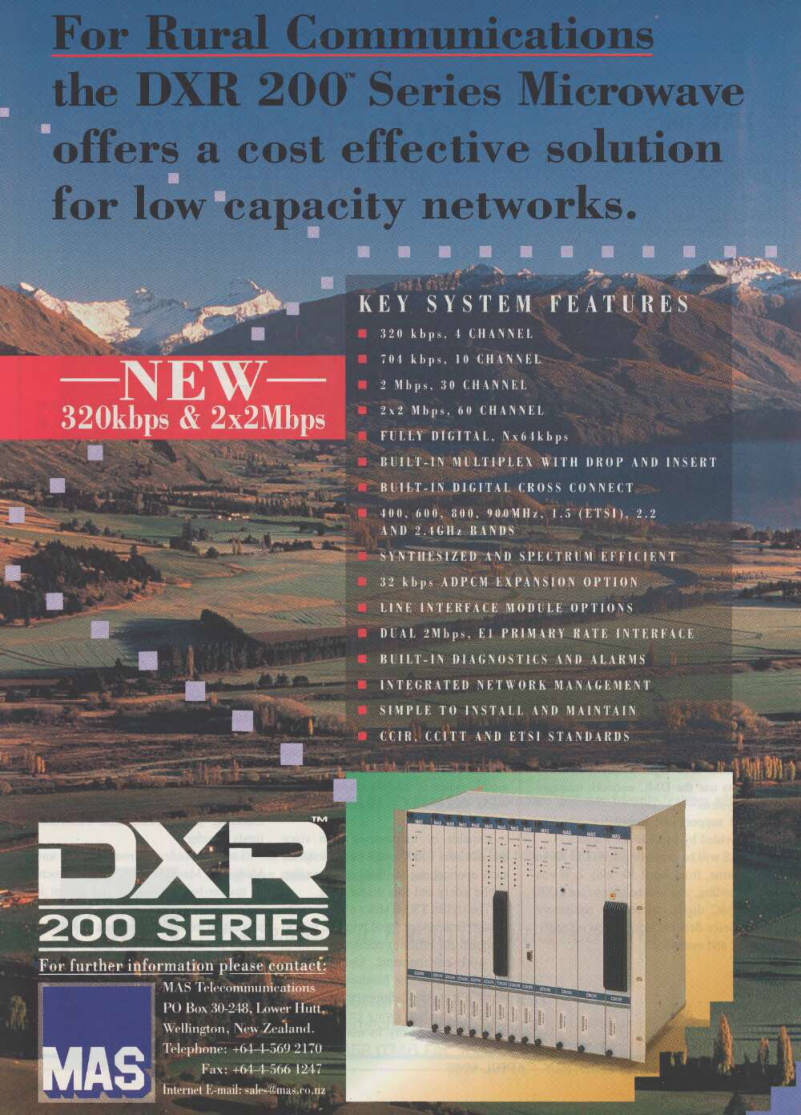
The DXR 200 was originally designed to serve clusters of subscribers in rural net works. Experience with installation world wide has also proven the DXR 200 to be popular for cellular and PMR network linking. Private network operators like the ability to build a complete network using only DXR 200 equipment.
Pairs of DXR 200 terminals are used to form line-of-sight radio links. These links are easily interconnected to form a wide area network which can connect commu nities separated by sea. Digital technology ensures quality does not suffer through multiple-hop transmission.
DXR 200 is offered in 4, 10, 30 and 60 channel versions, which permits matching
of capacity with available radio spectrum.
Optional ADPCM doubles the capacity of each version without increasing occupied bandwidth.
DXR 200 terminals accept optional end-user interface modules which permit connection of standard 2-wire telephones, payphones, 4-wire E&M devices and digi tal equipment through V.l 1, V. 35, V. 24 and ISDN interfaces.
DXR terminals also provide 2Mbps G.703/4 ports for interconnecting DXR terminals or connecting directly to digital switching equipment. At each radio site, DXR 200 terminals connect together using the G.703/4 interface, and individual 64kbps channels can be dropped and inserted onto the radio link or to local end user interfaces.
An internal cross connect switch pro vides the drop and insert function and is the heart of the DXR’s integrated network capability. Individual 64kbps channels can be freely connected between the 2Mbps interface, the radio link and local inter faces under software control. The permuta tions are many and control is rapid and flexible. A comprehensive network man agement system based on the SNMP pro tocol, permits system managers to remote ly monitor and configure any terminal on the network.
The DXR 200 is set apart from the other microwave products by its spectrum efficiency, frequencies of operation and its integrated network capability. The DXR 200 has rugged modular design and uses advanced manufacturing techniques for reliability at a reasonable cost. A wide operating temperature range allows the DXR 200 to keep working under harsh cli matic conditions.
(Continued on page 36)
Dxr 100
The recently released DXR 100 pro vides point to point linking at a low cost per line. The DXR 100 is primarily designed for cellular and PMR network linking. Digital interfaces are provided for connecting to other equipment and a point to j point digital radio link connects between radio base sites.
An optional integral cross connect switch allows channels to be dropped and inserted to specified base sites.
DXR 100 provides a particularly com pact and rugged package which can be relied upon for continuous operation. A DXR 200 compatible network manage ment option allows network operation to be closely monitored from a central loca tion.
Microwave
MAS represents Digital Microwave Corporation (DMC) in the Pacific Islands.
DMC is a world leader in medium to high capacity digital microwave systems which particularly suit cellular infrastructure development and microwave backbones.
DMC offers bands from two to 38GHz and capacities from Nx64kbps to 34Mbps.
The new Spectrum II series follows DMC’s tradition of innovation. Like the DXR series, Spectrum II incorporates for ward error correction, order wire and fre quency synthesis. All functions are con trolled via a laptop PC. A “split-mount” construction eliminates the need to install and maintain wave-guides and reduces installation time significantly. All DMC products use the DMC network manage ment system.
Full support and installation services are provided by MAS in the Pacific.
MAS will be exhibiting at ATUG ‘96 in Melbourne, from April 30- May 2. If you are attending, you will be able to see DXR and DMC digital microwave equipment and receive detailed information on appli cations and operation. ■