A trip back
pp. 56-58 · Read in the full issue
Event
A trip back in time
By Sally Andrew
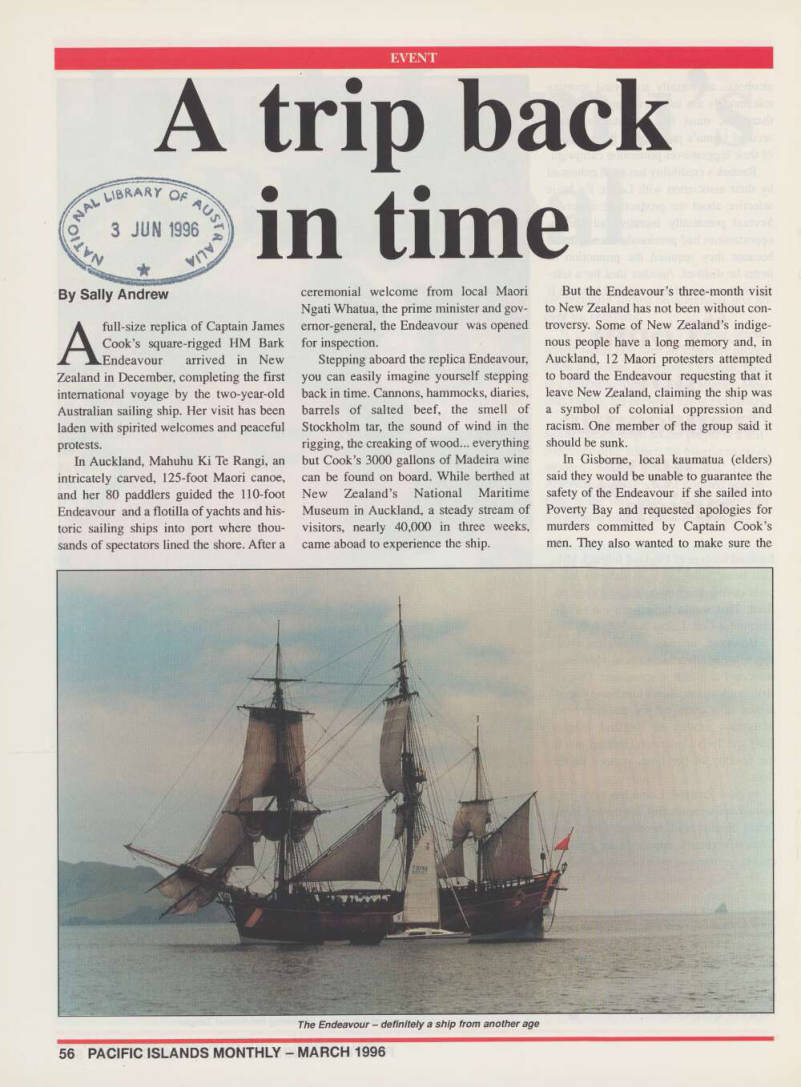
A full-size replica of Captain James Cook’s square-rigged HM Bark Endeavour arrived in New Zealand in December, completing the first international voyage by the two-year-old Australian sailing ship. Her visit has been laden with spirited welcomes and peaceful protests.
In Auckland, Mahuhu Ki Te Rangi, an intricately carved, 125-foot Maori canoe, and her 80 paddlers guided the 110-foot Endeavour and a flotilla of yachts and his toric sailing ships into port where thou sands of spectators lined the shore. After a
ceremonial welcome from local Maori Ngati Whatua, the prime minister and gov ernor-general, the Endeavour was opened
for inspection.
Stepping aboard the replica Endeavour,
you can easily imagine yourself stepping
back in time. Cannons, hammocks, diaries, barrels of salted beef, the smell of Stockholm tar, the sound of wind in the rigging, the creaking of w00d... everything but Cook’s 3000 gallons of Madeira wine can be found on board. While berthed at New Zealand’s National Maritime Museum in Auckland, a steady stream of visitors, nearly 40,000 in three weeks, came aboad to experience the ship.
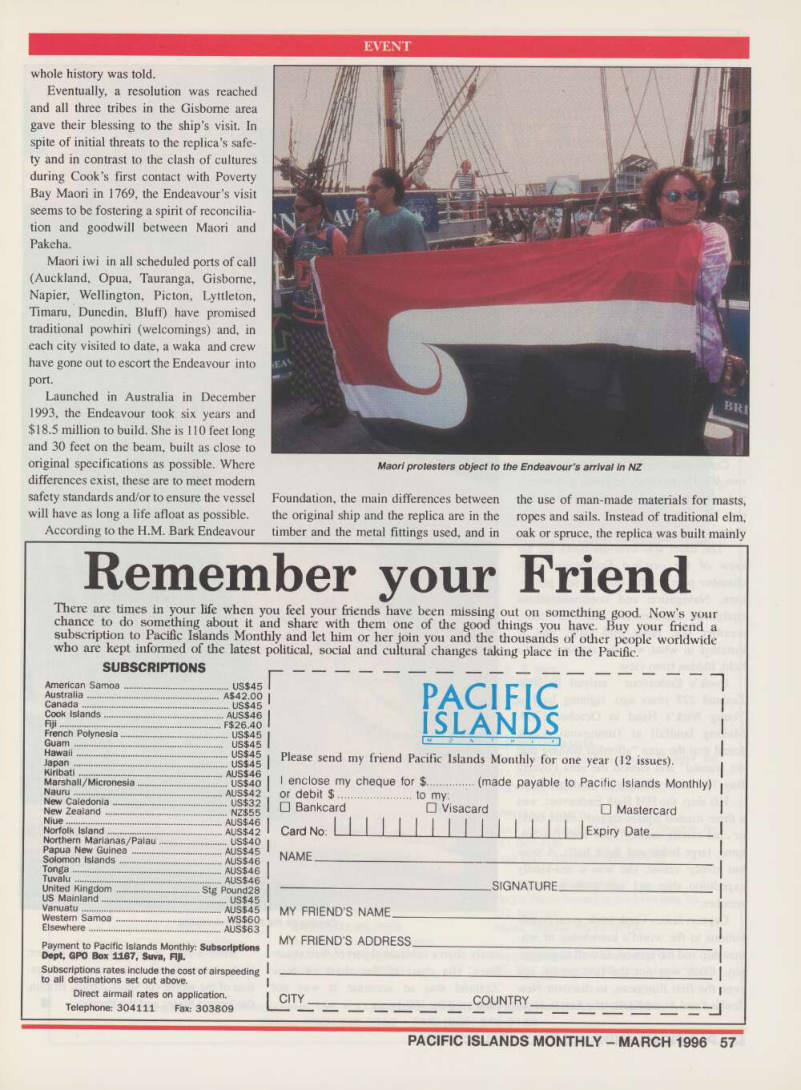
But the Endeavour’s three-month visit to New Zealand has not been without con troversy. Some of New Zealand’s indige nous people have a long memory and, in Auckland, 12 Maori protesters attempted to board the Endeavour requesting that it leave New Zealand, claiming the ship was a symbol of colonial oppression and racism. One member of the group said it should be sunk.
In Gisborne, local kaumatua (elders) said they would be unable to guarantee the safety of the Endeavour if she sailed into
Poverty Bay and requested apologies for
murders committed by Captain Cook’s men. They also wanted to make sure the
The Endeavour - definitely a ship from another age
whole history was told.
Eventually, a resolution was reached and all three tribes in the Gisborne area gave their blessing to the ship’s visit. In spite of initial threats to the replica’s safe ty and in contrast to the clash of cultures during Cook’s first contact with Poverty Bay Maori in 1769, the Endeavour’s visit seems to be fostering a spirit of reconcilia tion and goodwill between Maori and Pakeha.
Maori iwi in all scheduled ports of call (Auckland, Opua, Tauranga, Gisborne,
Napier, Wellington, Picton, Lyttleton,
Timaru, Dunedin, Bluff) have promised traditional powhiri (welcomings) and, in each city visited to date, a waka and crew have gone out to escort the Endeavour into port.
Launched in Australia in December 1993, the Endeavour took six years and $18.5 million to build. She is 110 feet long and 30 feet on the beam, built as close to original specifications as possible. Where differences exist, these are to meet modem safety standards and/or to ensure the vessel will have as long a life afloat as possible.
According to the H.M. Bark Endeavour
Foundation, the main differences between the original ship and the replica are in the timber and the metal fittings used, and in
the use of man-made materials for masts, ropes and sails. Instead of traditional elm, oak or spruce, the replica was built mainly
Maori protesters object to the Endeavour’s arrival in NZ
from jarrah, a native West Australian hard wood which will ensure a long life for the
ship. Old growth Douglas Fir, specially
imported from North America, was used for the masts, spars, topsides and decks. To prevent rotting and for crew comfort the replica has better ventilation than the orig inal ship and both modem and traditional preservatives were used on the timbers.
Iron fastenings are galvanised; the running rigging is polyester; the standing rigging is manilla; the sails are made of a synthetic canvas which looks and handles the same as flax canvas.
Crew accommodation is in hammocks, though less crowded than on Cook’s Endeavoiy where nearly twice as many people lived aboard. The replica Endeavour carries 14 professional mariners, 30 volunteer crew, two media people, and 10 paying passengers. Ship’s master is Captain Chris Blake, no relation to Kiwi yachtsman Sir Peter Blake!
Concessions to the 20th century include two 405 HP auxiliary engines, generators, a desalination unit, electric galley, freez ers, bilge pumps, showers and modem heads.
The toilet was over-the-bows for the crew of the original Endeavour, with chamber pots for the officers and gentle men. Navigation and communications equipment includes HE and VHP radio, weather fax, radar and GPS, and is installed in what was the original ship’s hold, hidden from view.
Cook’s Endeavour arrived in New Zealand 227 years ago, sighting land at Young Nick’s Head in October 1769.
Making landfall at Turanganui, Cook found that the area “afforded nothing that we wanted” and named the area Poverty Bay. The name still annoys modem Maori.
His ship, the HM Bark Endeavour, was a three masted square-rigged collier bark, or coal carrier, solidly built with flat bot toms, large holds and thick hulls. A slow but sturdy vessel, she was a sea-kindly expedition ship and safe even in rough weather.
Captain James Cook made great contri butions to the world’s knowledge of sea manship and navigation, as well as geogra phy. Cook was not the first person nor even the first European, to discover New Zealand and Australia, but the first to accu-
rately chart a substantial part of their coastlines. His chart of the coast of New Zealand was so accurate it was not improved for 100 years.
After a refit in Fremantle in October, Endeavour will undertake a circumnaviga tion of the world via South Africa, Britain, the United States and the Pacific. ■
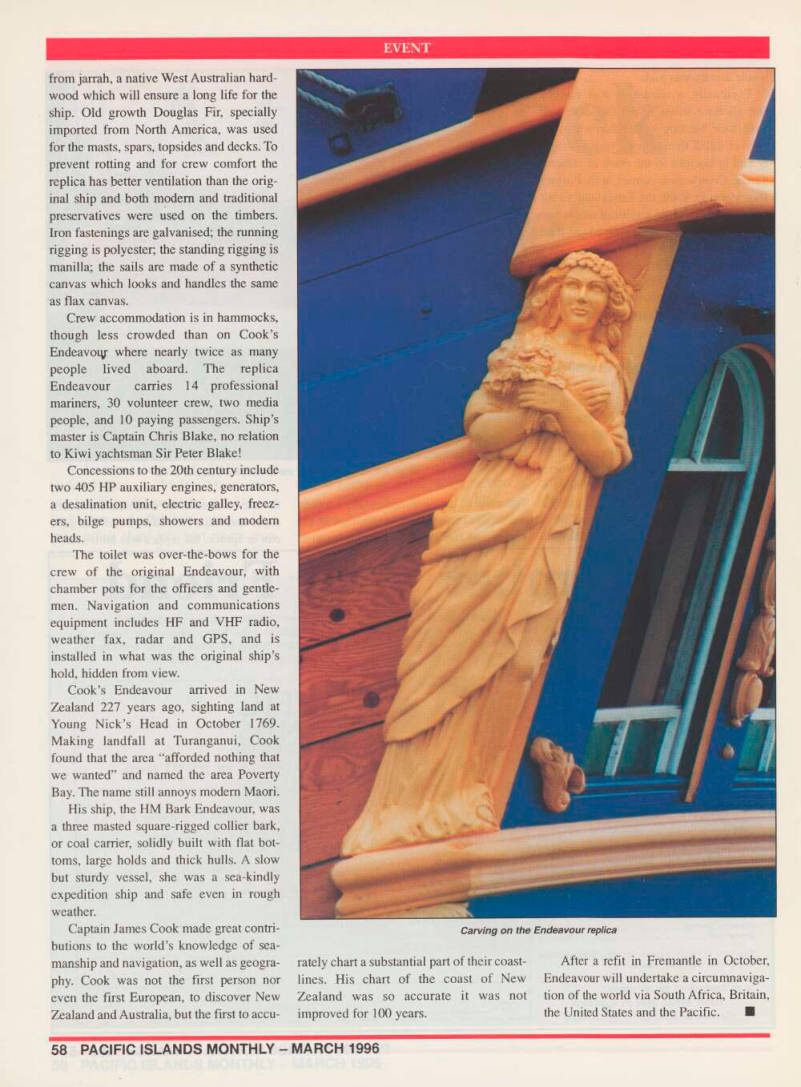
Carving on the Endeavour replica