Adelaide
pp. 50-51 · Read in the full issue
Annihilation in Adelaide
By Atama Raganivatu
The Oceania Olympic Qualifying
Tournament, which ended in early February, gave Pacific islands soc cer fans much food for thought.
The previously wide-held belief that Oceania’s minnows had begun catching up with Australia was rudely revealed to be nonsensical as “The Olyroos” clinically administered hammerings to the national under-23 selections of Solomon Islands, Fiji and Vanuatu - the latter two suffered 10-0 and 12-0 humiliations respectively.
Fiji’s annihilation was particularly harrow ing. Their squad travelled to Adelaide with high expectations of success; having just beaten Oceania’s second ranked senior team, Tahiti, and completed an undefeated tour of New Zealand.
However, before local supporters
become too depressed by those seemingly
horrendous setbacks, they should reflect upon how immensely handicapped their teams are when facing Australia. It is a sad, but often overlooked, fact that the Australians enjoy huge superiority in the two most important materials in the build ing of a winning soccer team - player num bers and financial resources.
Although soccer is only the third most popular football code in Australia, 512,271 people are registered as playing the sport there. This compares with 3215 players in Fiji, 2688 in the Solomons and 1980 in Vanuatu! Those figures, surely, put the defeats into perspective.
To compound that colossal advantage, the Australian government annually injects huge amounts of money into soccer’s development. This cash has enabled the Australian Institute of Sport in Canberra to evolve into being amongst the most profi cient cultivators of young footballing tal ent in the world and given the Olyroos
opportunities to continuously hone their skills against prominent foreign teams.
They undertook a month-long tour of Europe and were pitted against several powerful overseas sides on home soil dur ing a preparation programme that com menced early in 1994.
Australia has also enthusiastically exploited her position as a “nation of immigrants”. Most Australians, because of their ancestry, can acquire visas to enter and work in European nations relatively easily. This enables gifted young Aussie soccer players to travel overseas and join
high profile professional clubs who pro vide a polish that only those resident in the French, territories have access to in our region. Olyroos Craig Moore and Mark Viduka are currently attached to world famous outfits Glasgow Rangers and Dynamo Zagreb respectively.
The odds, then, were stacked against Fiji, Vanuatu and the Solomons. Flowever, a few crumbs of comfort were salvaged from the Hindmarsh Stadium. Fiji gained a meritorious 2- 1 victory over runners-up New Zealand and, in strikers Livai Duguca and Manoa Masi, had two players the
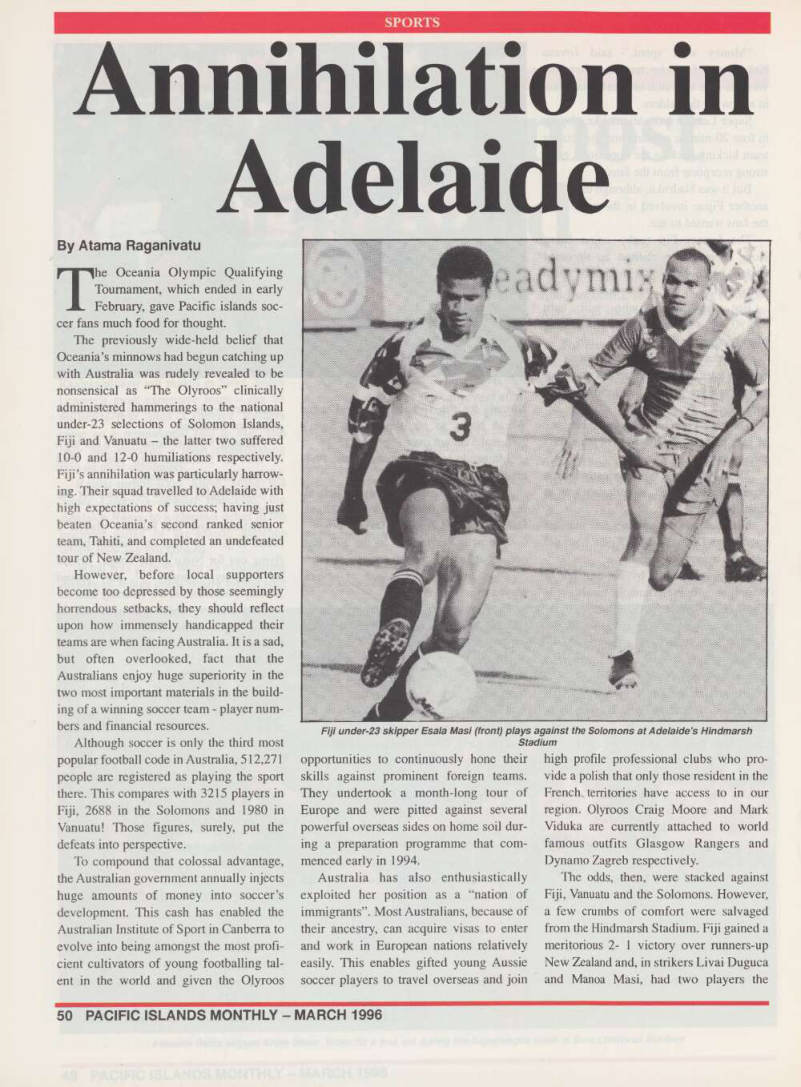
Fiji under-23 skipper Esala Masi (front) plays against the Solomons at Adelaide’s Hindmarsh Stadium
equal to any on display. The Solomons produced excellent football in patches and gave even the Australians some anx ious moments, whilst Vanuatu’s tech nique was not nearly as bad as their results suggested.
Still, the “local” teams were, overall, light years behind Australia in both tech nical ability and fitness. The gap will only be closed if our players’ prepara tions are improved at least tenfold.
Australian soccer’s archilles heel is the often woeful ineptitude of its admin istrators and it is they who give the small er island nations cause for hope. That incompetence became apparent to the world when a player not listed on the Olyroos’ team sheet was fielded against the Solomons and the original 4-0 win turned into a 2-0 loss as a consequence.
Everybody connected with Australian soccer has at least one horror story to tell about Soccer Australia, as the Sydney based administrative body now call themselves. Their everyday “housekeep ing” is notoriously haphazard. If the Fiji Football Association, Solomon Islands Football Federation and Vanuatu Football Federation can get their acts together they will, at least in one respect, gain a distinct edge.
The F FA’s first goal should be to take serious steps in getting to grips with the abysmal disciplinary problems which have blighted their selections for many years now, whilst the Vanuatu and Solomons federations urgently need to widen their domestic infrastructures so that the many capable players from the outer areas feature in national combina tions. At the moment, they don’t look beyond Vila and Honiara.
With those steps taken, our teams will be much better equipped to meet sides of Australia’s calibre. But to be competitive, they require vastly superior groundwork for major tournaments than has been available to them in the past. That, alas, takes a large cash outlay and there seems little likelihood of the sums needed becoming available within the foresee able future.
As visiting coaches have, for decades, observed, our young players have great potential. Sadly, it seems probable that potential will never be realised. ■