pollution
pp. 44-45 · Read in the full issue
Environment
Forgera's pollution
By Liz Thompson
Once again, reports of environmen tal damage are emerging from Papua New Guinea. This time it’s not Bougainville or Ok Tedi but Porgera mine and the pollution of the Strickland River. Porgera is mined by PJV which comprises of Placer Pacific, Goldfields Limited, Highlands Gold (a subsidiary of Mount Isa Mines) and the PNG govern ment. All the companies involved are largely Australian-owned. The report con
eludes that the pollution result ing from Porgera mine is on a par with the terrible pollution of the Fly River attributed to BHP’s mine at OK Tedi. Porgera has now become the focus of landowner discontent and envi ronmental concern.
The track record of multi
national companies operating in
countries such as Papua New Guinea is abysmal. You cannot help but ask why it is Australian
companies continually fail to
apply similar environmental standards to resource exploita tion activities in PNG to those they know they are obliged to
abide by when operating in Australia. It seems extraordinary that companies will knowingly enter into operations which will
pollute river systems, damage gardens and
wildlife and generally lower the standards of the local communities whose resources are being exploited. You would like to believe that humanitarian concerns speak louder than dollars but clearly this is not the case. Australians speak out against much publicised atrocities on the interna tional arena but remain largely unaware of the damage Australian companies, sup
ported by the Australian share-holding
public, are doing to our indigenous neigh bours.
The Porgera File: Adding to Australia’s Legacy of Destruction is a recently released report on the environmental and social impacts of the Porgera mine in PNG. It has been compiled by the Mineral Policy Institute, Australian Conservation Foundation, Community Aid Abroad and World Wide Fund for Nature. While the operations of CRA’s Panguna Mine in Bougainville, PNG, and BHP’s Ok Tedi Mine have been subject to intense public
scrutiny, (the latter particularly in recent months), operations of Porgera Mine which is also located in the Fly River catchment have continued largely unno ticed.
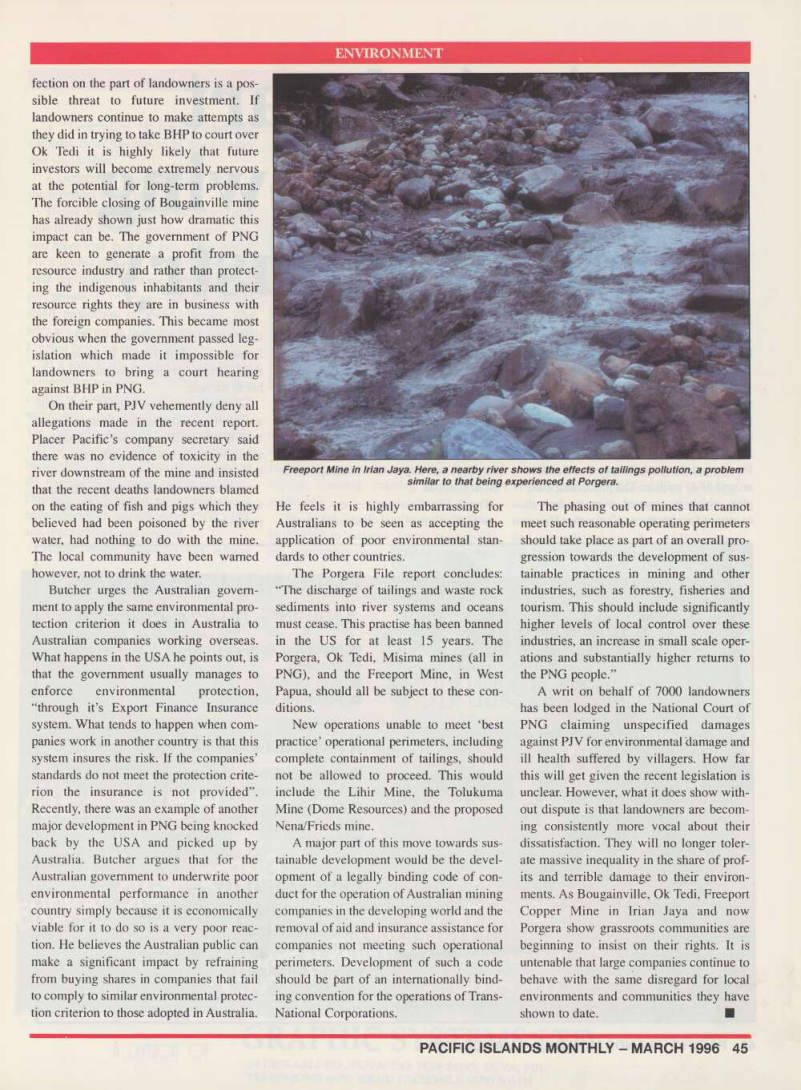
In common with all major Australian owned and operated mines in PNG, the Porgera mine discharges all its tailings directly into the environment, in this case the Strickland/Fly River system. The tail ings contain high levels of potentially toxic metals. Even though these dilute as they travel further down the river system the river is still contaminated with arsenic
at least 65 kms from the mine site. In the mines Environmental Impact Statement it was estimated that the river bed would rise by several metres on the basis of the mil lions of tonnes of residue from the mine which would enter the river. Ground ore is
piled-up alongside the river and during
heavy rainfall is carried downstream. The estimate of water rises was based on the idea that the material would spread through the length of the river, however according to David Butcher, the director of World Wide Fund for Nature, (WWF)
“where the river is low-lying it has already risen by several metres and covered low-lying surrounding areas which are
mainly gardens with centimetres
if not metres of very fine materi al”.
The second part of the problem according to WWF is that when ore is treated it produces a whole suite of other elements, mainly heavy metals such as mercury, lead and arsenic. The assessment of materials is on a soluble basis.
Since these elements are not terri bly soluble the government of PNG has effectively said that as long as the soluble component does
not go beyond a certain level the practice of dumping in the river is alright.
However, according to Butcher the soluble component is several thousand times what in some instances would be allowed in Australia. He argues that whilst it is insol uble when it is dumped, “in the longer term with differences in pH and so forth, solubility is just about assured”.
Part of the problem is undoubtedly the stance of the PNG government who are going out of their way to protect the rights of large international companies involved in resource extraction. Any public disaf
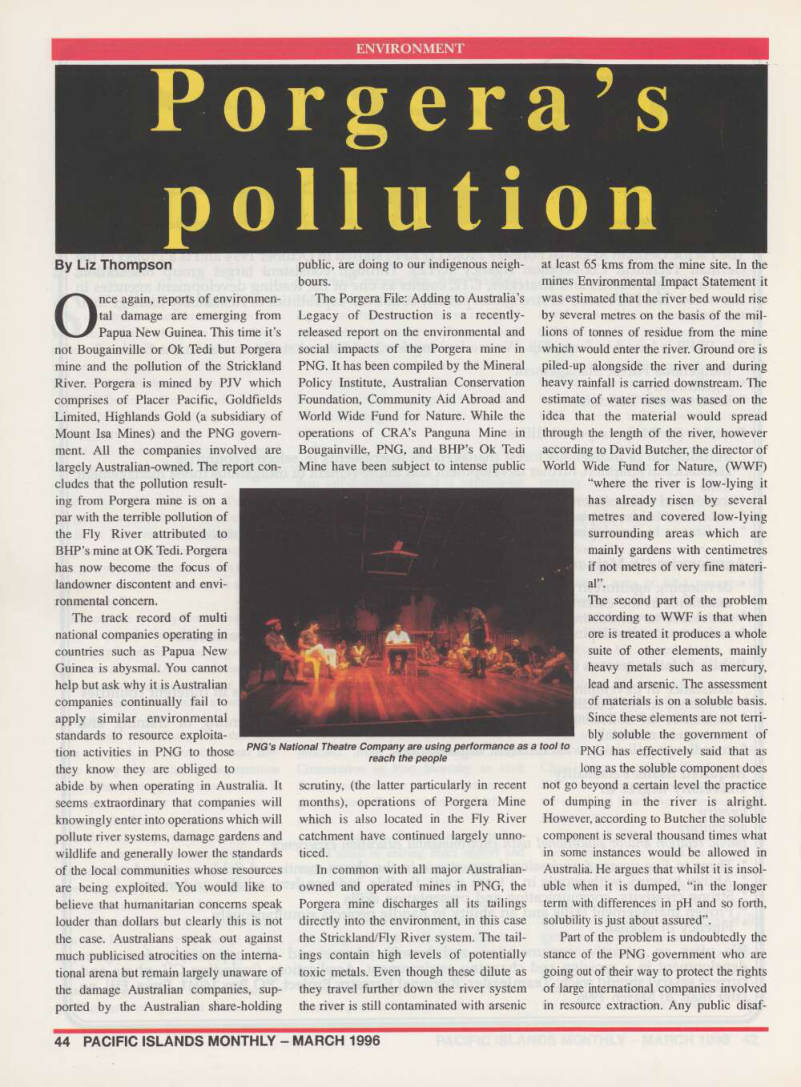
PNG’s National Theatre Company are using performance as a tool to reach the people
fection on the part of landowners is a pos sible threat to future investment. If landowners continue to make attempts as they did in trying to take BHP to court over Ok Tedi it is highly likely that future investors will become extremely nervous at the potential for long-term problems.
The forcible closing of Bougainville mine has already shown just how dramatic this impact can be. The government of PNG are keen to generate a profit from the resource industry and rather than protect ing the indigenous inhabitants and their resource rights they are in business with the foreign companies. This became most obvious when the government passed leg islation which made it impossible for landowners to bring a court hearing against BHP in PNG.
On their part, PJV vehemently deny all allegations made in the recent report.
Placer Pacific’s company secretary said there was no evidence of toxicity in the river downstream of the mine and insisted that the recent deaths landowners blamed on the eating of fish and pigs which they believed had been poisoned by the river water, had nothing to do with the mine.
The local community have been warned however, not to drink the water.
Butcher urges the Australian govern ment to apply the same environmental pro tection criterion it does in Australia to
Australian companies working overseas.
What happens in the USA he points out, is that the government usually manages to enforce environmental protection, “through it’s Export Finance Insurance system. What tends to happen when com panies work in another country is that this system insures the risk. If the companies’ standards do not meet the protection crite rion the insurance is not provided”.
Recently, there was an example of another major development in PNG being knocked back by the USA and picked up by Australia. Butcher argues that for the Australian government to underwrite poor environmental performance in another country simply because it is economically viable for it to do so is a very poor reac tion. He believes the Australian public can
make a significant impact by refraining
from buying shares in companies that fail to comply to similar environmental protec tion criterion to those adopted in Australia.
He feels it is highly embarrassing for Australians to be seen as accepting the application of poor environmental stan dards to other countries.
The Porgera File report concludes; “The discharge of tailings and waste rock sediments into river systems and oceans must cease. This practise has been banned in the US for at least 15 years. The Porgera, Ok Tedi, Misima mines (all in PNG), and the Freeport Mine, in West Papua, should all be subject to these con ditions.
New operations unable to meet ‘best
practice’ operational perimeters, including
complete containment of tailings, should not be allowed to proceed. This would include the Lihir Mine, the Tolukuma Mine (Dome Resources) and the proposed Nena/Frieds mine.
A major part of this move towards sus tainable development would be the devel opment of a legally binding code of con duct for the operation of Australian mining companies in the developing world and the removal of aid and insurance assistance for
companies not meeting such operational
perimeters. Development of such a code should be part of an internationally bind ing convention for the operations of Trans- National Corporations.
The phasing out of mines that cannot meet such reasonable operating perimeters should take place as part of an overall pro gression towards the development of sus tainable practices in mining and other industries, such as forestry, fisheries and tourism. This should include significantly higher levels of local control over these industries, an increase in small scale oper ations and substantially higher returns to the PNG people.”
A writ on behalf of 7000 landowners has been lodged in the National Court of
PNG claiming unspecified damages
against PJV for environmental damage and ill health suffered by villagers. How far this will get given the recent legislation is unclear. However, what it does show with out dispute is that landowners are becom ing consistently more vocal about their dissatisfaction. They will no longer toler ate massive inequality in the share of prof its and terrible damage to their environ ments. As Bougainville, Ok Tedi, Freeport Copper Mine in Irian Jaya and now Porgera show grassroots communities are beginning to insist on their rights. It is untenable that large companies continue to behave with the same disregard for local environments and communities they have shown to date. ■
Freeport Mine in Irian Jaya. Here, a nearby river shows the effects of tailings pollution, a problem similar to that being experienced at Porgera.