Back to
pp. 23-24 · Read in the full issue
Region
Back to square one
Following the formation of a coalition government last December 21, Vanuatu has been plunged into political turmoil: new prime minister Serge Vohor resigned on February 8 to avoid facing a motion of no confidence. And the country was awaiting the formation of a new government before the end of February.
By Patrick Decloitre
On February 8, Vanuatu’s prime minister, Serge Vohor, announced his resignation, 48 days after his election, last December 21.
Vohor, who was leading a coalition of Union of Moderate Parties (UMP, 17 seats in parliament) with former prime minister Walter Lini’s National United Party (NUP, 9 seats), announced in a nation-wide broadcast he had called a meeting of the Council of ministers to announce his deci sion.
Vohor’s resignation comes after six MPs from UMP allied with opposition Unity Front (UF, 22 seats in parliament) to sign a motion of no confidence against the newly-elected prime minister.
In a recent memorandum of agreement signed between Donald Kalpokas’s UF and the UMP dissident faction led by MP Amos Andeng, it was hinted Tuesday the next prime minister would be Vohor’s pre decessor and rival Maxime Carlot, and his deputy Kalpokas.
In this planned government, UMP would have five ministries (including prime ministership) and UF seven (includ ing deputy prime ministership).
The agreement, which is supported by 28 MPs (in the 50-seat parliament) follows a memorandum of understanding signed last January 27 between the same parties.
who filed a notice of motion of no confi dence at the end of January to oust Serge Vohor.
UMP (17 seats) formed a coalition government last December 21 with former
prime minister Walter Lini’s National United Party (NUP, 9 seats) led by prime minister Serge Vohor with Lini as his deputy, excluding UF from power.
The motion was to be discussed on February 8 in an extraordinary session of the island state’s parliament. It was post poned due to a boycott by the government opposition, which, it was seen here, only
represented 20 empty seats out of 50, not enough to meet the two-third quorum required at a first seating.
Parliament met again the following Monday (February 12) with every MP pre sent in the house, but was again unable to elect a new prime minister. After the ses sion was opened, NUP MP Hilda Lini pointed out parliament was called to debate a motion of no confidence and not solely to elect a prime minister.
The agenda of the seating, which called MPs to debate the motion of no confi dence, was no longer relevant since
Vohor’s resignation.
After a one and-a-half hour break, opposition leader Donald Kalpokas and UMP dissident Amos Andeng withdrew their motion.
The Speaker, former prime minister Maxime Carlot (who is likely to come back at the head of government if the motion is passed), after receiving advice from the island state’s attorney-general, agreed to close this session and immedi ately call another extraordinary session for
February 20.
The new agenda would include the election of a new prime minister, whereas the first extraordinary session’s agenda was the debate of a motion of no-confi dence.
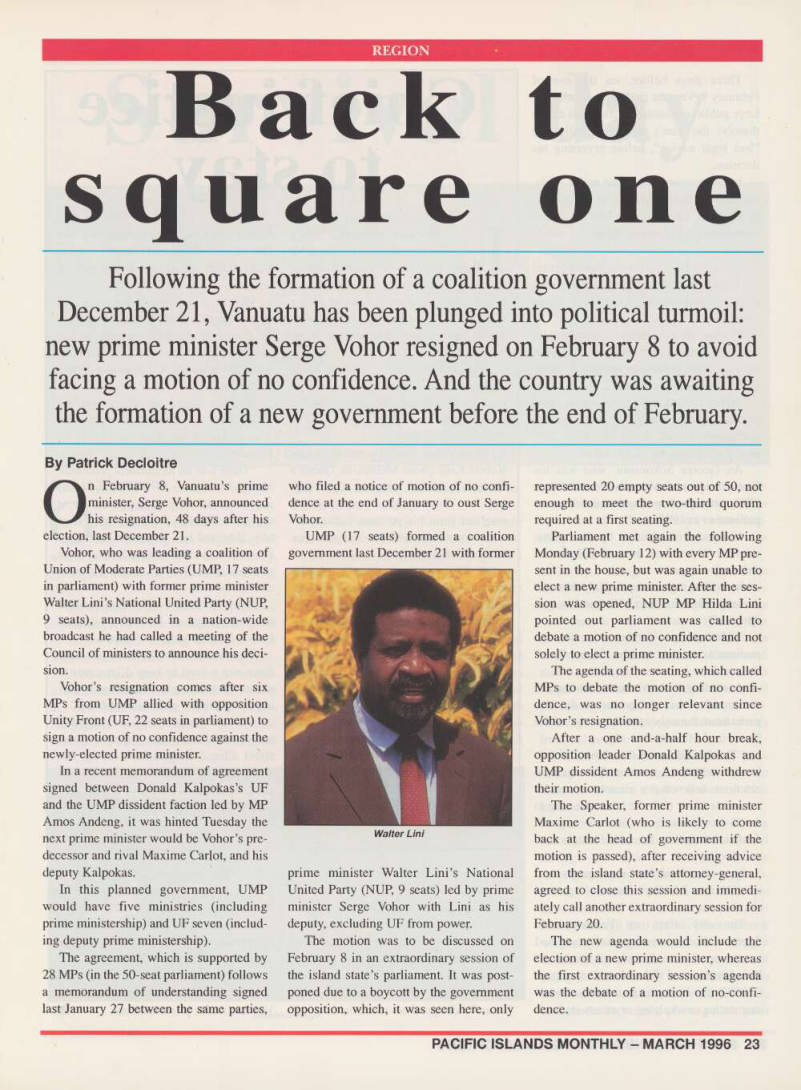
Walter Lini
Three days before, on the eve of February 9, Vanuatu president, Jean-Marie Leye publicly admitted he tried that day to dissolve the state’s parliament following “bad legal advice”, before reversing his decision.
In an interview broadcast nation-wide, the Head of State said his first intention to dissolve the 50-seat house was a “misun derstanding”, following “requests” made to him.
“Now, after receiving good legal
advice, I know that as a president, I cannot dissolve parliament,” Leye told Radio Vanuatu.
“I want the population to remain calm and not to take the law into their own hands. Let the politicians solve their polit ical problems in parliament,” he added.
“What I’m saying, I’m saying as Head of State, I won’t change my mind again. I don’t want to fall down like what hap pened to Sokomanu,” Leye asked.
Ati George Sokomanu, who was the first president of Vanuatu from 1980 to 1988, attempted to dissolve the Vanuatu parliament in 1988.
Charged with sedition by then prime minister Walter Lini, he was jailed, then demised.
In a joint communique, Kalpokas and
Andeng asked for Leye’s “immediate res ignation”.
“Otherwise, we’ll take action through parliament to remove him from office,”
they said.
According to the Vanuatu constitution, the president has the power to dissolve parliament, but only upon the advice of the Council of Ministers.
“There shall be no dissolution of par liament within 12 months of the general elections following a dissolution under subarticle (2) or (3)”, the latter referring to a self-dissolution by the house or a presi dential dissolution, the island state’s con stitution says.
Leye dissolved the former parliament last October 3, before Vanuatu’s general elections.
The day after, on February 10, Supreme Court, stressing parliament had not been dissolved, ordered Vanuatu’s Broadcasting and Television Corporation (VBTC) that “no statement shall be broad cast stating or implying or otherwise lead
ing people to believe that parliament has been dissolved” and that “any person breaching this order shall be arrested forthwith and brought before the court to show cause why they should not be com mitted to prison for contempt of court”.
Since the end of January, police have set up special operation (code named “Nasara”) designed to maintain law and
order. The exercise involves 24-hour patrols in the capital and police and Vanuatu Mobile Force officers being post ed at strategic points of Port Vila, includ ing Parliament, Radio Vanuatu, the prime minister’s office and State House.
Meanwhile, all political parties have resumed lobbying and negotiating to elect Vanuatu’s next prime minister. ■