Shipping saga
pp. 20-22 · Read in the full issue
Shipping
Shipping saga extraordinaire
By Sophie Foster
The year was 1989, the place - Suva.
The Fiji Government had just won a $F9.5 million (SUS6.6m) con tract to build the largest and most sophis ticated vessel its shipyard had ever
attempted.
It was a brilliant strategy to upgrade the Government Shipyard from state-work horse to internationally recognised boat builder. But it went horribly wrong.
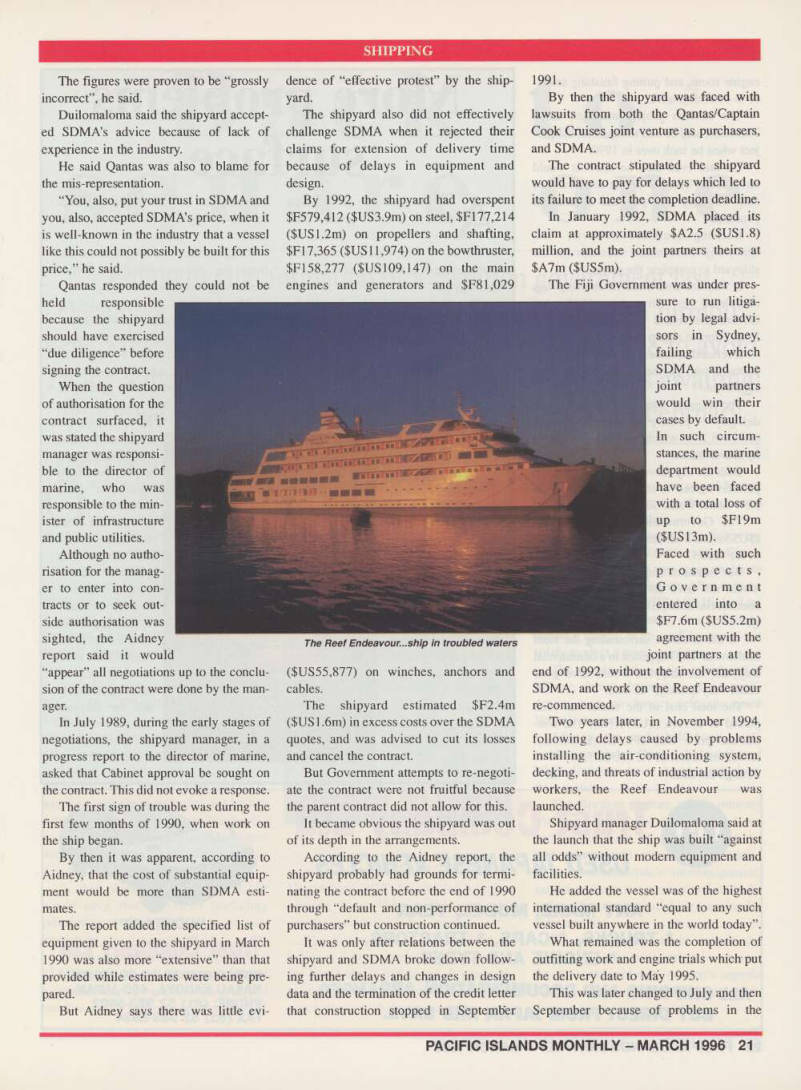
And six years and seven project man agers later, as the Reef Endeavour finally sailed over the horizon and out of Suva Bay in January, Government is still reeling from the impact of the losses it incurred through the deal.
The shipyard management, which has changed since 1989, protested last year that they were misled by their Australian counterparts when they entered into the deal.
But it has also been revealed Government signed the contract against legal advice.
The contract, between the Government
Shipyard and Sydney-based Ship Design
and Management stated a 73-metre vessel would be constructed in Fiji for
$A7,712,640 (Suss.6M)
The purchaser was a Qantas/Captain Cook Cruises joint venture.
The deal was finalised after seven months of negotiations between the par ties.
But a report by Fiji accountant and sen ator Don Aidney, who was commissioned by Government in January 1992 to study the deal, states shipyard representatives were not adequately prepared during
negotiations.
The report found the shipyard arrived at cost estimates and a building schedule
on inadequate design data and equipment
specifications.
“In doing so, it was persuaded to accept cost estimates and material quanti ties submitted by the purchasers,” it said.
The shipyard informed Aidney that during negotiations, it placed preliminary cost estimates at $Fl5m (SUS 10.3 m), but then lowered the price after accepting costs quoted by SDMA.
On July 31, 1989, the shipyard advised SDMA it had revised its price to $A8,125,868 (SUS6.Im) excluding cer
tain equipment.
But the figure was rejected by SDMA who said: “Construction and fitting out budget for this ship is $A7.4m (SUSS.6m).
Our estimates indicate that this budget is realistic”.
In August 1989, there were further price revisions by both parties, which resulted in the shipyard accepting $A7.3m (SUSS.Sm) as the contract figure.
But it was not until the next month, that the shipyard received preliminary draw ings of the Reef Endeavour and in October, inspected a similar ship, the Lady Hawkesbury, in Australia.
Two days before the contract was signed in Sydney on December 22, 1989, the shipyard received a hand-written revised estimate from SDMA containing their own cost figures placing the estimate at $A7.7m (SUSS.6m).
Aidney’s report says the shipyard could not have been able to verify cost figures in the 48 hours before the contract was
signed.
The resulting contract gave the ship yard little room to move.
“A contract was then entered into, which was strongly biased towards the purchasers, which contained no provisions for variances in material and equipment
costs (including those items based on the purchaser’s estimates) and which gave lit tle protection to the shipyard in the event of default,” the Aidney report states.
Legally, Government is said to have entered into the agreement on an uneven
footing.
Indeed, the shipyard was advised by the Solicitor-General’s Office in 1989 that certain clauses would have to be reviewed.
According to the Aidney report, “sev eral undesirable features” of the contract were pointed out to the shipyard but these issues were not dealt with by SDMA.
Flaws in the contract that were high lighted included the disadvantages of New South Wales law (where the contract was drawn up), and the provisions for delay which were dependent on labour stan dards.
Government sources have confirmed protests against the contract were made repeatedly until they were “blue in the face,” but these warnings were not heeded.
But although the Solicitor-General’s office objected to some of the clauses, one of their representatives was a signatory to the 1989 contract signed in Sydney.
The director of marine, who had trav elled to Australia to visit the Lady Hawkesbury, was the other Fiji
Government signatory.
The director stepped-in for the then Government minister who had cancelled his visit to Sydney.
Last May, the shipyard’s new manager, Ratu Mosese Duilomaloma, told Qantas Group executive Geoff Dixon there was
“something fundamentally amiss” about
the contract.
He said it was based on misrepresenta tion because SDMA had provided mis leading figures on which the contract was based.
The figures were proven to be “grossly incorrect”, he said.
Duilomaloma said the shipyard accept ed SDMA’s advice because of lack of experience in the industry.
He said Qantas was also to blame for
the mis-representation.
“You, also, put your trust in SDMA and you, also, accepted SDMA’s price, when it is well-known in the industry that a vessel like this could not possibly be built for this price,” he said.
Qantas responded they could not be
held responsible i because the shipyard should have exercised “due diligence” before signing the contract.
When the question of authorisation for the contract surfaced, it was stated the shipyard manager was responsi ble to the director of marine, who was responsible to the min ister of infrastructure and public utilities.
Although no autho risation for the manag er to enter into con tracts or to seek out side authorisation was sighted, the Aidney report said it would
“appear” all negotiations up to the conclu sion of the contract were done by the man ager.
In July 1989, during the early stages of negotiations, the shipyard manager, in a progress report to the director of marine, asked that Cabinet approval be sought on the contract. This did not evoke a response.
The first sign of trouble was during the first few months of 1990, when work on the ship began.
By then it was apparent, according to Aidney, that the cost of substantial equip ment would be more than SDMA esti mates.
The report added the specified list of equipment given to the shipyard in March 1990 was also more “extensive” than that provided while estimates were being pre
pared.
But Aidney says there was little evi
dence of “effective protest” by the ship yard.
The shipyard also did not effectively challenge SDMA when it rejected their claims for extension of delivery time because of delays in equipment and design.
By 1992, the shipyard had overspent $F579,412 (SUS3.9m) on steel, $F177,214 (SUSI.2m) on propellers and shafting, $F17,365 ($U511,974) on the bowthruster, $F158,277 ($U5109,147) on the main engines and generators and $F81,029
($U555,877) on winches, anchors and cables.
The shipyard estimated $F2.4m (SUS 1.6 m) in excess costs over the SDMA quotes, and was advised to cut its losses and cancel the contract.
But Government attempts to re-negoti ate the contract were not fruitful because the parent contract did not allow for this.
It became obvious the shipyard was out of its depth in the arrangements.
According to the Aidney report, the shipyard probably had grounds for termi nating the contract before the end of 1990 through “default and non-performance of purchasers” but construction continued.
It was only after relations between the shipyard and SDMA broke down follow ing further delays and changes in design data and the termination of the credit letter that construction stopped in September
1991.
By then the shipyard was faced with lawsuits from both the Qantas/Captain Cook Cruises joint venture as purchasers, and SDMA.
The contract stipulated the shipyard would have to pay for delays which led to its failure to meet the completion deadline.
In January 1992, SDMA placed its claim at approximately $A2.5 (SUSI.B) million, and the joint partners theirs at
$A7M (Sussm).
The Fiji Government was under pres
sure to run litiga tion by legal advi sors in Sydney,
failing which
SDMA and the
joint partners
would win their cases by default.
In such circum stances, the marine department would have been faced with a total loss of up to $Fl9m
(Susi3M).
Faced with such prospects.
Government entered into a
$F7.6M (Suss.2M)
agreement with the
joint partners at the end of 1992, without the involvement of SDMA, and work on the Reef Endeavour re-commenced.
Two years later, in November 1994,
following delays caused by problems
installing the air-conditioning system, decking, and threats of industrial action by workers, the Reef Endeavour was launched.
Shipyard manager Duilomaloma said at the launch that the ship was built “against all odds” without modem equipment and facilities.
He added the vessel was of the highest international standard “equal to any such vessel built anywhere in the world today”.
What remained was the completion of outfitting work and engine trials which put the delivery date to May 1995.
This was later changed to July and then September because of problems in the
The Reef Endeavour...ship in troubled waters
engine room, and putting finishing touch es to outfitting work.
The seventh project manager, Chris Tsantikos, said he had tried to halt the pro ject when he took over in 1990.
He said even then he knew it would have been “cheaper in the long run” to stop building and pay the contractual
penalties.
Building continued however, with heavy Fiji Government subsidies for the shipyard to complete the project.
It was not until work on the ship was completed in November 1995 that Government seized the Reef Endeavour in an effort to regain costs.
It refused to release the ship to the joint partners until payments and claims were sorted out.
The shipyard was being charged a late delivery penalty of $F650,000 ($U5448,240) which was being disputed by Government.
Both the Fiji Government and the joint partners agreed to legal arbitration in the New South Wales Supreme Court.
The Government was paid $F4.4m (SUS3m) as a settlement and took control of the vessel.
But Tsantikos emphasised the shipyard would not have survived had it been a commercial enterprise with limited liabili ty.
“If the situation surrounding the Reef Endeavour had happened in a commercial shipyard, the shipyard would have gone under very quickly,” he said.
The total cost of the vessel has been placed at $Fl9m (SUS 13.1 m). The con tractual price was $F9.5m (SUS6.Sm).
Government lost $F9.5 (SUS6.Sm) through the deal. ■