opportunity
pp. 16-17 · Read in the full issue
Opinion
Window of opportunity
The government of Japan has approved more than $U5250,000 towards establishing a South Pacific Forum office in Tokyo.
Together with its annual SUS7OO,OOO grant to regional programmes adminis tered by the South Pacific Forum Secretariat, the SPEESC funding has made Japan the number one non-Forum donor to the Suva-based Secretariat.
The office, to be formally known as the South Pacific Economic Exchange Support Centre (SPEESC), will be a “clearing house” for growing business activities between Japan and members of the Forum, in particular Forum Island
Tokyo’s decision, formally conveyed
to the Secretary-General of the South Pacific Forum, Hon. leremia Tabai, in late December came as a nice surprise for member countries.
Over the years, member governments, through the annual visit to Japan by the chair of the Forum and other channels, raised with successive Japanese govern ments possible assistance for setting-up the office.
As there was no progress on the long
standing proposal, a suggestion was made
recently that a feasibility study be under taken to determine the project’s viability.
These were to no avail.
Last April, however, there was a change of heart. Tokyo had informed the Secretary- General in a letter that Japan had agreed to help fund and take part in a
joint feasibility study.
Until then, even the idea of a feasibili ty study was not entertained. This was due largely to costs which, in Tokyo, are almost prohibitive. Because of this, it was argued, the benefit from such an office may not justify the cost.
Full credit must go to the former presi dent of Nauru, Hon. Bernard Dowiyogo, who during his time as Chair of the Forum in 1993/94 convinced the Japanese gov ernment to agree on the feasibility study.
Equal credit goes to the government of Japan for its decision to provide funding for the SPEESC office. It is a decision which must be seen as further proof of the co-operative relations between Japan and the Fomm.
For many member governments, the momentum has never been faster. In the space of five months (April-August 1995) the study was completed by the Forum’s Trade and Investment Division and sub mitted by the Oceania Division of Japan’s ministry of foreign affairs to the ministry of finance (MOF) in Tokyo for funding in 1996.
Four months later came the good news that Japan had agreed to provide 25 mil lion yen (about $U5250,000) for the set ting-up and running of the office for six months beginning in October this year. A new funding proposal will then be submit ted to the government of Japan for 1997.
The funding approval seems to have brought with it a new spirit of optimism and enthusiasm on both sides. The speed with which SPEESC evolved from a mere concept (at the time of the feasibility study) to reality also appears to suggest
The Forum
Countries (FICs).
Alfred
Sasako
that there is scope for an additional market for island products.
Tokyo appears to have satisfied itself that SPEESC has a role to play in boosting the warm and cooperative relations between Japan and the region. The approval also seems to be a vote of confi dence in the potential for the expansion of the existing market.
Some may wonder why an office in Japan is necessary, especially in the capi tal where it seems the sky is the limit, when it comes to the cost of office space rental. Why, critics may ask, is such an office necessary, especially when the trend world-wide is to cut costs?
Well, there are always three sides to a story - the version of the one who tells it; the version of the person about whom the story is told and the true version.
Whatever critics may say, everyone realises that one of the established princi ples of doing business is that you onlyget out what you put in. In other words, if you do not invest, you do not expect any return.
FlC’s leaders know there is a market in Japan. They know the potential for expan sion is also there. They do not have the money, but they have the time, so they invested in time in pursuing the SPEESC
office proposal.
They are convinced that an on-the ground presence through the establish ment of a SPEESC office in one of the world’s biggest and most complex markets is essential to promote and strengthen existing trade, tourism and investment links.
Their conviction is one of the reasons why they persevered in the face of initial setback to the idea. The leaders realised that, like everything else, it takes two to tango. In this case, they recognise the importance that an input by the Japanese government, monetary or otherwise, can make.
Apart from Australia and New Zealand, Japan’s proximity and its status as a Pacific Rim country are important consid erations.
According to the World Almanac, there are about 124 million people living in Japan today. Of this, about 17 per cent are between the ages of zero and 14 years, while 60 per cent of the population
account for the 15-60 year old age brack etin 1991, Japan’s Gross Domestic Product (GDP) was estimated at SUS 2.3 trillion. Its international foreign reserves (minus gold) were estimated at SUS 73 bil lion in March 1993. Gold was estimated at 24.23 million oz.
Japan’s per capita GDP in 1991 was
SUSI9,IOO, suggesting a powerful buying
power.
But perhaps more relevant to the region are figures on trade between Japan and some FICs, namely Papua New Guinea, Western Samoa, Vanuatu, Fiji, Solomon Islands, Tonga, Kiribati, Nauru, Tuvalu, the Republic of the Marshall Islands, Federated States of Micronesia and Palau.
Although the level of trade has fallen between Japan and some individual FICs, generally the total value is on the increase.
For instance, the value of Japanese imports of FICs products rose from SUS9OO million in 1993 to well over SUSI billion (SUS 1,055,190) in 1994.
On the other hand, Japanese exports to FICs fell by almost SUSI 39 million in the
same period.
On a country-by-country basis, some
FICs have recorded stunning increases in terms of the value of their imports to Japan, according to official Japanese fig ures.
Take, for example, Papua New Guinea, RMI and Fiji, to cite a few. In 1993, PNG’s exports to Japan (mainly copper concen trate and timber) were valued at about SUS 673 million.
By the end of 1994, this had gone up to $U5748.43 million. On the other hand, Japan’s exports to PNG actually took a dive from about SUSIBB million in 1993 to about SUSI 79 million in 1994.
A similar pattern emerged in the trade between Japan and the Marshall Islands in the same period. From a mere $U5864,000 in 1993, RMI exports to Japan grew to $U524.26 million over the next 12 months.
Fiji’s exports to Japan also grew hand somely in the 1993/94 period. In 1993, Fiji exported products valued at around $U533.52 million. By 1994, total exports to Japan had exceeded SUSS9 million.
Japanese exports to Solomon Islands, Tonga, Western Samoa, Kiribati and Palau also grew markedly in the same period.B
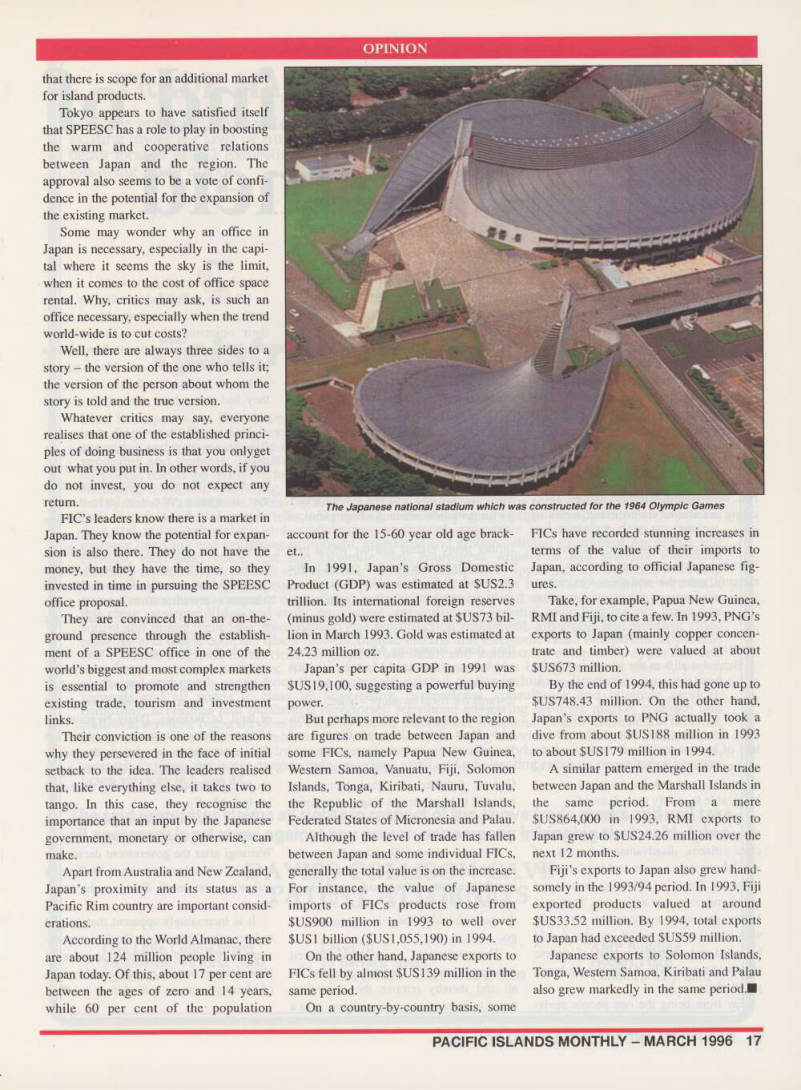
The Japanese national stadium which was constructed for the 1964 Olympic Games