A new beginning
pp. 24-25 · Read in the full issue
Culture
By Liz Thompson
Hundreds of people were converg ing on Kiriwina, an island amongst the Trobriand Islands in Papua New Guinea, to attend the Sagali for Chief Nalabutau. The sagali is a tradi tional Trobriand Island ceremony which takes place several months after the death of a member of the community. It is a time of, what the Trobriand islanders call, Lisaladabu, which literally means the ‘releasing of emotional energy’. In this case it is the emotional energy which sur rounds death and mourning. The sagali marks the end of the old and beginning of the new.
Trobriand island culture is matrilineal and land is passed from mother to daugh ter. During the sagali it is women who are
responsible for releasing the community
from mourning and sadness. The basic
principle of the sagali is exchange.
Exchange is something which underlies much of Trobriand island culture. In the instance of the sagali it is a repayment by the women of Chief Nalabutau’s family, to
all those who have mourned, who have brought food for the Chief’s widows and even more simply, for those with whom Nalabutau has had connections and rela tionships. In the process of repayement, Nalabutau’s spirit is released from all earthly obligations. His spirit is free to leave and travel to Tuma, the traditional place of the dead, a small island off the coast of Kiriwina.
The main form of payment during the sagali is doba, women’s traditional wealth.
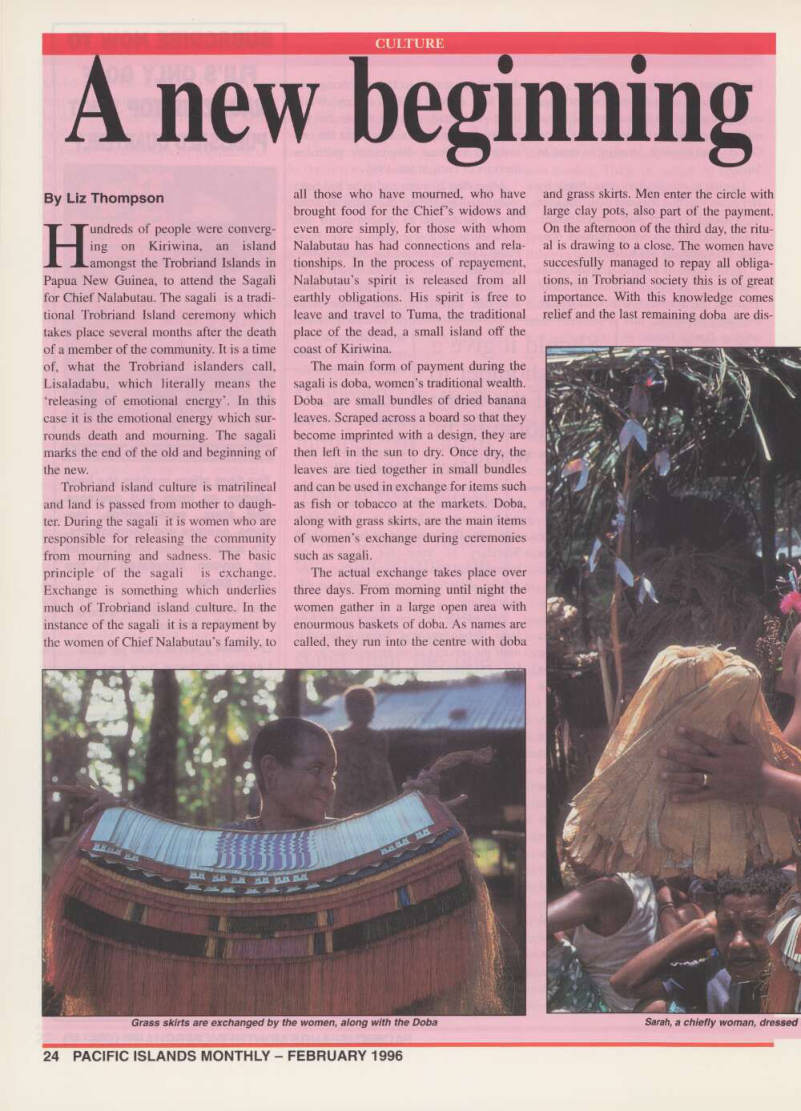
Doha are small bundles of dried banana leaves. Scraped across a board so that they become imprinted with a design, they are then left in the sun to dry. Once dry, the leaves are tied together in small bundles and can be used in exchange for items such as fish or tobacco at the markets. Doba, along with grass skirts, are the main items of women’s exchange during ceremonies such as sagali.
The actual exchange takes place over three days. From morning until night the women gather in a large open area with enourmous baskets of doba. As names are called, they run into the centre with doba
and grass skirts. Men enter the circle with large clay pots, also part of the payment.
On the afternoon of the third day, the ritu al is drawing to a close. The women have succesfully managed to repay all obliga tions, in Trobriand society this is of great importance. With this knowledge comes relief and the last remaining doba are dis-
Grass skirts are exchanged by the women, along with the Doba
Sarah, a chiefly woman, dressed
tributed amidst fun and games and a great deal of laughter. It is now time to take off the dark clothes which have been worn since the chief’s death and begin once
again to enjoy life.
Now, it is the men’s turn to repay the women for their work. This is done in the form of food. Huge pots of taro and coconut milk are prepared, rice and fish are cooked. Pigs are killed and baked in an earth oven and large piles of yams are dis tributed. As night falls, people sit about fires and smoke and talk as the sense that the community has been released from it’s sadness makes way for a new beginning.*
[?]aditional Trobriand island costume
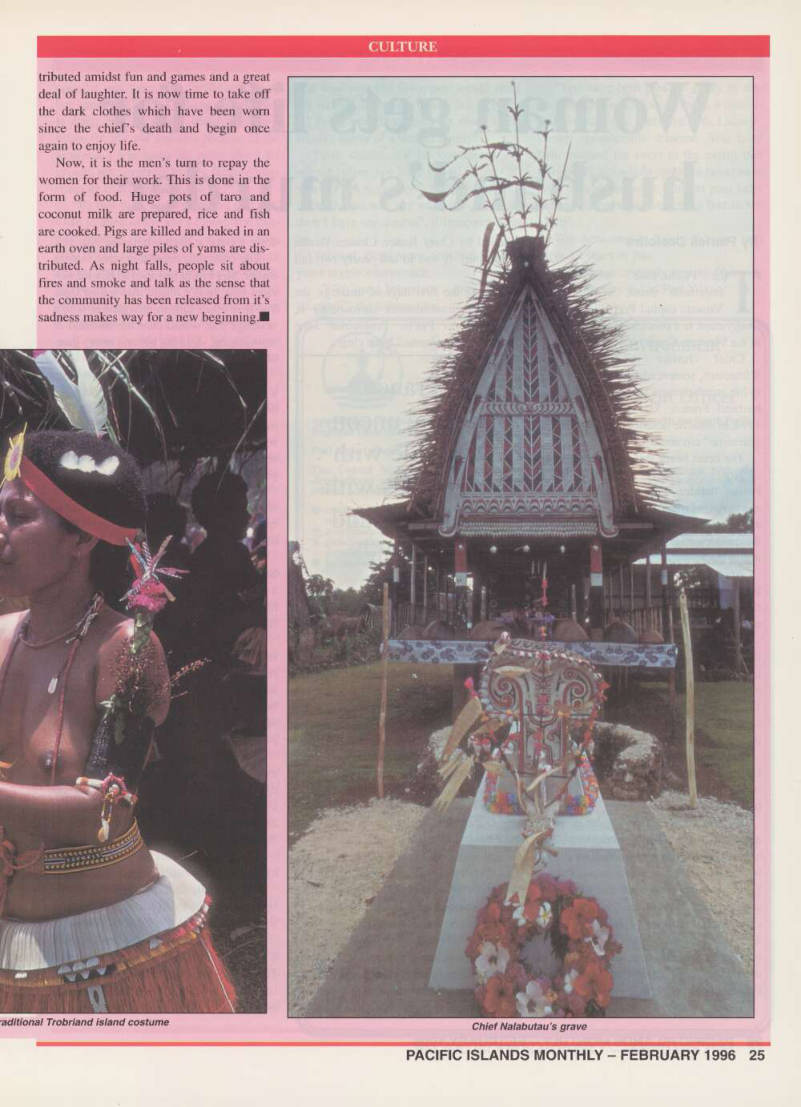
Chief Nalabutau’s grave