Carlton Brewery overco
pp. 46-47 · Read in the full issue
JUST when Fiji beer drinkers thought they had found all the ways to quench their thirst, Carlton Brewery (Fiji) Ltd embarks on a new marketing strategy.
In October last year the company, which has two breweries in Fiji, began its campaign to win back lost ground and expand the Fiji beer market.
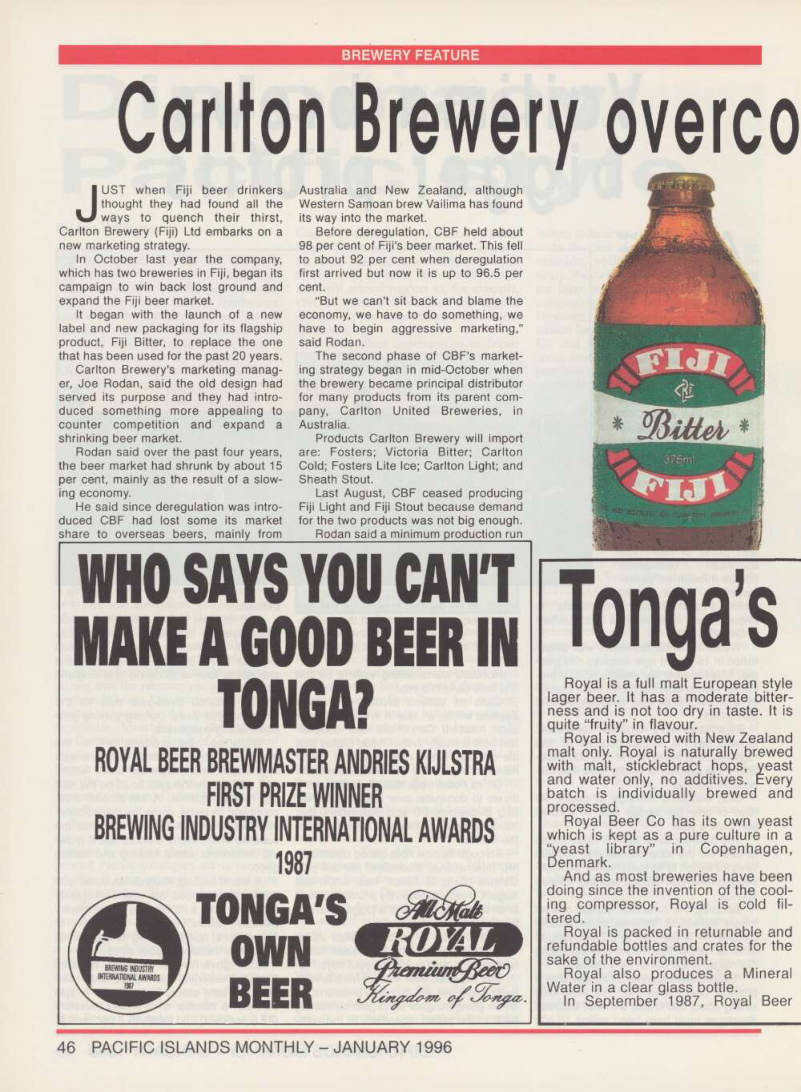
It began with the launch of a new label and new packaging for its flagship product, Fiji Bitter, to replace the one that has been used for the past 20 years.
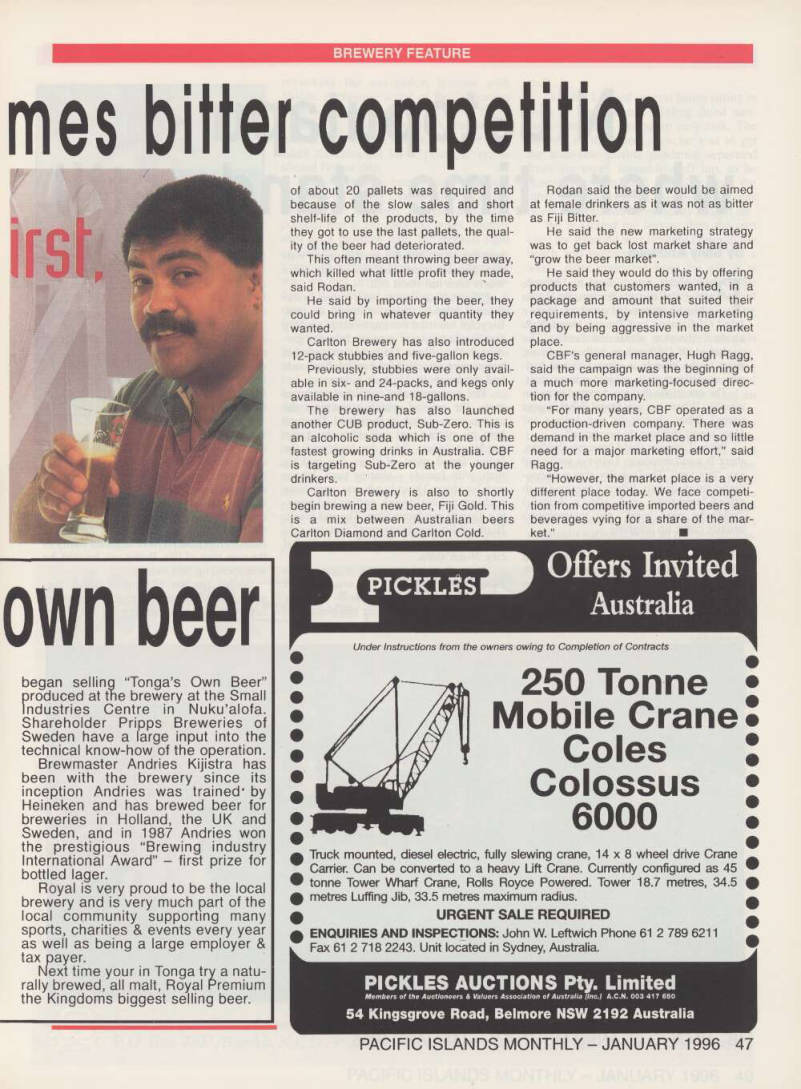
Carlton Brewery’s marketing manag er, Joe Rodan, said the old design had served its purpose and they had intro duced something more appealing to counter competition and expand a shrinking beer market.
Rodan said over the past four years, the beer market had shrunk by about 15 per cent, mainly as the result of a slow ing economy.
He said since deregulation was intro duced CBF had lost some its market share to overseas beers, mainly from
Australia and New Zealand, although Western Samoan brew Vailima has found its way into the market.
Before deregulation, CBF held about 98 per cent of Fiji’s beer market. This fell to about 92 per cent when deregulation first arrived but now it is up to 96.5 per cent.
“But we can’t sit back and blame the economy, we have to do something, we have to begin aggressive marketing,” said Rodan.
The second phase of CBF’s market ing strategy began in mid-October when the brewery became principal distributor for many products from its parent com pany, Carlton United Breweries, in Australia.
Products Carlton Brewery will import are: Fosters; Victoria Bitter; Carlton Cold; Fosters Lite Ice; Carlton Light; and Sheath Stout.
Last August, CBF ceased producing Fiji Light and Fiji Stout because demand for the two products was not big enough.
Rodan said a minimum production run
of about 20 pallets was required and because of the slow sales and short shelf-life of the products, by the time they got to use the last pallets, the qual ity of the beer had deteriorated.
This often meant throwing beer away, which killed what little profit they made, said Rodan.
He said by importing the beer, they could bring in whatever quantity they wanted.
Carlton Brewery has also introduced 12-pack stubbies and five-gallon kegs.
Previously, stubbies were only avail able in six- and 24-packs, and kegs only available in nine-and 18-gallons.
The brewery has also launched another CUB product, Sub-Zero. This is an alcoholic soda which is one of the fastest growing drinks in Australia. CBF is targeting Sub-Zero at the younger drinkers.
Carlton Brewery is also to shortly begin brewing a new beer, Fiji Gold. This is a mix between Australian beers Carlton Diamond and Carlton Cold.
Rodan said the beer would be aimed at female drinkers as it was not as bitter as Fiji Bitter.
He said the new marketing strategy was to get back lost market share and “grow the beer market”.
He said they would do this by offering products that customers wanted, in a package and amount that suited their requirements, by intensive marketing and by being aggressive in the market place.
CBF’s general manager, Hugh Ragg, said the campaign was the beginning of a much more marketing-focused direc tion for the company.
“For many years, CBF operated as a production-driven company. There was demand in the market place and so little need for a major marketing effort,” said Ragg.
“However, the market place is a very different place today. We face competi tion from competitive imported beers and beverages vying for a share of the mar ket.” ■