Changing
pp. 42-43 · Read in the full issue
Region
Changing hands at SPC
By Debbie Singh
THE Noumea-based headquarters of the South Pacific Commission will experience many changes in 1996.
Among them, the guidance of a new management team to steer the Commission over the next three years.
The new team was appointed by regional member governments at the 35th South Pacific Conference in Noumea in October.
It comprises new Secretary-General Dr Bob Dun (Australia), Director of Programmes Dr Jimmie Rodgers (Solomon Islands) and Director of Services Lourdes Pangelinian (Guam).
The SPC currently has a sub-regional membership of 22 Island governments and territories from Melanesia, Micronesia and Polynesia. The governments of the United States, Australia, New Zealand, France and the recently-withdrawn United Kingdom constitute the organisation’s remaining members and are its funding giants. Australia presently contributes 33 per cent of the SPC’s total organisational budget.
Dr Dunn will take up the post of Secretary-General on January 6, 1996.
Outgoing Secretary-General Ati George Sokomanu (Vanuatu) will remain in office until January 5, 1996.
At an interview in New Caledonia recently, a somewhat cynical Sokomanu reflected on his term at the SPC, saying he would have liked to have been re-elected for another three years but did not get the support of his government.
“I have pushed hard to tell Australia and New Zealand to keep away from this post as it belongs to the island nations and territories. But unfortunately, this has not happened,” Sokomanu said.
“(At the election of the new Secretary- General) we witnessed the spirit of con sensus in action. I was sorry to see that what we believe in as ‘doing things the Pacific way’, took another turn. The islanders were split in two, it’s sad to see, but I guess we have to believe in equality,
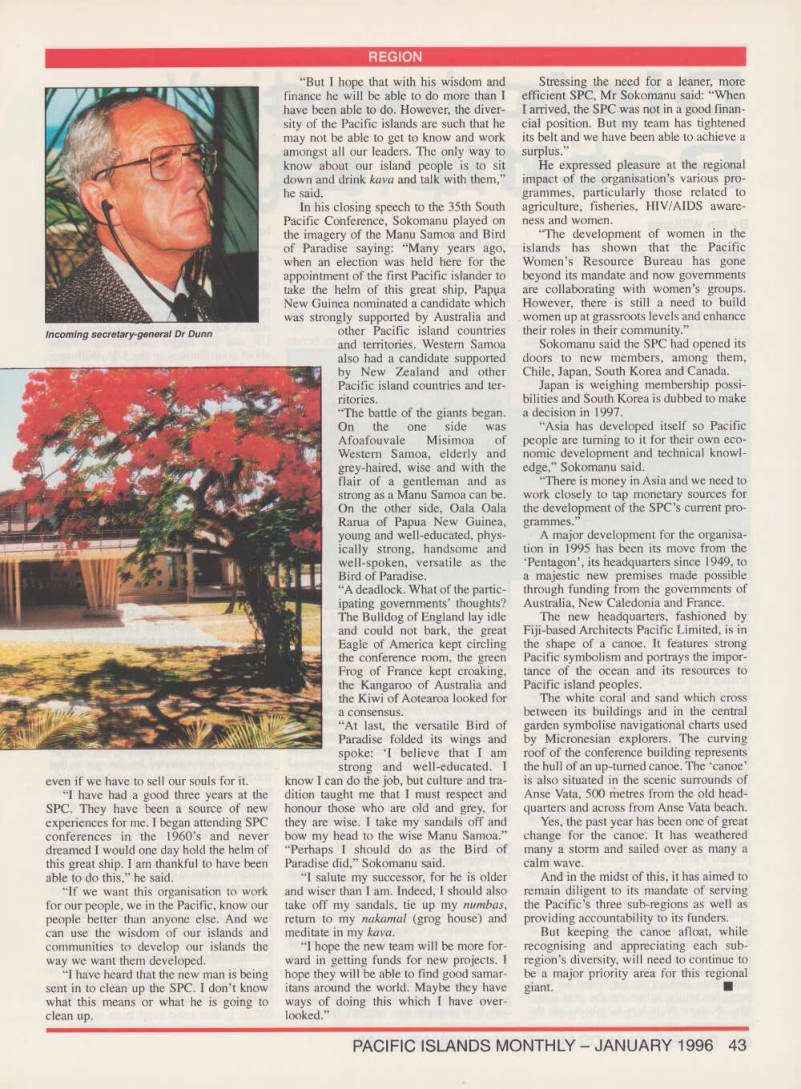
South Pacific Commission headquarters
Outgoing secretary-general Sokomanu
even if we have to sell our souls for it.
“I have had a good three years at the SPC. They have been a source of new experiences for me. I began attending SPC conferences in the 1960’s and never dreamed I would one day hold the helm of this great ship. I am thankful to have been able to do this,” he said.
“If we want this organisation to work for our people, we in the Pacific, know our people better than anyone else. And we can use the wisdom of our islands and communities to develop our islands the way we want them developed.
“I have heard that the new man is being sent in to clean up the SPC. I don’t know what this means or what he is going to clean up.
“But I hope that with his wisdom and finance he will be able to do more than I have been able to do. However, the diver sity of the Pacific islands are such that he may not be able to get to know and work amongst all our leaders. The only way to know about our island people is to sit down and drink kava and talk with them,” he said.
In his closing speech to the 35th South Pacific Conference, Sokomanu played on the imagery of the Manu Samoa and Bird of Paradise saying: “Many years ago, when an election was held here for the appointment of the first Pacific islander to take the helm of this great ship, Papua New Guinea nominated a candidate which was strongly supported by Australia and other Pacific island countries and territories. Western Samoa
also had a candidate supported by New Zealand and other Pacific island countries and ter ritories.
“The battle of the giants began.
On the one side was Afoafouvale Misimoa of Western Samoa, elderly and grey-haired, wise and with the flair of a gentleman and as strong as a Manu Samoa can be.
On the other side, Oala Oala Rarua of Papua New Guinea, young and well-educated, phys ically strong, handsome and well-spoken, versatile as the Bird of Paradise.
“A deadlock. What of the partic ipating governments’ thoughts?
The Bulldog of England lay idle and could not bark, the great Eagle of America kept circling the conference room, the green Frog of France kept croaking, the Kangaroo of Australia and the Kiwi of Aotearoa looked for a consensus.
“At last, the versatile Bird of Paradise folded its wings and spoke: ‘I believe that I am strong and well-educated. I
know I can do the job, but culture and tra dition taught me that I must respect and honour those who are old and grey, for they are wise. I take my sandals off and bow my head to the wise Manu Samoa.”
“Perhaps I should do as the Bird of Paradise did,” Sokomanu said.
“I salute my successor, for he is older and wiser than I am. Indeed, I should also take off my sandals, tie up my numbas, return to my nakamal (grog house) and meditate in my kava.
“I hope the new team will be more for ward in getting funds for new projects. I hope they will be able to find good Samar itans around the world. Maybe they have ways of doing this which I have over looked.”
Stressing the need for a leaner, more efficient SPC, Mr Sokomanu said: “When I arrived, the SPC was not in a good finan cial position. But my team has tightened its belt and we have been able to achieve a
surplus.”
He expressed pleasure at the regional impact of the organisation’s various pro grammes, particularly those related to agriculture, fisheries, HIV/AIDS aware ness and women.
“The development of women in the islands has shown that the Pacific Women’s Resource Bureau has gone beyond its mandate and now governments are collaborating with women’s groups.
However, there is still a need to build women up at grassroots levels and enhance their roles in their community.”
Sokomanu said the SPC had opened its doors to new members, among them, Chile, Japan, South Korea and Canada.
Japan is weighing membership possi bilities and South Korea is dubbed to make a decision in 1997.
“Asia has developed itself so Pacific people are turning to it for their own eco nomic development and technical knowl edge,” Sokomanu said.
“There is money in Asia and we need to work closely to tap monetary sources for the development of the SPC’s current pro grammes.”
A major development for the organisa tion in 1995 has been its move from the ‘Pentagon’, its headquarters since 1949, to a majestic new premises made possible through funding from the governments of Australia, New Caledonia and France.
The new headquarters, fashioned by Fiji-based Architects Pacific Limited, is in the shape of a canoe. It features strong Pacific symbolism and portrays the impor tance of the ocean and its resources to Pacific island peoples.
The white coral and sand which cross between its buildings and in the central garden symbolise navigational charts used by Micronesian explorers. The curving roof of the conference building represents the hull of an up-tumed canoe. The ‘canoe’ is also situated in the scenic surrounds of Anse Vata, 500 metres from the old head quarters and across from Anse Vata beach.
Yes, the past year has been one of great change for the canoe. It has weathered many a storm and sailed over as many a calm wave.
And in the midst of this, it has aimed to remain diligent to its mandate of serving the Pacific’s three sub-regions as well as providing accountability to its funders.
But keeping the canoe afloat, while recognising and appreciating each sub region’s diversity, will need to continue to be a major priority area for this regional giant. ■
Incoming secretary-general Dr Dunn