Return of the Nauruans
pp. 32-33 · Read in the full issue
Celebration
By Peter McQuarrie
January 31,1996 is a significant day in the history of Nauru. Not only does it mark Nauru’s 28th anniversary of independence but it also is the 50th anniversary of independence of the return to Nauru of survivors of the two-thirds of the population who were deported to Truk (Chuuk) in Micronesia by the Japanese in World War 11.
The Nauruan people suffered long and hard during the Pacific War. Theirs was the first Pacific island to come under attack and by the time the war ended, Nauru had been subjected to bombardments made in turn by German, Japanese and American forces. The Japanese finally surrendered Nauru to the Allies in October 1945, long after Tokyo itself had already capitulated.
By then the Nauruan population had been reduced by 30 per cent.
World War Two in the Pacific Islands began with a German attack on Nauru in December 1940, more than one year before other islands felt the war’s arrival with the surprise Japanese attack at Pearl Harbour. The Nauru attack, by German Raiders which used gun-boats disguised as harmless merchant ships, was an outstand ing success in destroying shipping and the island’s phosphate plant and oil tanks.
When the two raiders shelled the island’s oil storage tanks, the oil fires burnt for
days after.
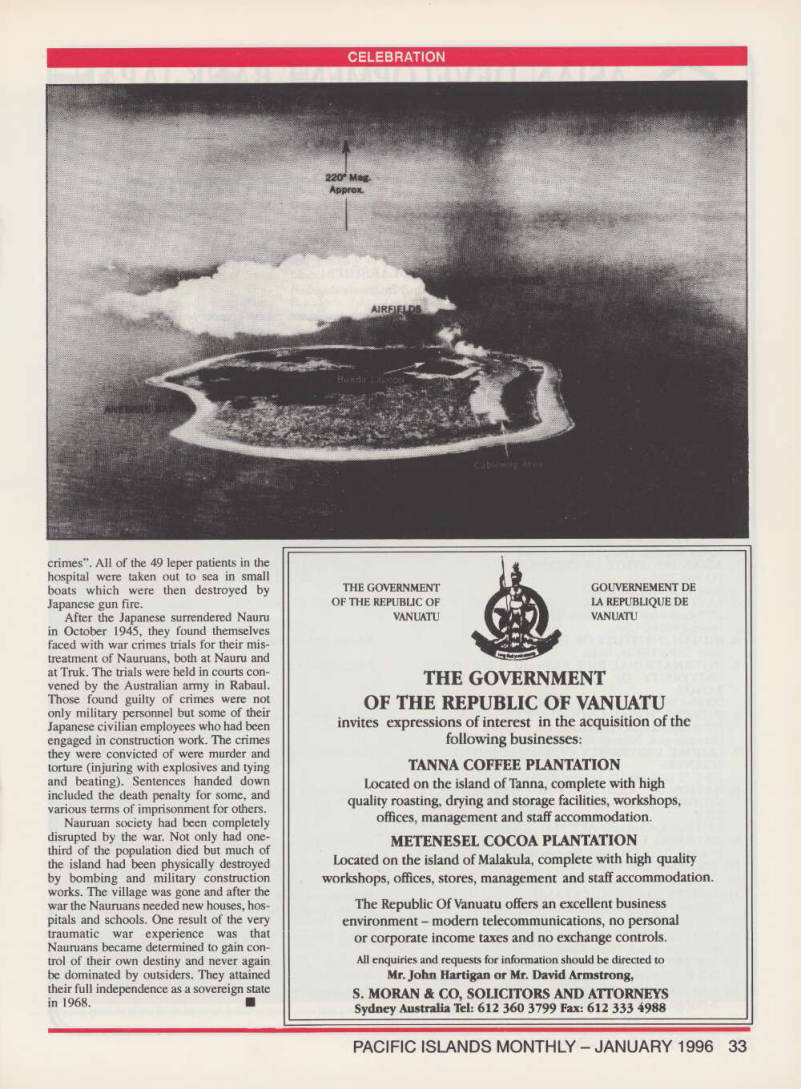
The next attack came from the Japanese who bombed Nauru the same week that they destroyed the American Pacific Fleet in Pearl Harbour, in December 1941. Then in August 1942 Japanese forces occupied Nauru and began building an air base there. Nauruans were used as slave-labour for the construction work. The creation of the air base precipitated heavy aerial bombing attacks from the Americans and these became a daily occurrence. The Americans considered it simpler and less costly in American lives to neutralise the Nauru base through continued bombing, rather than to capture it using ground forces. Through most of 1943 and all of 1944, the bombs rained down on Nauru.
The Japanese found it difficult to get supplies to the besieged and overpopulated island and so to relieve the demand on the limited food supply, they deported 1200 Nauruans, two-thirds of the population, to Truk in the Caroline Islands. Of these 1200 people, 461 died from ill treatment, malnu trition, disease and despair. Twenty of those
who died were killed in the American bombing of Truk, which was a major Japanese naval base. Thirty died in acci dents in the quarries where they were forced to work. When the war ended most of the Nauruan survivors were found to be engaged in work on sweet potato planta tions on Toll Island where’they were sub sisting on “only leaves and toddy”.
Those Nauruans who had remained at Nauru fared similarly to their friends and relatives who had been taken to Truk.
Several were killed in American bombing raids. One attack alone in August 1944 killed 19 Nauruans. Others died of starva tion and disease. Stealing of food became a capital offence under Japanese rule and Nauruans also died as the result of the “heavy punishment dealt out for lesser
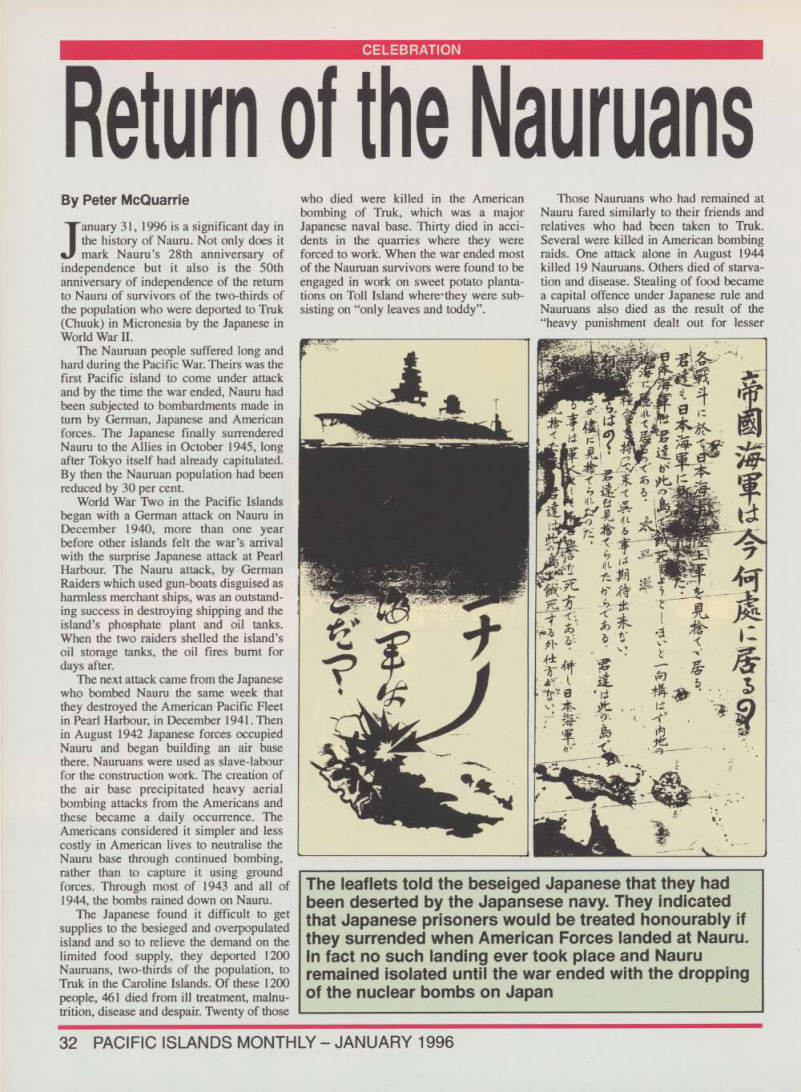
The leaflets told the beseiged Japanese that they had been deserted by the Japansese navy. They indicated that Japanese prisoners would be treated honourably if they surrended when American Forces landed at Nauru.
In fact no such landing ever took place and Nauru remained isolated until the war ended with the dropping of the nuclear bombs on Japan
crimes”. All of the 49 leper patients in the hospital were taken out to sea in small boats which were then destroyed by Japanese gun fire.
After the Japanese surrendered Naum in October 1945, they found themselves faced with war crimes trials for their mis treatment of Nauruans, both at Naum and at Tmk. The trials were held in courts con vened by the Australian army in Rabaul.
Those found guilty of crimes were not only military personnel but some of their Japanese civilian employees who had been engaged in constmction work. The crimes they were convicted of were murder and torture (injuring with explosives and tying and beating). Sentences handed down included the death penalty for some, and various terms of imprisonment for others.
Nauman society had been completely dismpted by the war. Not only had one third of the population died but much of the island had been physically destroyed by bombing and military constmction works. The village was gone and after the war the Naumans needed new houses, hos pitals and schools. One result of the very traumatic war experience was that Naumans became determined to gain con trol of their own destiny and never again be dominated by outsiders. They attained their full independence as a sovereign state in 1968. ■