Workers fight
pp. 24-26 · Read in the full issue
Discrimination
Workers fight oppression
By David North
The often-abused foreign workers in Micronesia are fighting back and, with some help from distant capitals, are actually winning a few battles.
The principal battleground is the Commonwealth of the Northern Marianas Islands (CNMI) which has more foreign workers than permanent residents, but there are also skirmishes in Palau and FSM (Federated States of Micronesia) as well.
The distant capitals include Washington, Manila and, strangely, Singapore.
The winners include farm hands, maids, waitresses, hotel workers, and school teachers, usually from the Philippines.
Some of the losers are powerful members of the islands’ establishments.
All too often island employers have treated the foreign workers as second-class human beings and, all too often, in the past, the workers felt powerless to do anything about it.
The losers When Roberto Clemente, a Filipino farm hand, got cuffed around by his Chamorro boss’s brother - a member of the CNMI House of Representatives, no less the expectation might have been that Clemente would simply accept the beating.
But he did not. He brought charges.
To the great surprise of the legislator, territorial congressman Benjamin A Sablan, the CNMI courts spent two days hearing the case and then convicted him of both assault and battery and disturbing the peace. Sablan had made the mistake of slugging the farm worker in a public place a government office - with witnesses who were willing to testify tog what they saw. A physician, who examined the farm worker immediately afterwards, testified that Clemente indeed had taken a blow to the jaw. Sablan’s defence consisted mainly of bringing in other ranking politicians to be character witnesses.
After his conviction, Sablan told the Press that he was innocent, and was a “sac rificial lamb”. Sentence had not been passed at this writing, but a jail term would appear to be unlikely.
Sablan is not the only powerful CNMI figure to get in to highly public trouble for
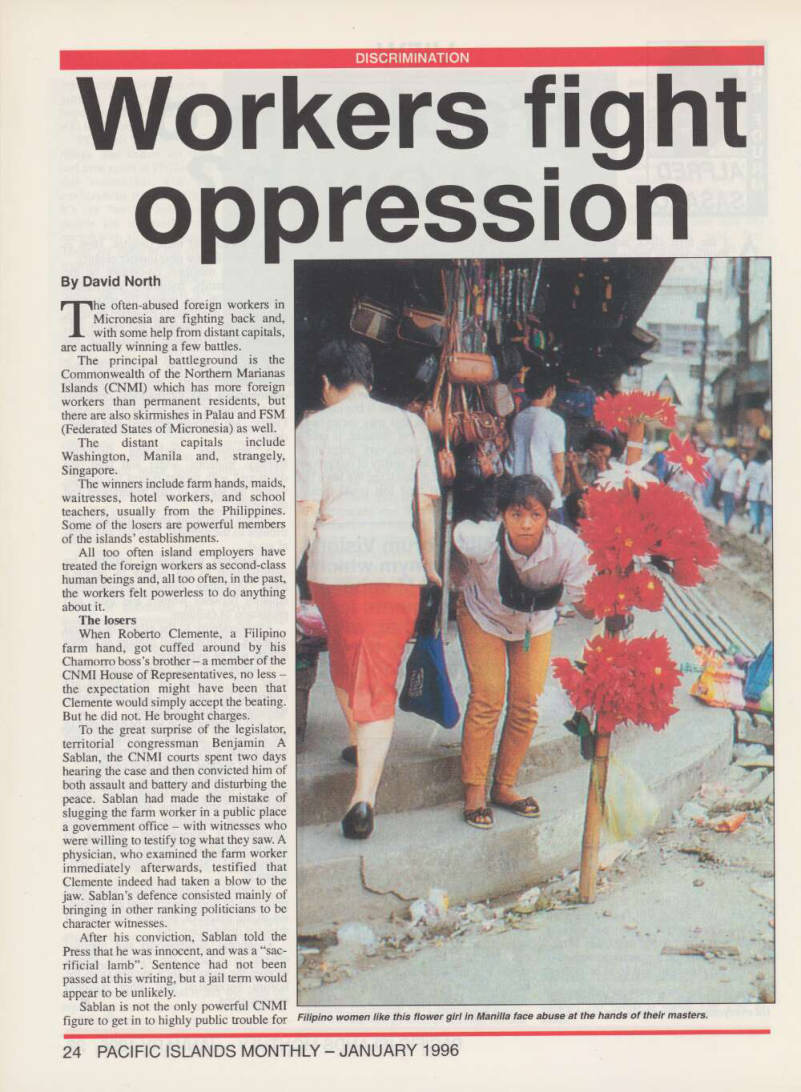
Filipino women like this flower girl in Manilla face abuse at the hands of their masters.
mistreating foreign workers. A partial list of such persons includes: • Mayor Joseph S Inos of Rota, has been charged with rape and assault by sev eral Filipinos, according to the Hawaii Filipino Chronicle but all have fled the island (they say out of fear for their lives) and no trial is expected. • Former CNMI immigration official Santiago B Cepeda, brother of the head of CNMI’s Customs Enforcement, has been sent to jail for a year for extorting money from three Philippine citizens in return for allowing them to enter CNMI illegally. He also has been ordered to repay the money he took illegally from the foreign workers. • Territorial Congressman Vicente .
Attao, minority leader of the CNMI House of Representatives, has been hauled into US District Court by the US Department of Labour on civil charges of failing to pay security guards in his employ more than
Sus3Oo,Ooo.
• A one-time local police chief, Antonio A. Reyes, faces similar labour standards charges from the same agency, but for twice as much money.
The winners If some of the big guys are in trouble, does it mean that all the foreign workers are now paid adequately and treated fairly?
Hardly, but more and more such workers are having their day in court and, like Sablan’s and Cepeda’s victims, winning their cases. Two more examples: • Nineteen Filipino workers tried to start a union at the luxurious Hafadai Beach Hotel on Saipan; they were fired.
The workers went to the (federal) National Labour Relations Board (NLRB) which in turn secured a court order telling the hotel to hire them back. US District Court Judge Alex Munson dismissed the hotel’s (frankly remarkable) argument that the NLRB had sway only over resident work ers, not non-resident ones. • A little further up the economic scale is the case of the underpaid Filipino school teachers. Years back, under the Bush Administration, the US Department of Justice sued the CNMI schools on the grounds that they were paying the Filipino teachers less than Caucasian and Chamorro ones. Under the pressure of the suit the schools agreed to pay the aggriev ed teachers $U52,250,000 in back pay. An initial payment was made, and then the schools dragged their feet. Recently, the US District Court ordered the schools to pay in full.
The issues While many of the items cited above deal with wages and salaries, other and perhaps more important issues are also at stake, such as race and citizenship. In fact, to a Mainlander the situation in Saipan now sounds very much like the situation in the Old American South 30 years ago.
In those days the Whites had all the
economic and political power, and the Blacks had virtually none. Until the civil rights laws of the 1960 s the Blacks’ pos session of citizenship was useless because few of them, in fact, were permitted to vote.
In Saipan, if anything, it is worse. The apparently oppressed population (the for eign workers) are barred by law from even applying for CNMI citizenship and they face a language barrier if they seek to assert their rights - while the American Blacks at least grew up speaking the English language, and could assert their citizenship rights if they moved out of the region.
Given this imbalance in power in CNMI, and apparently no strong local tra dition of treating strangers as equals, the foreign workers (as these court decisions suggest) have trouble getting equitable treatment. In the worst case scenarios, which keep getting into the local media, there are cases of forced prostitution, of rape, of being locked up after work hours, of living behind barbed wire fences, and of working (according to one security guard) a 36-hour shift. These are not just squab bles about wages.
What forces are at play?
One reason why the victims win some times is because conditions are so grim that once a case reaches anything like a fair tri bunal no other verdict is possible. But there are other forces at work - some of which are at play elsewhere in the insular Pacific, and some of which are pertinent only in CNMI. The list, an odd one, includes: • The hanging of a Filipino maid in
Singapore;
• The remarkable change in the posture of the Philippines Government, spurred in part by the hanging, regarding its overseas workers; • the role of CNMI’s tempestuous but often reform-minded governor, Froilan Tenorio (D). • the quiet but generally progressive posture of the Clinton Administration; • the staunch, continuing work of the US. court system; and • the assertive day-to-day coverage of all this by the highly competitive Press in the Marianas.
Singapore has just about the most vin dictive view of crime and punishment this side of the Sudan (where they whack off the hands of thieves). It was Singapore that caned an American teenager for vandalis ing some cars (he certainly had some pun ishment coming to him, but Singapore spun it out, apparently to make its point to the world.) Similarly, Singapore did not take it lightly when an uppity Filipino maid killed her employer in what might have been judged a case of manslaughter, not murder, in another jurisdiction. They hanged her.
When this hit the Manila Press, coupled as it was by many, many stories about the abuse of Filipino maids throughout the Gulf States (rapes, imprisonment by employers, non-payment of wages, etc), the government was pressed to do some thing, or more precisely, “to do something to protect our women overseas”.
It was in this setting that Manila started paying attention to the stories of physical and economic abuse coming out of CNMI.
And Manila acted; the government has stopped the departure of Filipinos as guest
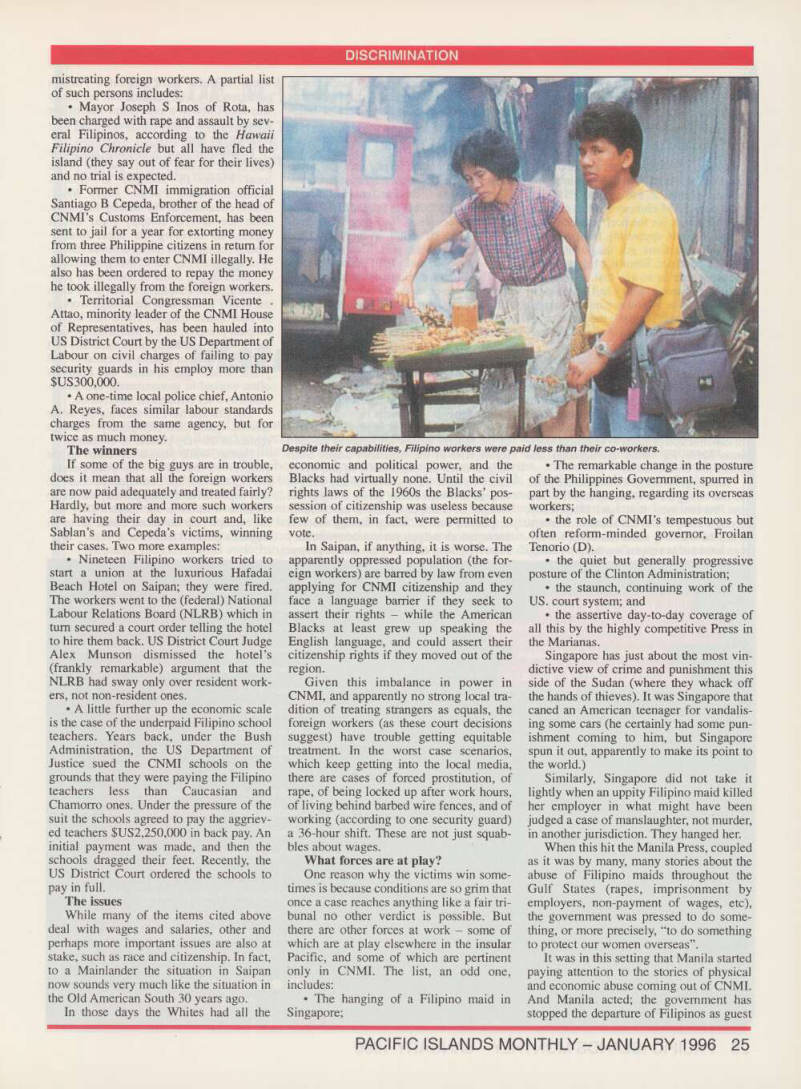
Despite their capabilities, Filipino workers were paid less than their co-workers.
workers (but not the men) to CNMI unless they hold a professional position (such as teacher or nurse.) For similar reasons, Manila has banned the movement of Filipino maids to Palau and there are stories in the Press that it is threatening FSM over its treatment of con struction workers. The Philippines has another weapon to use against FSM - it could deny FSM citizens visas to come to the Philippines for medical treatment; this weapon has not, apparently, been used yet.
Manila’s actions got the attention of CNMI’s governor, Tenorio, a reformer who told me a year or so ago that the scandal plagued garment industry had better clean up its act, or he would not mind seeing it leave the islands. Tenorio’s predecessor, on the other hand, was a solid ally of the gar ment industry, despite its bad Press.
Tenorio has played an interesting role.
He wants, desperately, to keep the island’s power over immigration (something that Guam, for example, lacks). In an effort to do so he made a deal with Washington to divert federal funds coming to the islands for construction projects to technical assis tance funds for better immigration and labour law enforcement.
Yet the governor is a complicated man.
He has struggled to clean up an often cor rupt bureaucracy that has, historically, turned a blind eye to the abuse of workers.
While he wants to make life better for for eign workers he resents anything - such as
the Republic of Philippines’ decision on non-professional workers - that he regards as an interference in his sphere of influ ence.
Meanwhile, the Clinton administration is paying attention to the subject at the assistant secretary level, and has taken steps to help Tenorio’s reformist positions.
There are now (thanks to Tenorio’s offer to recycle federal funds to law enforcement in CNMI) a couple of full-time wage-hour investigators on island, as there had been only visitors in the past. That’s progress. (And I suppose that’s faint praise as well.) The Clinton administration has nothing to do, however, with the behaviour of the US District Court in Saipan. In the United States judges sit for life and, Afex Munson, the local judge, was not appointed to his job by the Clintons. (Lifetime judgeships tend to free American judges of political considerations and worries about re appointment - in contrast, the Republic of the Marshalls, for example, appoints its judges for two-year terms.) In a sense, Munson is playing the role of the federal judges who upheld the civil rights laws in the American South. Such judges, often uncomfortably, sit and weigh cases on their merits, without any built-in bias as to which ethnic group is right, and without an undue deference to the econom ic powers that be. When foreign workers come before judges, such as Munson, they have a fighting chance. They do not always
win - Munson ruled against a Filipino nurse recently who claimed that her salary was set SUS6OOO a year below that of her Caucasian and Chamorro peers - but they do get to be heard.
Perhaps the most potentially replicable part of the Saipan story is the role of the local Press. In addition to Guam’s Mainland-owned Pacific Daily News, which circulates in the nearby Marianas, there are several scrappy local CNMI papers, all covering the latest foreign worker scandal, and none censored (direct ly or indirectly) by the CNMI government.
Interestingly, some of these local jour nalists are also Filipinos, which gives them the ability to talk with the foreign workers in their native tongue. There has been a Filipino presence in the Marianas for cen turies - after all, the Spanish ruled this part of the world from Manila for close to 300 years. Under the Spanish the Filipinos often worked in goyemmental and small business roles throughout Micronesia.
The Chinese have no such history in the islands, and their temporary workers remain at the very bottom of the ladder.
Further, while Manila has taken up the cudgels on behalf of its own people, Beijing has not; one consequence could be that exploitative employers may switch to Chinese workers in the future. They are, for example, the dominant ethnic group in Saipan’s garment factories. ■