Govt bails out national Bank
pp. 6-8 · Read in the full issue
Economy
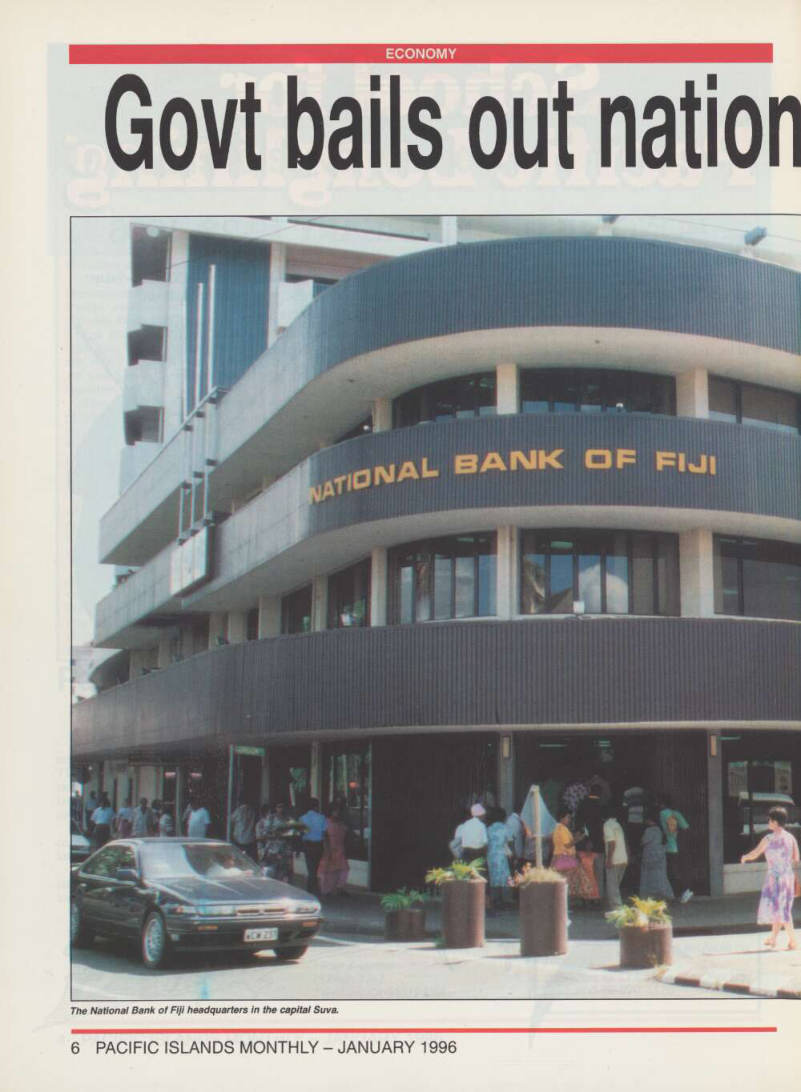
The National Bank of Fiji headquarters in the capital Suva.
It was Fiji’s ugliest budget session since before the coups. The collapse of the National Bank of Fiji and the ensuing financial obligation of the government to recapitalise the technically bankrupt bank by injecting SUSIS million sent shock waves through a public that had endured two weeks of Press revelations about the seedy finances and operations of what is touted as “Fiji’s Own Bank”. It was only when the politicians made it clear that, having supervised, and in some cases benefited from the present situation at the NBF, they were now asking the Fiji taxpayer to pay the bill, that the public finally got the message. To add insult to injury the information minister, Etuate Tavai, threatened to muzzle the Press in Fiji for daring to demand a public inquiry into the affairs of the NBF. The analogy that was so frequently heard in Suva was that the NBF saga was like the thief who robs your house, asks you to pay the bill for dinner and then gags you when you complain.
The vote to approve die budget was in doubt when, early in the session. Labour Party leader Mahendra Chaudhry threatened to invoke standing orders of parliament which would forbid members from voting on a bill in which they had a direct financial interest. Since the leaking of the secret Aidney-Dickson report into the NBF and the publishing of the names of those who have doubtful debts with the bank, at
least eight MP’s on both sides of the house would have been unable to vote. However, given that most were from the government side and with the ruling Soqosoqo ni Vakavulewa ni Taukei (SVT)/General Voters Party coalition in disarray it appeared as though it would be a very close call. When Chaudhry did ask for the votes of parliamentarians with NBF debts to be nullified, the speaker dismissed his motion.
With a majority of 36-30, the 1996 bud get was passed by parliament.
The NBF affair, which has dominated news and politics in Fiji throughout most of the second half of 1995, is now widely recognised as a watershed in Fiji’s history, Painful comparisons with other countries are frequently made. It is said that in Fiji when the nation’s bank loses SUSI 42 mil lion in loans the matter is swept under the carpet and dealt with by a secret inquiry with those responsible being shunted off into a sedate and pleasant retirement.
However, a banking disaster that costs 10 per cent of the nation’s Gross Domestic Product (GDP) does not disappear easily. It is not only a financial loss but a moral loss to Fiji. The government had allowed peo pie to obtain millions in loans that had not been backed by adequate securities and assets which ultimately lead to the collapse the government’s commercial bank, In other countries when such an affair
occurs the normal practice is that at the very least the minister responsible offers his resignation to parliament and very often if the central bank is seen to be neg ligent then the governor also offers his res ignation. In Fiji neither Paul Manueli, the home affairs minister who was, in one capacity or another responsible for the NBF throughout much of the post-coup era, nor the governor of the Reserve Bank of Fiji, Jone Kubuabola, have offered the government their resignation. The almost certain outcome of the secret Reserve Bank inquiry will be no prosecution and no reac tion.
The most dangerous comparison that has been made in Fiji is that the political situation is now beginning to resemble Papua New Guinea in the early 1980 s when there was one government inquiry into malpractice after another and no one in high office was ever prosecuted. This perceived failure of the justice system to prosecute those in power is seen as an important part in the equation that lead to the complete collapse of law and order in PNG. There is a widespread perception in PNG, and now in Fiji, that if those in power can act with impunity from the law then it should be possible for anyone to do so.
Deficit blow-out However, the whole NBF affair has overshadowed some of the other changes that occurred in the budget. One of the most unpleasant elements of the budget is that the government is once again on a path of high deficit spending. After the high deficits following Cyclone Kina in 1993 (four per cent of GDP) the government reined in deficit spending in 1994 to three per cent but 1996 deficit spending is pro jected to be in the vicinity of 3.6 per cent of GDP. Given the government’s past per formance of under estimating the magni tude of the deficit in its projection, it is likely that the 1996 deficit will surpass the four per cent mark. The Finance Minister, Berenado Vunibobo, in his budget address said that the deficit was only 2.8 per cent of GDP if one removed the “exceptional” cost of bailing out the NBF. With government ministers refusing to assure parliament of the financial soundness of the govern ment’s other financial arm, the Fiji Development Bank, the feeling was that the cost of bailing out the NBF was not exceptional and may well become business as usual in Fiji. In total, the government debt as a percentage of GDP will climb to 44 per cent by 1996. However, with low economic growth (2.2 per cent in 1995 and a forecast 2.9 per cent in 1996), rising unemployment and no obvious prospects for improvement, the Fiji economy seems headed for serious trouble.
The budget was also a watershed in other ways. In part because of the need of the government to raise revenue but large
ly because of the continual pressure that the department of trade has been receiving government finally caved in to the unre lenting demands of the Fiji Manufacturers Association and raised import duties on canned fish (from 20 per cent to 30 per cent), on corned beef (10 per cent to 17.5 per cent), on flour and sharps (20 per cent to 22.5 per cent) and cosmetics (10 per cent to 15 per cent). These were protective mea sures and the government made it perfect ly clear that there would be no further decreases in the general rate of import duty from the current rate of 22.5 per cent until such time as other parts of its liberalisation policy proceeded. Given the snail’s pace of reform the manufacturers have little to fear.
What the about-face means is that despite its rhetoric about trade liberalisa tion the government is willing now to take
a more protective pro-business approach.
The changes have pleased some manufac turers in Fiji but some of the manufacturers would have liked even higher rates of duty.
Currency panic?
There is a widespread perception in PNG, and now in Fiji, that if those in power can act
with impunity
from the law then it should be
possible for
anyone to do so.
Meanwhile, the government announced further liberalisation of the country’s for eign exchange dealings. It will become easier for investors to remit foreign exchange. It will also be easier for those emigrating as well as importers to receive foreign exchange. While the liberalisation is generally applauded there is the well recognised danger that the Fiji dollar is over-valued by at least 10 per cent. The World bank and the recent AusAid report by John Fallon recognised as much and both in effect recommended a devaluation of the currency. The governments and the Reserve Bank of Fiji which has been strongly influenced by IMF thinking on this question has firmly resisted any talk of devaluation of the currency. “Stability of
the currency at all costs, and international export competitiveness be dammed” has been the government’s and the IMF’s posi tion in Fiji since the 33 per cent devalua tion of 1987.
The problem with the government’s position is that the business community is not at all convinced that there can be no devaluation, especially when everyone is advising the government to devalue. In 1994 there was a massive speculative cap ital outflow of $U549.7 million in the space of a week or two when the business community sensed an imminent devalua tion. What the government is doing is maintaining an overvalued currency while
simultaneously liberalising foreign
exchange rules in the country. At some point there will be another speculative run against the Fiji dollar and given the liberal foreign exchange rules, it could easily result in the forced floatation of the curren cy as occurred in PNG in 1994 and in New Zealand in the 1980 s. Thus, perhaps inad vertently, the government is sowing the seeds for the floatation of the Fiji dollar as a fully convertible currency. However, what will happen is that by overvaluing the currency the government will create a float from a panic rather than a reasoned policy decision.
Namosi-Placer gets it all Perhaps the most bizarre announcement to come from the budget debate was that made by the Finance Minister that he had finally come to an agreement with Placer Pacific over the proposed tax regime at the huge SUS 1.2-billion Namosi copper and gold mine which is located just 35km from that capital Suva. However, the minister did not announce the terms of the agree ment. In other words, one seasoned observ er said the reason was “because the prover bial... would hit the fan once the public realised what Fiji would get from this mine”.
The joy of indicating to the Fiji public what they were going to get from Placer was left to Trade Minister Jim Ah Koy and while he would not state the exact nature of the tax concessions, he did announce that the tax concessions would be “more gener ous than those offered to tax-free facto ries”. The tax-free factories pay no Value Added Tax, import duty and have a tax hol iday of 13 years. There is a long-standing precedent in Fiji of offering mining com panies outrageously generous terms.
Emperor Mines Limited, in 1983 “negoti ated” a 21-year tax holiday for its gold mines at Vatukoula and it is now widely understood that Fiji will get almost nothing in direct tax revenue from the giant Namosi mine.
It is a sign of the government’s desper ation for investment that is willing to grant what it is in effect tax-free status to a huge copper mine in order to create what is esti mated to be 2,000 jobs. ■