Herald 1852-1861”
p. 58 · Read in the full issue
Books
“The Voyage of HMS Herald 1852-1861”
Reviewed by Derek Parker In the middle of the last century, the islands of the Pacific were both unknown and alluring to most Europeans. The decade-long exploration voyage of HMS Herald under the com-
mand of Captain Henry Mangles Denham
was meant to fill in the blank spaces on the maps, as well as identify opportunities for further colonisation and economic development. Until now, this historical, remarkable voyage has been largely forgotten.
The Voyage of HMS Herald 1852-1861 (Miegunyah Press, $A 69.95) provides a comprehensive account of the ship’s long, complex journey. Author Andrew David, a retired naval officer, formerly worked in the Hydrographic Office of Britain’s Ministry of Defence, and had access to a wide range of original documents and reports. This gives the book an astonishing depth of detail, both in the official work of the expedition and the character of the men involved.
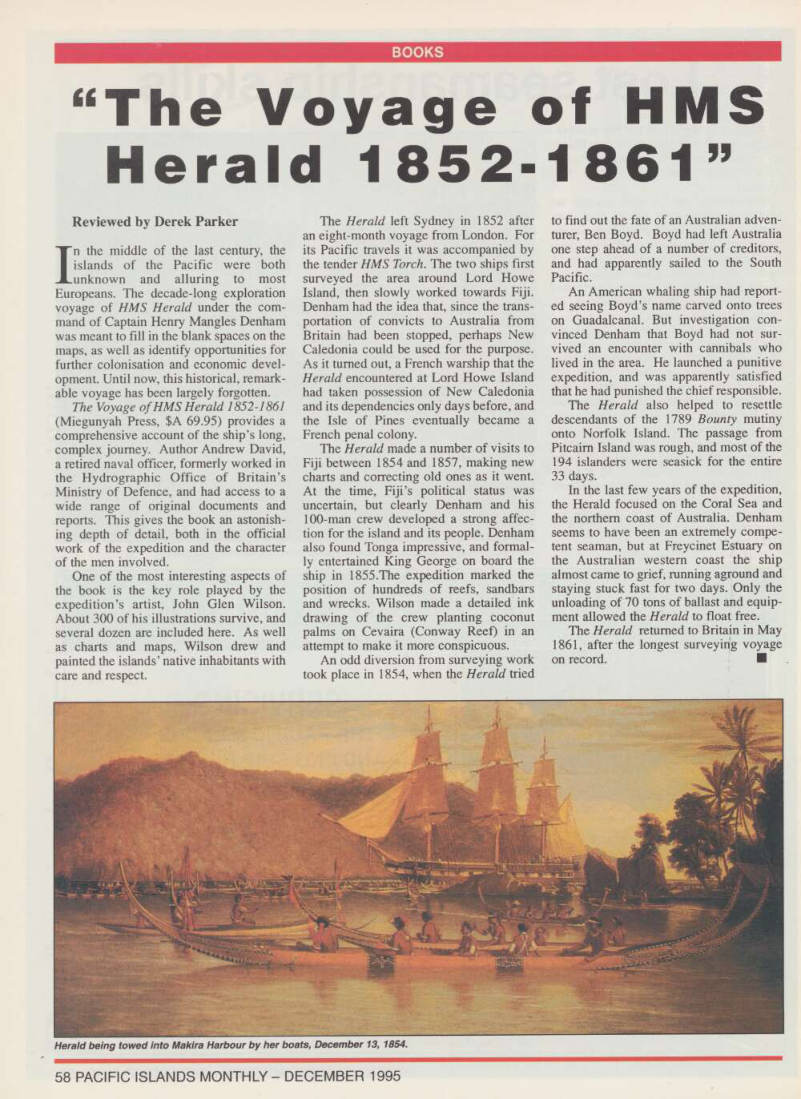
One of the most interesting aspects of the book is the key role played by the expedition’s artist, John Glen Wilson, About 300 of his illustrations survive, and several dozen are included here. As well as charts and maps, Wilson drew and painted the islands’ native inhabitants with care and respect.
The Herald left Sydney in 1852 after an eight-month voyage from London. For its Pacific travels it was accompanied by the tender HMS Torch. The two ships first surveyed the area around Lord Howe Island, then slowly worked towards Fiji.
Denham had the idea that, since the transportation of convicts to Australia from Britain had been stopped, perhaps New Caledonia could be used for the purpose, As it turned out, a French warship that the Herald encountered at Lord Howe Island had taken possession of New Caledonia and its dependencies only days before, and the Isle of Pines eventually became a French penal colony.
The Herald made a number of visits to Fiji between 1854 and 1857, making new charts and correcting old ones as it went.
At the time, Fiji’s political status was uncertain, but clearly Denham and his 100-man crew developed a strong affection for the island and its people. Denham also found Tonga impressive, and formally entertained King George on board the ship in 1855. The expedition marked the position of hundreds of reefs, sandbars and wrecks. Wilson made a detailed ink drawing of the crew planting coconut palms on Cevaira (Conway Reef) in an attempt to make it more conspicuous.
An odd diversion from surveying work took place in 1854, when the Herald tried
to find out the fate of an Australian adven turer, Ben Boyd. Boyd had left Australia one step ahead of a number of creditors, and had apparently sailed to the South Pacific.
An American whaling ship had report ed seeing Boyd’s name carved onto trees on Guadalcanal. But investigation con vinced Denham that Boyd had not sur vived an encounter with cannibals who lived in the area. He launched a punitive expedition, and was apparently satisfied that he had punished the chief responsible.
The Herald also helped to resettle descendants of the 1789 Bounty mutiny onto Norfolk Island. The passage from Pitcairn Island was rough, and most of the 194 islanders were seasick for the entire 33 days.
In the last few years of the expedition, the Herald focused on the Coral Sea and the northern coast of Australia. Denham seems to have been an extremely compe tent seaman, but at Freycinet Estuary on the Australian western coast the ship almost came to grief, running aground and staying stuck fast for two days. Only the unloading of 70 tons of ballast and equip ment allowed the Herald to float free.
The Herald returned to Britain in May 1861, after the longest surveying voyage on record. ■
Herald being towed into Makira Harbour by her boats, December 13, 1854.