Dance with a dugong
pp. 50-51 · Read in the full issue
Yachting
By Sally Andrew
Duane Yates and Henriette
Schlupmann departed Sydney,
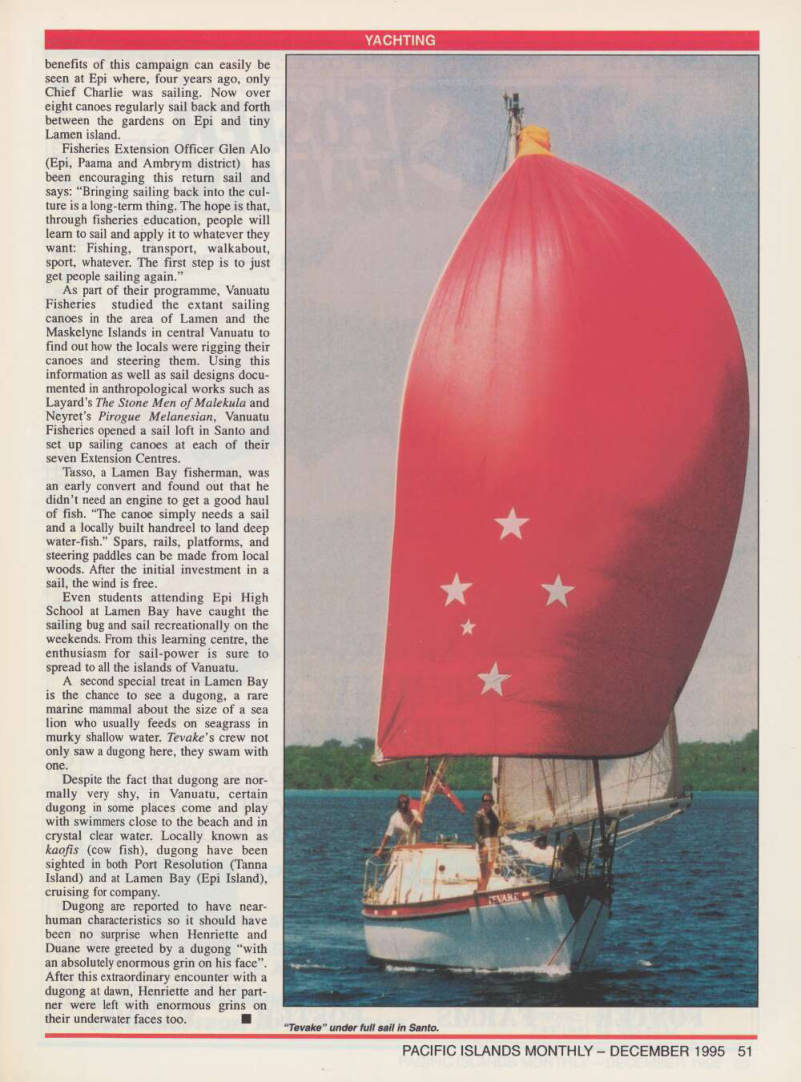
Australia, in 1994, headed for the South Pacific and new adventures. Their boat, Tevake, a 31-foot steel double ender, is named for the Pacific tropic-bird and also for the great Polynesian naviga tor from the Santa Cruz Reef Islands who used the stars, swells and other natural phenomena for his orientation on the sea.
Before his death in 1970, navigator Tevake shared his knowledge of tradi tional Polynesian techniques of ocean voyaging as described by Dr David Lewis in his recently republished book.
We, The Navigators. Although Tevake’s owner, Duane Yates, appreciates the sophistication and validity of ancient voyaging methods, he, like most modern day cruisers, navigates with all the latest mod-cons and equipment, including the
Global Positioning System.
Duane and his partner, Henriette, share a passion for the undersea and
underwater photography. After stopping
at Lord Howe and New Caledonia, Tevake arrived in northern Vanuatu, home
to the best wreck diving in the South Pacific. Henritte describes the hassles and the rewards of scuba diving: “Never mind the tedious filling of the tanks with the slow air-compressor, the time con suming assembly of the underwater cam eras and moody strobes far too early in the morning. (In Santo) we went as far as hitch-hiking attired in full scuba gear, tanks on our backs, fins and underwater cameras in hand, to reach the President Coolidge wreck in Luganville Channel.
“But at the end of this funny pilgrim age, we descended into an underwater dreamscape where the old liner’s carcass served as a house in which individual fish had their own territory. Boris, a wrasse as big as a sea-lion, was waiting for us at the bow hoping for some gift of fish; a spe cial lion-fish had taken residence in the
captain’s bathroom; a huge porcupine
fish usually fed at the entrance of the promenade deck; a large moray eel had found a home under a shark cage; an old angel fish and two red spotted rock-cods hovered in the cannon on the bow.
“Under the bow, in the strong current, I found an old sea-pen with which Poseidon could have written it all.”
After diving on the President Coolidge in Santo, Tevake. headed for Port Vila, stopping at Lamen Bay, on Epi Island. This is a popular protected anchorage and a convenient stopping spot for both northbound and southbound yachts cruising in Vanuatu. The black
sandy bottom provides good holding.
What makes Lamen Bay so special, though, is the sight of traditional sailing canoes, seldom seen in the Pacific these days. Every morning. Chief Charlie’s lime-green sail appears on the horizon as he and his family begin their daily com mute from tiny Lamen Island to their mainland gardens. And at the end of the day, their canoes loaded down with kakae (food), he and his neighbours sail back some hoist canvas sails, others use improvised ‘biodegradable sails’ made of propped-up palm fronds which work just fine for this downwind leg back home!
Unconventional perhaps, but effective.
During the past few years, Vanuatu Fisheries’ Senior Executive Officer, Francis Hickey, and other staff have been travelling to the outer islands proselytis ing the benefits of sailing by helping local guys rig their canoes with sails. The
benefits of this campaign can easily be seen at Epi where, four years ago, only Chief Charlie was sailing. Now over eight canoes regularly sail back and forth between the gardens on Epi and tiny Lamen island.
Fisheries Extension Officer Glen Alo (Epi, Paama and Ambrym district) has been encouraging this return sail and says: “Bringing sailing back into the cul ture is a long-term thing. The hope is that, through fisheries education, people will leam to sail and apply it to whatever they want; Fishing, transport, walkabout, sport, whatever. The first step is to just get people sailing again.”
As part of their programme, Vanuatu Fisheries studied the extant sailing canoes in the area of Lamen and the Maskelyne Islands in central Vanuatu to find out how the locals were rigging their canoes and steering them. Using this information as well as sail designs docu mented in anthropological works such as Layard’s The Stone Men of Malekula and Neyrefs Pirogue Melanesian, Vanuatu Fisheries opened a sail loft in Santo and set up sailing canoes at each of their seven Extension Centres.
Tasso, a Lamen Bay fisherman, was an early convert and found out that he didn’t need an engine to get a good haul of fish. “The canoe simply needs a sail and a locally built handreel to land deep water-fish.” Spars, rails, platforms, and steering paddles can be made from local woods. After the initial investment in a sail, the wind is free.
Even students attending Epi High School at Lamen Bay have caught the sailing bug and sail recreationally on the weekends. From this learning centre, the enthusiasm for sail-power is sure to spread to all the islands of Vanuatu.
A second special treat in Lamen Bay is the chance to see a dugong, a rare marine mammal about the size of a sea lion who usually feeds on seagrass in murky shallow water. Tevake’s crew not only saw a dugong here, they swam with one.
Despite the fact that dugong are nor mally very shy, in Vanuatu, certain dugong in some places come and play with swimmers close to the beach and in crystal clear water. Locally known as kaofis (cow fish), dugong have been sighted in both Port Resolution (Tanna Island) and at Lamen Bay (Epi Island), cruising for company.
Dugong are reported to have near human characteristics so it should have been no surprise when Henriette and Duane were greeted by a dugong “with an absolutely enormous grin on his face”.
After this extraordinary encounter with a dugong at dawn, Henriette and her part ner were left with enormous grins on their underwater faces too. ■
“Tevake” under full sail in Santo.