a double-edged sword
pp. 45-46 · Read in the full issue
Sports
Kiwi rugby fame is a double-edged sword
By Atama Raganivatu
The fact that four of the five players nominated for the 1995 season’s two top individual awards were Pacific Islanders gives a fair indication of how influential Tongans, Western Samoans and Fijians have become in New Zealand
rugby union.
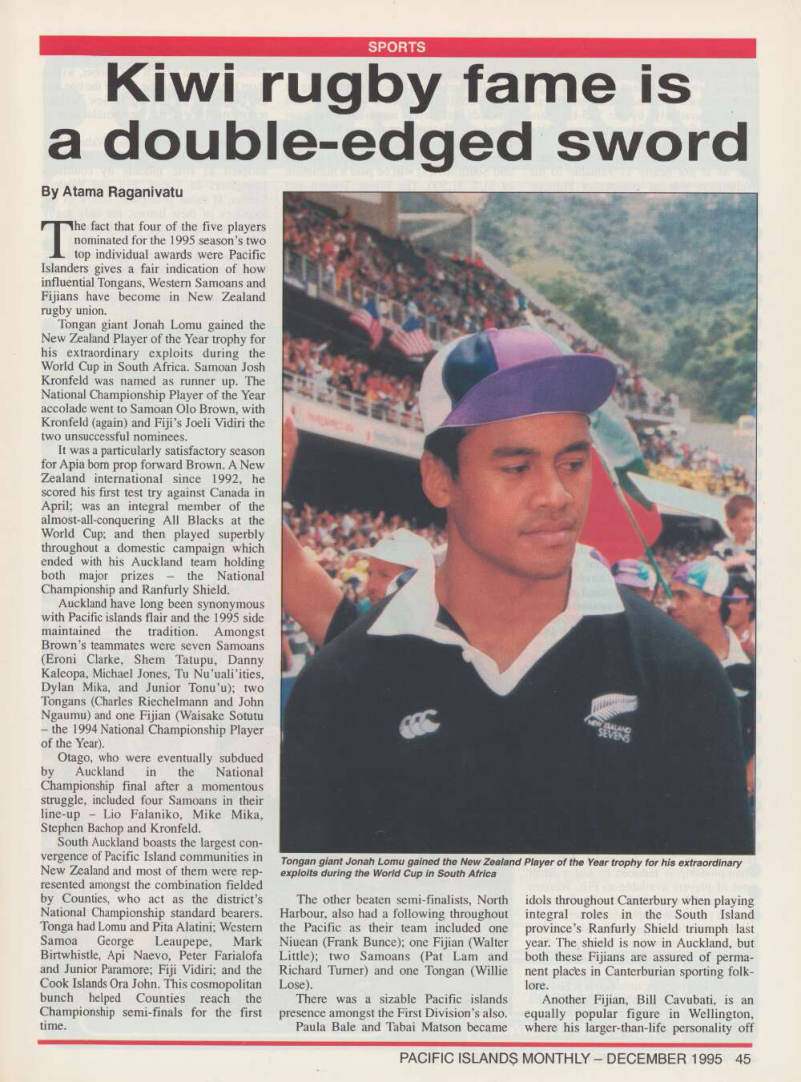
Tongan giant Jonah Lomu gained the New Zealand Player of the Year trophy for his extraordinary exploits during the World Cup in South Africa. Samoan Josh Kronfeld was named as runner up. The National Championship Player of the Year accolade went to Samoan 010 Brown, with Kronfeld (again) and Fiji’s Joeli Vidiri the two unsuccessful nominees.
It was a particularly satisfactory season for Apia bom prop forward Brown. A New Zealand international since 1992, he scored his first test try against Canada in April; was an integral member of the almost-all-conquering All Blacks at the World Cup; and then played superbly throughout a domestic campaign which ended with his Auckland team holding both major prizes - the National
Championship and Ranfurly Shield.
Auckland have long been synonymous with Pacific islands flair and the 1995 side maintained the tradition. Amongst Brown’s teammates were seven Samoans (Eroni Clarke, Shem Tatupu, Danny Kaleopa, Michael Jones, Tu Nu’uali’ities, Dylan Mika, and Junior Tonu’u); two Tongans (Charles Riechelmann and John Ngaumu) and one Fijian (Waisake Sotutu - the 1994 National Championship Player of the Year).
Otago, who were eventually subdued by Auckland in the National Championship final after a momentous struggle, included four Samoans in their line-up - Lio Falaniko, Mike Mika,
Stephen Bachop and Kronfeld.
South Auckland boasts the largest con vergence of Pacific Island communities in New Zealand and most of them were rep resented amongst the combination fielded by Counties, who act as the district’s National Championship standard bearers.
Tonga had Lomu and Pita Alatini; Western
Samoa George Leaupepe, Mark
Birtwhistle, Api Naevo, Peter Farialofa and Junior Paramore; Fiji Vidiri; and the Cook Islands Ora John. This cosmopolitan bunch helped Counties reach the Championship semi-finals for the first time.
The other beaten semi-finalists. North Harbour, also had a following throughout the Pacific as their team included one Niuean (Frank Bunce); one Fijian (Walter Little); two Samoans (Pat Lam and Richard Turner) and one Tongan (Willie Lose).
There was a sizable Pacific islands presence amongst the First Division’s also.
Paula Bale and Tabai Matson became
idols throughout Canterbury when playing integral roles in the South Island province’s Ranfurly Shield triumph last year. The shield is now in Auckland, but both these Fijians are assured of perma nent placbs in Canterburian sporting folk lore.
Another Fijian, Bill Cavubati, is an equally popular figure in Wellington, where his larger-than-life personality off
Tongan giant Jonah Lomu gained the New Zealand Player of the Year trophy for his extraordinary exploits during the World Cup in South Africa
the field and bulldozing style on it have elevated him to cult hero status. Amongst the teammates overshadowed (both literal
ly and figuratively) by the 135-kilogram
prop were Samoans Alama leremia, Alex Talea, Tana Umaga and Filo Tiatia.
Although Cavubati enjoys a high pro
file, he is not nearly as valuable to his
Wellington side as compatriot Philippe
Rayasi is to King Country. Rayasi has been instrumental in maintaining King Country - a small, rural province with limited resources - as the First Division’s unlikeli est member. The winger’s last ditch tackles and exhilarating tries at vital times have meant the difference between survival and relegation in both 1994 and 1995. His countrymen Jo Vaitayaki and Laurence Little also played sterling parts in keeping K C afloat.
Western Samoa’s world-class centre To’o Vaega was the stand out performer for Southland, who suffered demotion thanks to King Country’s latest Houdini act. In fact, Vaega was too good - often being stranded with the ball upfield and without support because of teammates’ inability to read his sophisticated play.
Jones, Brown, Kronfeld, leremia, Lomu, Bunce and Walter Little all gained selection for the All Blacks party which, at the time of writing, is just about to com mence a tour of Italy and France. Tonu’u had to withdraw from the squad through injury, Sotutu is on “standby” should any of the tourists be forced into returning home and Vidiri would have been a reserve had he not been rendered ineligible by his appearance for Fiji against Canada early this year (a fact the New Zealand Rugby Football Union overlooked when naming their original selection).
These 10; four of whom were intro-, duced to international rugby by Manu Samoa, are now all committed to the Kiwis. So too are approximately half of the other players previously mentioned in this article. They have rejected opportuni ties to represent their home countries in order to remain eligible for possible All Black selection and the huge monetary advantages this brings (even though some, like Vidiri and Dylan Mika, won’t qualify until 1998 under current International Rugby Board regulations). Thus, the large reservoir of honed Pacific Island talent featuring in New Zealand’s National Championship is reduced to just a small pool of players available to Fiji, Western Samoa and Tonga. And, the likelihood is that the pool will evaporate further.
Next year’s new professional Southern Hemisphere international structure offers nothing to the Pacific trio. Not only are Tonga, Western Samoa and Fiji excluded from the two major tournaments scheduled but their leading New Zealand and Australian-based players are being dis suaded from representing them by finan
cial considerations.
All Blacks can anticipate receiving at least SUS 160,000 each a year from 1996 onwards and players involved in the inau gural International Provincial
Championship (which features the leading
domestic teams of New Zealand, Australia and South Africa) will be paid a minimum of SUS 41,500. The Fijian, Tongan and Western Samoan unions simply do not have the resources to match these figures.
Another perturbing development is the fact that the players who sign professional contracts with the New Zealand Rugby Football Union can not appear for Tonga, Fiji or Western Samoa during the durations of the I P C and National Championship.
These run from March to October, with a short break between the end of the one and the beginning of the other. New Zealand representatives do not face similar restric tions.
Players like Jonah Lomu, Walter Little and Michael Jones have already been adopted as role models by countless youngsters in Tonga, Fiji and Western Samoa. If those youngsters follow in the footsteps of their heroes, the only rugby glory our region can look forward to is
reflected glory.
There is a distinct danger that Pacific
Island rugby will degenerate into nothing
more than a nursery for the top New Zealand and Australian domestic teams. ■
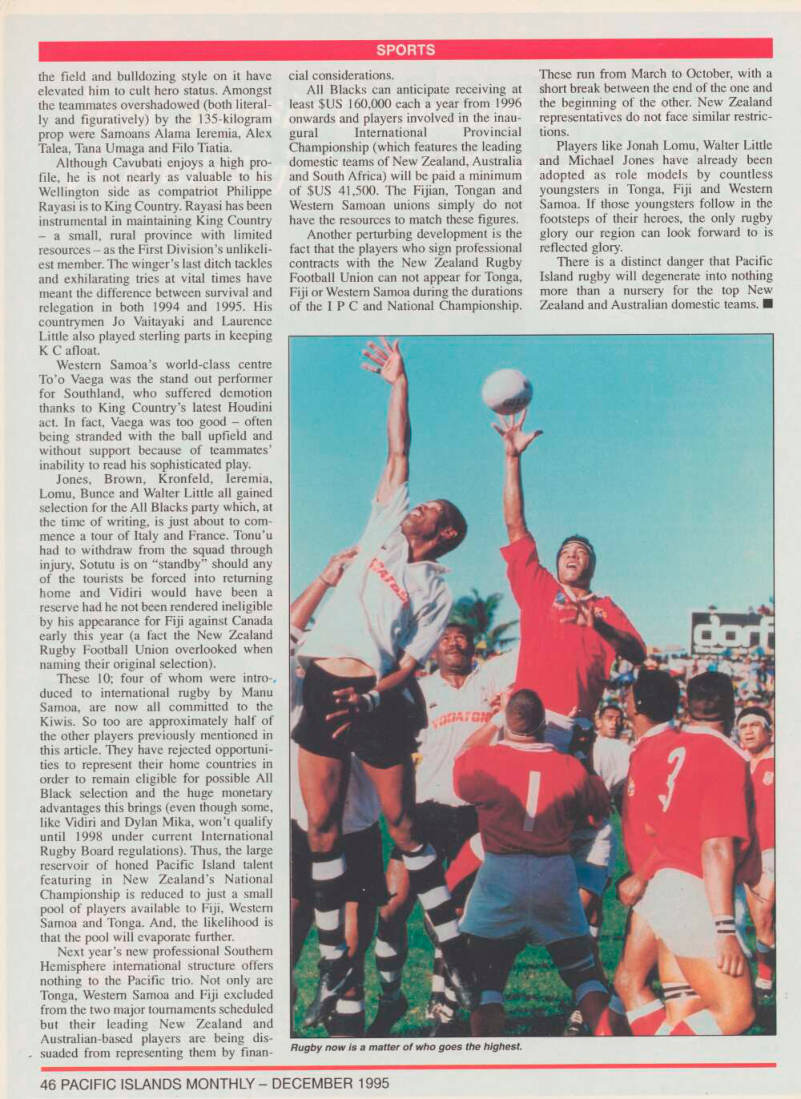
Rugby now is a matter of who goes the highest.