Chirac rewards Carlot
pp. 13-14 · Read in the full issue
The Region
By Patrick Decloitre In Paris
A three-day visit in France last October was the occasion for Vanuatu Prime Minister Maxime Carlot to be rewarded by his “long-time friend”, French President Jacques Chirac for his moderate position on the nuclear tests issue. Just over one month before a general elections, Carlot was decorated with one of the highest French distinctions : Grand Officer in the order of the Legion d’Honneur. The French-speaking island state also received further aid from Paris.
The schedule was particularly tight, but rewarding for the Vanuatu delegation, which met three ministers of the French government (Herve de Charette, Foreign Affairs; Jacques Godfrain, Cooperation; and Jean-Jacques de Perreti, overseas terri tories), Prime minister Alain Juppe and President Jacques Chirac.
The delegation, which was led by the Vanuatu prime minister, also included his deputy, Sethy Regenvanu, his first secre tary Father Gerard Leymang as well as the secretary-general of ruling Union of Moderate Parties (UMP) Petre Malsungai.
Each time during his three-day stay in Paris, Vanuatu’s prime minister stated the island state’s position regarding French nuclear tests, a moderate opposition with a will to maintain political dialogue with Paris, a source in the delegation said. Since the resumption of the tests, the Vanuatu Government has consistently said it want ed to adopt a “more realistic” approach to the issue and discuss with Paris the long term consequences of the tests.
During the talks with French officials, the source added, France indicated its “total acceptation” of Port Vila’s position.
Besides the Vanuatu stand, Carlot also had the mission to convey the Melanesian
Spearhead Group’s position (including
Vanuatu, Papua New Guinea, the Solomon
Islands and New Caledonia’s pro-indepen dence movement FLNKS) which, last August on Malekula island (north Vanuatu), in a so-called “Lakatoro declara tion”, condemned French tests while indi cating their will to maintain the dialogue with Paris. The following month, the South Pacific Forum member countries’ summit in Madang (Papua New Guinea) strongly condemned the tests, voicing their
“extreme outrage”.
The French Government, which wanted to obtain Vanuatu’s view on the issue, said it was “willing to pursue a dialogue with Pacific countries” on the issue. Another indirect reward for Vanuatu came too ; On the same day Carlot met Jacques Chirac, France, Britain and the United States
simultaneously announced their intention to sign the Rarotonga treaty on the South Pacific Nuclear-Free Zone (SPNFZT). The SPNFZT was signed in 1985 by the South Pacific Forum’s 15 member countries. It binds signatories “not to possess” and “to prevent in their territory the testing” of
nuclear-explosive device.
Carlot’s immediate reaction was to say he was “happy to see France intended to
ratify (the treaty)”.
“It would be good if all countries that have made (nuclear) tests in the South Pacific follow France’s example,” Carlot commented after a three-hour meeting with Chirac (...) I think France has com mitted itself, after its tests finish, to be responsible for the effects of the test (...)
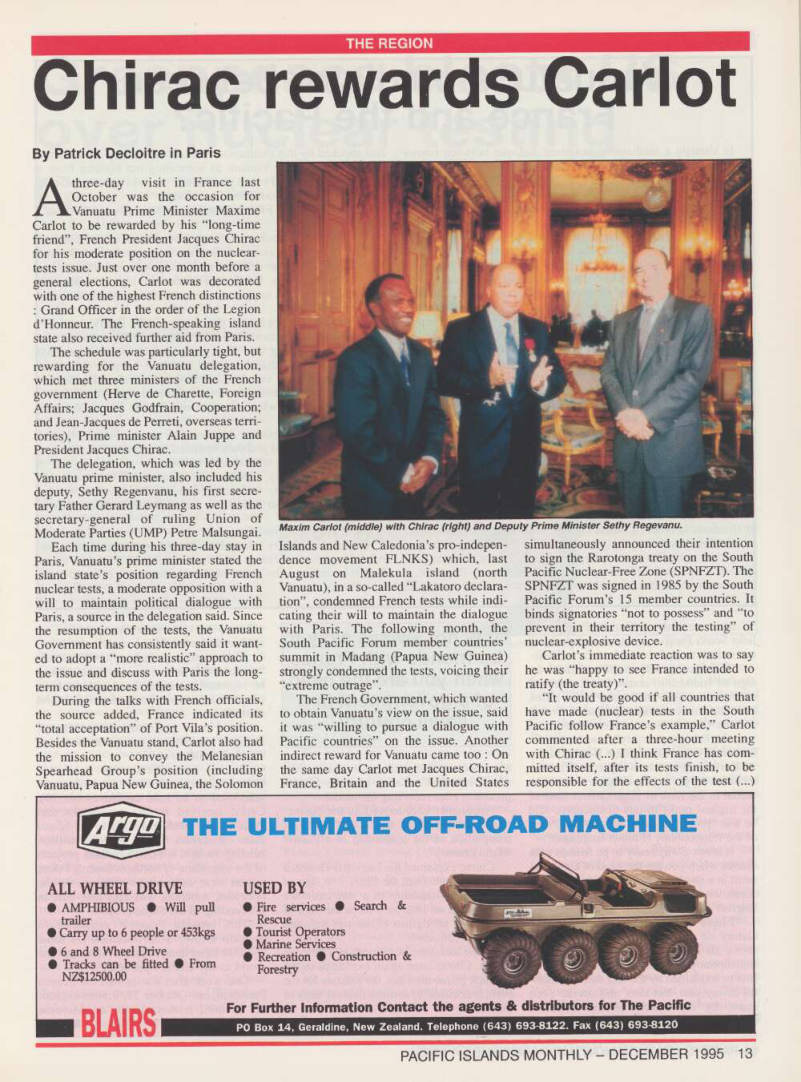
Maxim Carlot (middle) with Chirac (right) and Deputy Prime Minister Sethy Regevanu.
“if there are leaks, pollution, France will help South Pacific countries to help wash out radioactivity,”, he told media in Paris.
“This visit, which was placed under the sign of friendship, comes in a context of easing tensions with South Pacific states, after the announcement by France, Britain and the United States of their intention to sign the Rarotonga treaty”, a source in the French Elysee Palace (State House) said.
Carlot, in a short speech after he received the prestigious Legion d’Honneur medal in the rank of High Officer (one of the highest ranks in this distinction), said he was “proud” to assert himself as a “man of the francophony (French language)”.
“It is not always easy to be friends with France when you are the head of a govern ment in a small country in the middle of an ocean where all independent countries are
English speaking,” Carlot said.
“I have respect and admiration for the history of the Anglo-Saxon world, but above all I am proud to be a man of the
francophony. My friendship for France can
first be explained by the fact that I’m faith ful to my past, but also, and maybe even more, by my conviction that France’s uniqueness must assert itself without shy
“It is not always easy to be friends with France when you are the head of a government in a small country.”
ness, because it contributes to the welfare of all mankind”, Carlot told the French president after receiving his medal.
Apparently very moved by the distinc tion, Carlot said he saw it as “a sign of recognition of the leadership in a Pacific
Island country”.
Chirac explained the Legion d’Honneur was “a gesture from the heart”, “a sign of esteem and friendship to a statesman we respect and we like, as well as the sign of our will to strengthen closer ties between our two countries”.
As he had done last month in a letter to Carlot, Chirac once again explained to the Vanuatu prime minister the reasons for the French decision to resume nuclear tests in the Pacific.
“The Vanuatu prime minister told
(Chirac) he understood his position,” a spokesman in the Elysee said.
Chirac said has was happy of Vanuatu’s “moderation” on the nuclear issue, adding he regretted a similar stand had not been adopted by other South Pacific Island countries.
The French president also confirmed France’s commitment to support the island state’s development.
On his last official visit to France before general elections (which were scheduled to be held on November 30), Carlot received further assurances that Paris would increase its aid to the island state: Requests for a SUS2.4-million funding (within a SUS 16-million project) of the upgrading of northern Santo’s Pekoa airport were welcomed by France. On the occasion, Australia will also take part in the funding of the Santo project.
This brought France’s assistance to Vanuatu to over SUSIO million for some 165,000 inhabitants, Paris’s highest in the world to any country per head.
One week after Carlot met the French President, on October 27, France explod ed its third nuclear bomb on Mururoa Atoll. ■