points to recovery
p. 11 · Read in the full issue
Finance
Kina stabilises and points to recovery
There are signs Papua New Guinea’s
much-maligned economy is finally
turning the comer; indeed, if you are to accept the government’s recent verbal offerings, a bright future is just upon the country.
However, now is perhaps the most cru cial time in the nation’s struggle to throw off the economic shackles of the recent past - the wrong move now could undo a lot of the hard work which has occurred in the past year.
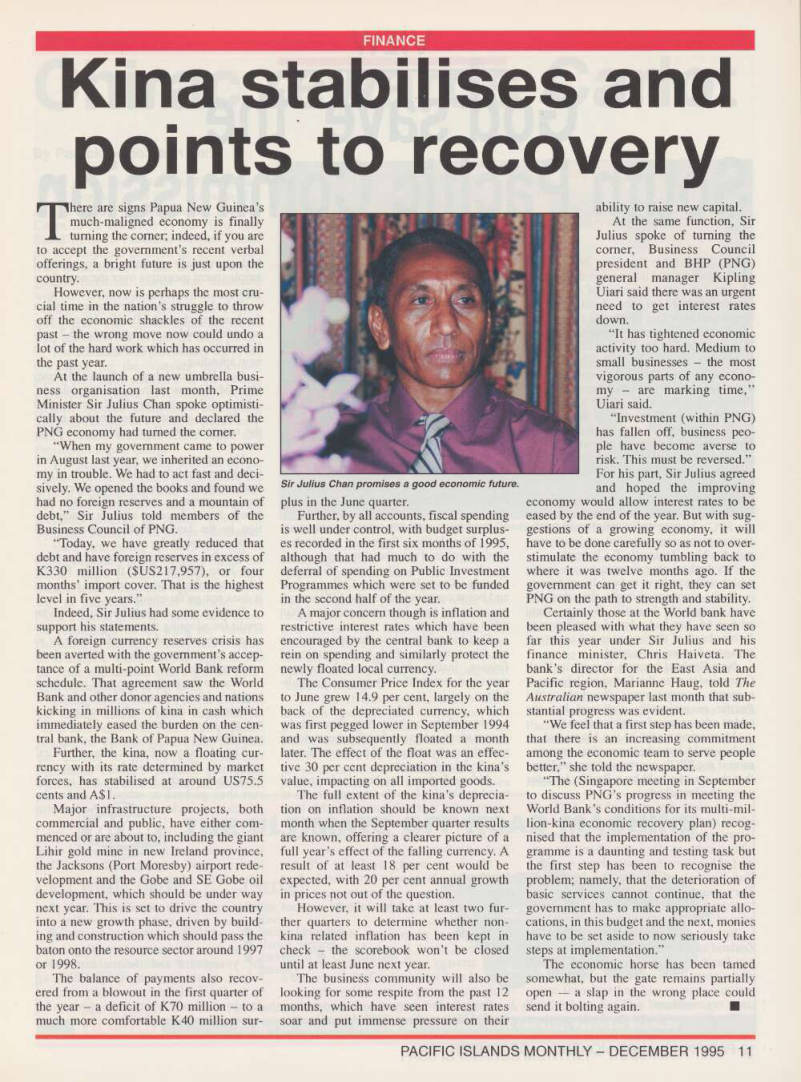
At the launch of a new umbrella busi ness organisation last month. Prime Minister Sir Julius Chan spoke optimisti cally about the future and declared the PNG economy had turned the comer.
“When my government came to power in August last year, we inherited an econo my in trouble. We had to act fast and deci sively. We opened the books and found we had no foreign reserves and a mountain of debt,” Sir Julius told members of the Business Council of PNG.
“Today, we have greatly reduced that debt and have foreign reserves in excess of K 330 million ($U5217,957), or four months’ import cover. That is the highest level in five years.”
Indeed, Sir Julius had some evidence to support his statements.
A foreign currency reserves crisis has been averted with the government’s accep tance of a multi-point World Bank reform schedule. That agreement saw the World Bank and other donor agencies and nations kicking in millions of kina in cash which immediately eased the burden on the cen tral bank, the Bank of Papua New Guinea.
Further, the kina, now a floating cur rency with its rate determined by market forces, has stabilised at around U 575.5 cents and A$ 1.
Major infrastructure projects, both
commercial and public, have either com menced or are about to, including the giant Lihir gold mine in new Ireland province, the Jacksons (Port Moresby) airport rede velopment and the Gobe and SE Gobe oil development, which should be under way next year. This is set to drive the country into a new growth phase, driven by build ing and construction which should pass the baton onto the resource sector around 1997 or 1998.
The balance of payments also recov ered from a blowout in the first quarter of the year - a deficit of K7O million - to a much more comfortable K4O million sur-
plus in the June quarter.
Further, by all accounts, fiscal spending is well under control, with budget surplus es recorded in the first six months of 1995, although that had much to do with the deferral of spending on Public Investment Programmes which were set to be funded in the second half of the year.
A major concern though is inflation and restrictive interest rates which have been encouraged by the central bank to keep a rein on spending and similarly protect the newly floated local currency.
The Consumer Price Index for the year to June grew 14.9 per cent, largely on the back of the depreciated currency, which was first pegged lower in September 1994 and was subsequently floated a month later. The effect of the float was an effec tive 30 per cent depreciation in the kina’s value, impacting on all imported goods.
The full extent of the kina’s deprecia tion on inflation should be known next month when the September quaiter results are known, offering a clearer picture of a full year’s effect of the falling currency. A result of at least 18 per cent would be expected, with 20 per cent annual growth in prices not out of the question.
However, it will take at least two fur ther quarters to determine whether non kina related inflation has been kept in check - the scorebook won’t be closed until at least June next year.
The business community will also be looking for some respite from the past 12 months, which have seen interest rates soar and put immense pressure on their
ability to raise new capital.
At the same function. Sir Julius spoke of turning the corner. Business Council president and BHP (PNG)
general manager Kipling
Uiari said there was an urgent need to get interest rates down.
“It has tightened economic activity too hard. Medium to small businesses - the most vigorous parts of any econo my - are marking time,”
Uiari said.
“Investment (within PNG) has fallen off, business peo ple have become averse to risk. This must be reversed.”
For his part, Sir Julius agreed
and hoped the improving
economy would allow interest rates to be eased by the end of the year. But with sug gestions of a growing economy, it will have to be done carefully so as not to over stimulate the economy tumbling back to where it was twelve months ago. If the government can get it right, they can set PNG on the path to strength and stability.
Certainly those at the World bank have been pleased with what they have seen so far this year under Sir Julius and his finance minister, Chris Haiveta. The bank’s director for the East Asia and Pacific region, Marianne Haug, told The Australian newspaper last month that sub stantial progress was evident.
“We feel that a first step has been made, that there is an increasing commitment among the economic team to serve people better,” she told the newspaper.
“The (Singapore meeting in September
to discuss PNG’s progress in meeting the World Bank’s conditions for its multi-mil lion-kina economic recovery plan) recog nised that the implementation of the pro gramme is a daunting and testing task but the first step has been to recognise the problem; namely, that the deterioration of basic services cannot continue, that the government has to make appropriate allo cations, in this budget and the next, monies have to be set aside to now seriously take steps at implementation.”
The economic horse has been tamed somewhat, but the gate remains partially open a slap in the wrong place could send it bolting again. ■
Sir Julius Chan promises a good economic future.