Fishing training
p. 51 · Read in the full issue
Industry
Fishing training nets dividends
By Gerard Hutching
The fax from the Japanese importer to Tonga’s Alatini Fisheries said it all: “The quality of your Onegadai in your last several shipments has been much improved. The freshness is good. Most of our buyers here now give more good value for your Onegadai than our competitor’s Onegadai from New Caledonia.”
It was the confirmation that Bay of Plenty Polytechnic tutor John Stewart was looking for, and proof that a little training can go a long way.
The enthusiastic Scot, who has recently co-ordinated courses in Tuvalu and Tonga
in fish processing, says the Japanese fish importer’s response was pleasing endorsement of the work he carried out in the Pacific Island states on behalf of the New Zealand overseas aid programme. In the competi tive Japanese market, where
presentation is everything,
Tonga’s Alatini Fisheries had passed with flying colours.
“The response from the overseas importers is almost unbelievable as they set high
standards and don’t like to pay any more than they have to for their product. Within two weeks of the course completion, they actually admitted the product was superior both in presentation and freshness. That was the cream on the top for us,” he says.
Prior to John’s and tutor Ray Walsh’s arrival in Tonga the product was quite inferior, and the islanders suffered as a result from low prices. All aspects of handling. from the time the fish were landed on the boats to when they were despatched to the airport, required improvement.
John undertakes the co-ordination and prepares the course outline according to the company’s needs and with an emphasis on quality and export requirements. He then arranges for New Zealand seafood trainers to deliver the practical training.
The course content and trainers are accredited to the New Zealand Seafood Industry Training Organisation but the course delivery is somewhat different to that offered within New Zealand. The management of Alatini Fisheries offered a
translation service for the two-week course and the majority of the theory and skill workbooks were translated into Tongan.
This proved to be a major factor in the suecess of the training.
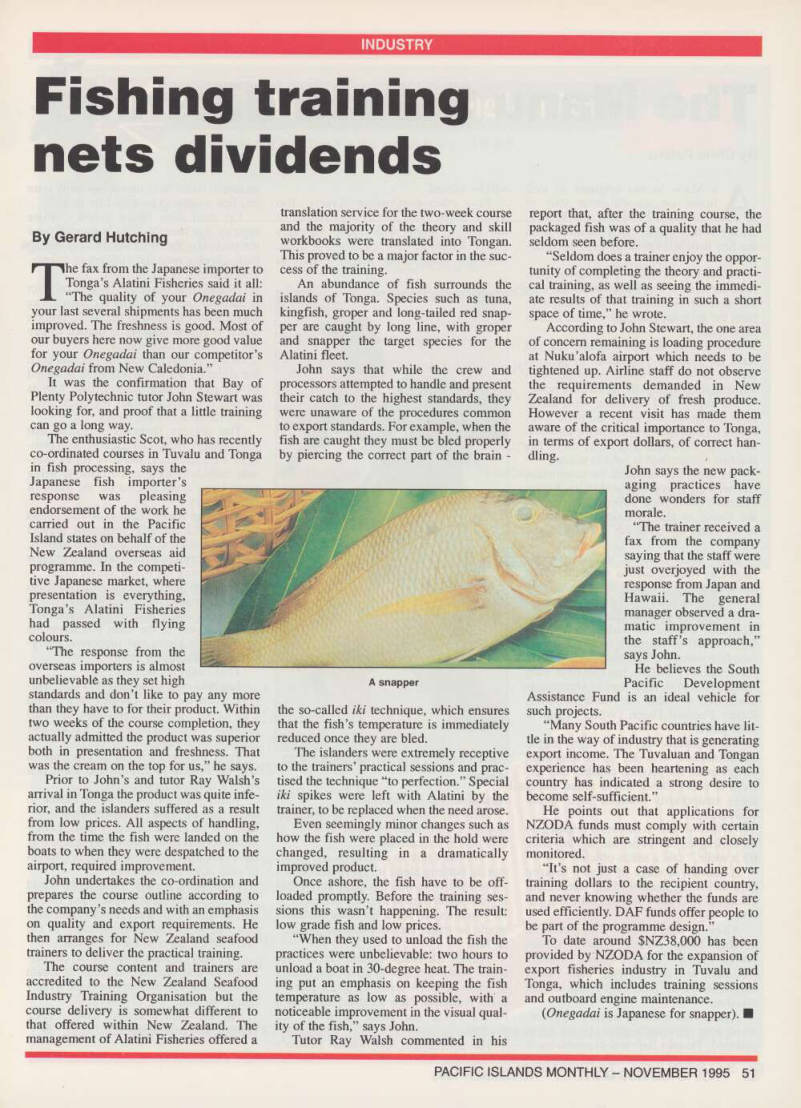
An abundance of fish surrounds the islands of Tonga. Species such as tuna, kingfish, groper and long-tailed red snapper are caught by long line, with groper and snapper the target species for the Alatini fleet.
John says that while the crew and processors attempted to handle and present their catch to the highest standards, they were unaware of the procedures common to export standards. For example, when the fish are caught they must be bled properly by piercing the correct part of the brain -
the so-called iki technique, which ensures that the fish’s temperature is immediately reduced once they are bled.
The islanders were extremely receptive to the trainers’ practical sessions and prac tised the technique “to perfection.” Special iki spikes were left with Alatini by the trainer, to be replaced when the need arose.
Even seemingly minor changes such as how the fish were placed in the hold were changed, resulting in a dramatically improved product.
Once ashore, the fish have to be off loaded promptly. Before the training ses sions this wasn’t happening. The result: low grade fish and low prices.
“When they used to unload the fish the practices were unbelievable: two hours to unload a boat in 30-degree heat. The train ing put an emphasis on keeping the fish temperature as low as possible, with a noticeable improvement in the visual qual ity of the fish,” says John.
Tutor Ray Walsh commented in his
report that, after the training course, the packaged fish was of a quality that he had seldom seen before.
“Seldom does a trainer enjoy the oppor tunity of completing the theory and practi cal training, as well as seeing the immedi ate results of that training in such a short space of time,” he wrote, According to John Stewart, the one area
of concern remaining is loading procedure
at Nukualofa airport which needs to be tightened up. Airline staff do not observe the requirements demanded in New Zealand for delivery of fresh produce, However a recent visit has made them aware of the critical importance to Tonga, in terms of export dollars, of correct han
dling.
John says the new pack aging practices have done wonders for staff morale.
“The trainer received a fax from the company saying that the staff were just overjoyed with the response from Japan and Hawaii. The general manager observed a dra matic improvement in the staff’s approach,” says John.
He believes the South Pacific Development
Assistance Fund is an ideal vehicle for such projects.
“Many South Pacific countries have lit tle in the way of industry that is generating export income. The Tuvaluan and Tongan experience has been heartening as each country has indicated a strong desire to become self-sufficient.”
He points out that applications for NZODA funds must comply with certain criteria which are stringent and closely monitored.
“It’s not just a case of handing over training dollars to the recipient country, and never knowing whether the funds are used efficiently. DAF funds offer people to be part of the programme design.”
To date around SNZ3B,OOO has been provided by NZODA for the expansion of export fisheries industry in Tuvalu and Tonga, which includes training sessions and outboard engine maintenance. (Onegadai is Japanese for snapper). ■
A snapper