Fiji’s legal eagle
pp. 35-37 · Read in the full issue

By Yunus Rashid
When Fiji’s economic, political
and social status took a nose dive as a result of the 1987 mili tary coup, judges, including the Chief Justice, Sir Timoci Tuivaga, resigned from the high court. This turn of events left peo ple worried about the law and order situa tion in Fiji.
Temporary judges were appointed by
the military government but this did little to allay fears held by people wanting an impartial judiciary. When an interim gov ernment was appointed to rebuild - more than govern - the nation. Sir Timoci was persuaded to take over the judicial reins and restore the peoples’ faith in it.
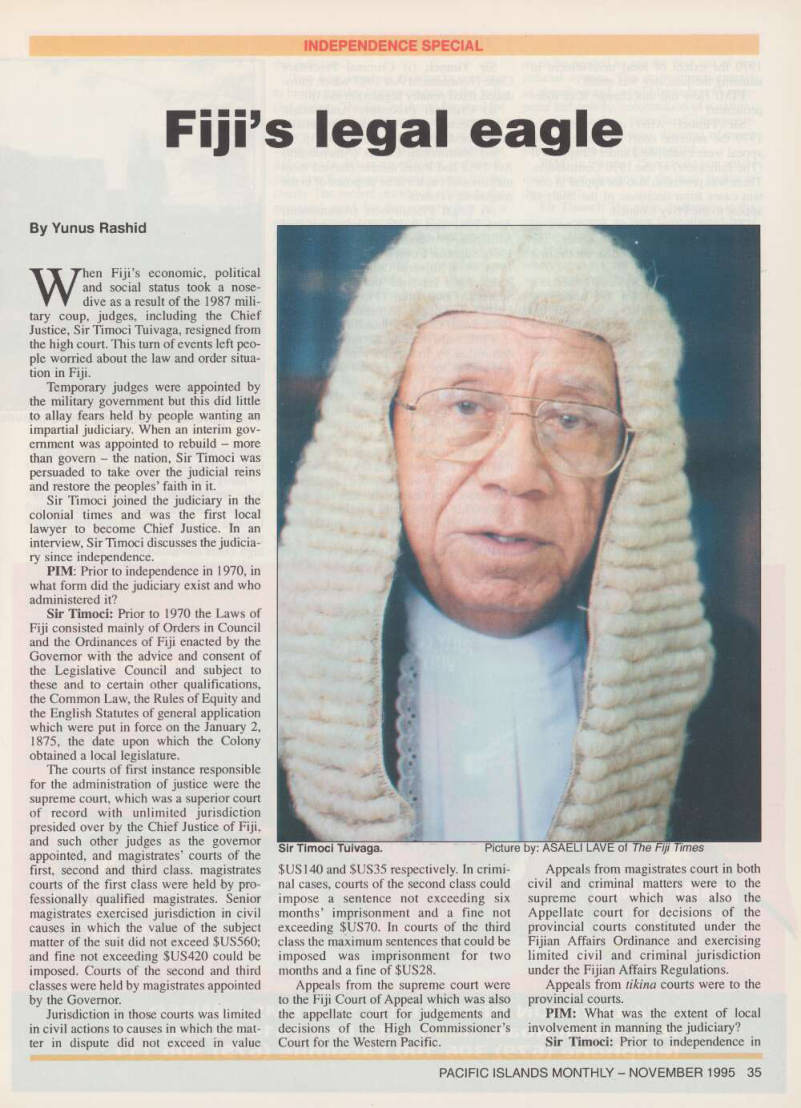
Sir Timoci joined the judiciary in the colonial times and was the first local lawyer to become Chief Justice. In an interview. Sir Timoci discusses the judicia ry since independence.
PIM: Prior to independence in 1970, in what form did the judiciary exist and who administered it?
Sir Timoci: Prior to 1970 the Laws of Fiji consisted mainly of Orders in Council and the Ordinances of Fiji enacted by the Governor with the advice and consent of the Legislative Council and subject to these and to certain other qualifications, the Common Law, the Rules of Equity and
the English Statutes of general application
which were put in force on the January 2, 1875, the date upon which the Colony obtained a local legislature.
The courts of first instance responsible for the administration of justice were the supreme court, which was a superior court of record with unlimited jurisdiction presided over by the Chief Justice of Fiji, and such other judges as the governor appointed, and magistrates’ courts of the first, second and third class, magistrates courts of the first class were held by pro
fessionally qualified magistrates. Senior
magistrates exercised jurisdiction in civil causes in which the value of the subject matter of the suit did not exceed SUSS6O; and fine not exceeding SUS42O could be imposed. Courts of the second and third
classes were held by magistrates appointed
by the Governor.
Jurisdiction in those courts was limited in civil actions to causes in which the mat ter in dispute did not exceed in value
SUSI4O and SUS3S respectively. In crimi nal cases, courts of the second class could impose a sentence not exceeding six months’ imprisonment and a fine not exceeding SUS7O. In courts of the third class the maximum sentences that could be imposed was imprisonment for two months and a fine of SUS2B.
Appeals from the supreme court were to the Fiji Court of Appeal which was also the appellate court for judgements and decisions of the High Commissioner’s Court for the Western Pacific.
Appeals from magistrates court in both civil and criminal matters were to the supreme court which was also the Appellate court for decisions of the provincial courts constituted under the Fijian Affairs Ordinance and exercising limited civil and criminal jurisdiction under the Fijian Affairs Regulations.
Appeals from tikina courts were to the
provincial courts.
PIM: What was the extent of local involvement in manning the judiciary?
Sir Timoci: Prior to independence in
Sir Timoci Tuivaga. Picture by: ASAELI LAVE of The Fiji Times
1970 the extent of local involvement in manning the judiciary was small.
PIM: How did this change after inde
pendence?
Sir Timoci: After independence in 1970 the supreme court and the court of appeal were established under Chapter VII (The Judicature) of the 1970 Constitution.
There was provision also for appeal in cer tain cases from decisions of the court of appeal to the Privy Council.
The newly constituted Fiji Court of Appeal was established under the Judicature Decree 1988 and sat for the first time on May 2, 1988.
The supreme court was established as a final appellate court for Fiji under the Judicature Decree 1988 in place of the Privy Council, to which the right of appeal ceased in October 1987 when Fiji became a Republic. At the same time the Constitution of 1970 was abrogated.
A new constitution of Fiji, which was promulgated on July 25, 1990, retained the supreme court as the final appeal tribunal for Fiji.
The chief justice is president of the court while other justices of the court may be appointed for one or more sessions or for a term not exceeding three years, jus tices of the court of appeal are ex-officio members and may be asked upon to partic ipate in any sitting or session of the court.
PIM: To date, what important judicial changes have been made?
Sir Timoci: (i) Criminal Procedure Code (Amendment Act 1983 which intro
duced fixed penalty legislation to Fiji).
ii) Criminal Procedure Amendment Code Decree 1988 which substantially modernised Criminal Procedure in Fiji. iii) Matrimonial Causes (Amendment) Act 1982 and Rules thereto enabled most matrimonial causes to be disposed of in the
magistrate’s courts.
iv) Legal Practitioners (Amendment) Acts 1981 and 1986; Maintenance and Affiliation (Amendment) Acts 1981 and 1986; Supreme Court (Amendment) Rules 1983, 1984; Supreme Court (Amendment) Rules 1988 (updated the Rules of the Supreme Court from 1976 to 1987; Fiji Court of Appeal (Amendment) Rules 1985; Small Claims Tribunal Rules 1994.
PIM: Until recently, the profession was dominated by Indian lawyers. What was the reason for more Fijians undertaking
legal studies?
Sir Timoci: Lack of financial resources has been the main reason why many Fijians were not able to study law. It was only in recent years when law scholarships became available to Fijians more freely that more Fijians studied law and became lawyers. Fijians who obtained law degrees increased significantly in the last three years. This trend should continue so long as law scholarships are available to
Fijians.
PIM: In the last 25 years have the for-
malities of the courts changed from being highly officious to being less formal?.
Sir Timoci: Court dress requirements have not changed except in the court of appeal. There the wig is no longer worn.
Lounge suit and tie with black robe is the preferred attire in that court. However, the high court continued to use either scarlet
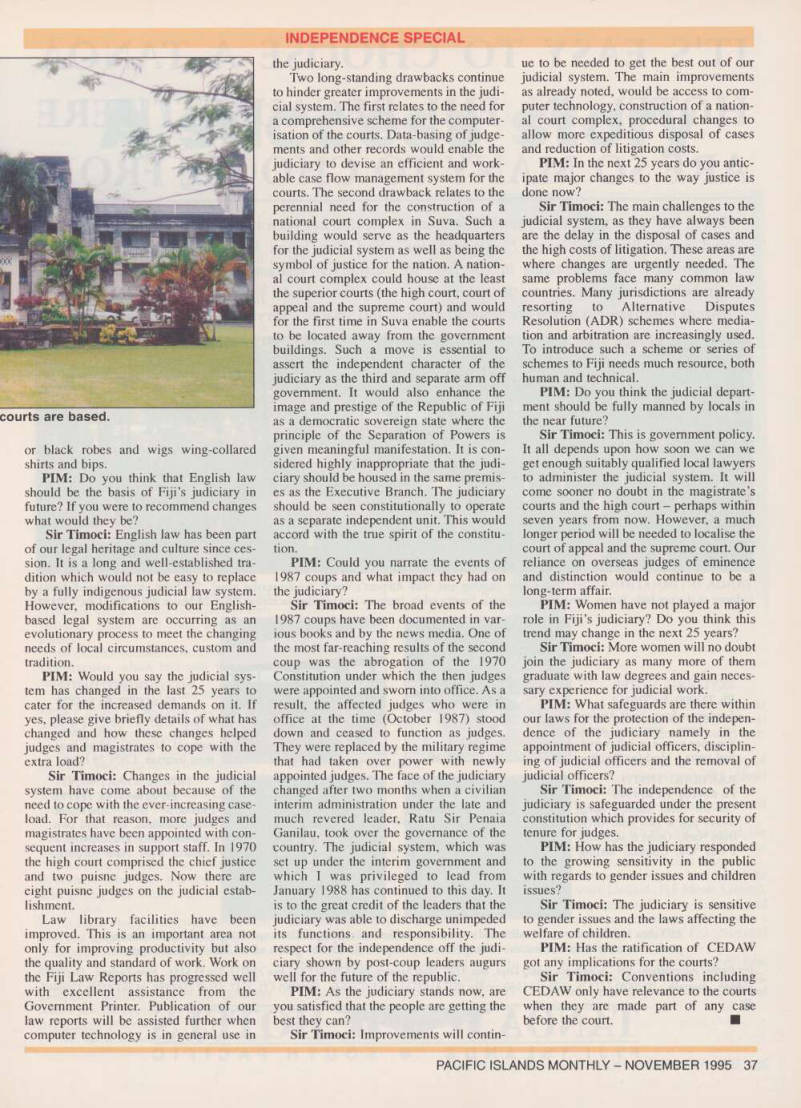
Fiji’s government building where the
or black robes and wigs wing-collared shirts and bips.
PIM: Do you think that English law should be the basis of Fiji’s judiciary in future? If you were to recommend changes what would they be?
Sir Timoci: English law has been part of our legal heritage and culture since ces sion. It is a long and well-established tra dition which would not be easy to replace by a fully indigenous judicial law system.
However, modifications to our English based legal system are occurring as an evolutionary process to meet the changing needs of local circumstances, custom and tradition.
PIM: Would you say the judicial sys tem has changed in the last 25 years to cater for the increased demands on it. If yes, please give briefly details of what has changed and how these changes helped judges and magistrates to cope with the extra load?
Sir Timoci: Changes in the judicial system have come about because of the need to cope with the ever-increasing case load. For that reason, more judges and magistrates have been appointed with con sequent increases in support staff. In 1970 the high court comprised the chief justice and two puisne judges. Now there are eight puisne judges on the judicial estab lishment.
Law library facilities have been improved. This is an important area not only for improving productivity but also the quality and standard of work. Work on the Fiji Law Reports has progressed well with excellent assistance from the Government Printer. Publication of our law reports will be assisted further when computer technology is in general use in
the judiciary.
Two long-standing drawbacks continue to hinder greater improvements in the judi cial system. The first relates to the need for a comprehensive scheme for the computer isation of the courts. Data-basing of judge ments and other records would enable the judiciary to devise an efficient and work able case flow management system for the courts. The second drawback relates to the perennial need for the construction of a national court complex in Suva. Such a building would serve as the headquarters for the judicial system as well as being the symbol of justice for the nation. A nation al court complex could house at the least the superior courts (the high court, court of appeal and the supreme court) and would for the first time in Suva enable the courts to be located away from the government buildings. Such a move is essential to assert the independent character of the judiciary as the third and separate arm off government. It would also enhance the image and prestige of the Republic of Fiji as a democratic sovereign state where the principle of the Separation of Powers is given meaningful manifestation. It is con sidered highly inappropriate that the judi ciary should be housed in the same premis es as the Executive Branch. The judiciary should be seen constitutionally to operate as a separate independent unit. This would accord with the true spirit of the constitu tion.
PIM: Could you narrate the events of 1987 coups and what impact they had on
the judiciary?
Sir Timoci: The broad events of the 1987 coups have been documented in var ious books and by the news media. One of the most far-reaching results of the second coup was the abrogation of the 1970 Constitution under which the then judges were appointed and sworn into office. As a result, the affected judges who were in office at the time (October 1987) stood down and ceased to function as judges.
They were replaced by the military regime that had taken over power with newly appointed judges. The face of the judiciary changed after two months when a civilian interim administration under the late and much revered leader, Ratu Sir Penaia Ganilau, took over the governance of the country. The judicial system, which was set up under the interim government and which I was privileged to lead from January 1988 has continued to this day. It is to the great credit of the leaders that the judiciary was able to discharge unimpeded its functions and responsibility. The respect for the independence off the judi ciary shown by post-coup leaders augurs well for the future of the republic.
PIM: As the judiciary stands now, are you satisfied that the people are getting the best they can?
Sir Timoci: Improvements will contin
ue to be needed to get the best out of our judicial system. The main improvements as already noted, would be access to com puter technology, construction of a nation
al court complex, procedural changes to
allow more expeditious disposal of cases and reduction of litigation costs.
PIM: In the next 25 years do you antic ipate major changes to the way justice is done now?
Sir Timoci: The main challenges to the judicial system, as they have always been are the delay in the disposal of cases and the high costs of litigation. These areas are where changes are urgently needed. The same problems face many common law countries. Many jurisdictions are already resorting to Alternative Disputes Resolution (ADR) schemes where media tion and arbitration are increasingly used.
To introduce such a scheme or series of schemes to Fiji needs much resource, both human and technical.
PIM: Do you think the judicial depart ment should be fully manned by locals in the near future?
Sir Timoci: This is government policy.
It all depends upon how soon we can we get enough suitably qualified local lawyers to administer the judicial system. It will come sooner no doubt in the magistrate’s courts and the high court - perhaps within seven years from now. However, a much longer period will be needed to localise the court of appeal and the supreme court. Our reliance on overseas judges of eminence and distinction would continue to be a long-term affair.
PIM: Women have not played a major role in Fiji’s judiciary? Do you think this trend may change in the next 25 years?
Sir Timoci: More women will no doubt join the judiciary as many more of them graduate with law degrees and gain neces sary experience for judicial work.
PIM: What safeguards are there within our laws for the protection of the indepen dence of the judiciary namely in the appointment of judicial officers, disciplin ing of judicial officers and the removal of
judicial officers?
Sir Timoci: The independence of the judiciary is safeguarded under the present constitution which provides for security of tenure for judges.
PIM: How has the judiciary responded to the growing sensitivity in the public with regards to gender issues and children issues?
Sir Timoci: The judiciary is sensitive to gender issues and the laws affecting the welfare of children.
PIM: Has the ratification of CEDAW got any implications for the courts?
Sir Timoci: Conventions including CEDAW only have relevance to the courts when they are made part of any case before the court. ■
courts are based.