The last Rainforest
pp. 52-55 · Read in the full issue

The Environment
Bob, contract logger,
Guadalcanal, Solomons.
Bob is a contract logger for Pacific Timbers and earns 45¢ an hour, $3.60 a day. He describes his work as being hard and dangerous. He says he doesn’t like his work much, but needs the money. His contract
The great rainforests of Papua New Guinea, the Solomon Islands and Vanuatu are in great danger of being logged to extinction because of greed, bad management, bad decisions and poverty
By Peter Soiness
TO the near north of Australia, blanketing the remote Melanesian arch ipelago of Papua New Guinea and the Solomon Islands, there
survives one of the world’s last extensive tracts of pristine tropical rainforest. It is
the largest remaining rainforest in the Pacific, acclaimed for it incredibly rich bio-diversity of flora and fauna.
Depending on perspectives, it is also rich in other ways. The commercial timber value of this unique rainforest area has been estimated to be as great as $lOO bil lion.
To the powerful Asian economies near by, with their increasing hunger for natur al resources, this is an opportunity that has unsurprisingly not gone unnoticed. Over the past several years, a combination of events have led to a dramatic surge in log ging activity on these islands, the extent to which many Australians may find surpris
ing.
These events were precipitated during the 1980 s when it was realised that Asia’s
traditional tropical hardwood supplies
were beginning to dry up.
Countries such as Thailand, Indonesia, Malaysia and the Philippines began shut ting down their depleted rainforest
reserves to large scale log exports. As a result world prices for whole logs began escalating, (approx. 200% over the past couple of years) as the insatiable Japanese and South Korean timber markets started
vigorously bargaining for the region’s
remaining timber supplies. (Timber is largely used for such undignified purposes as disposable concrete form work for
Japanese building sites.)
Consequently, aggressive Asian log
ging companies, in particular the notorious
Malaysian conglomerate Rimbunan Hijau,
have targeted to great effect the gullible and poorly educated villagers of the Melanesian islands, (the traditional hold ers of 97% of the land) to successfully shore up long-term, and highly lucrative,
logging supply deals.
Deep in the forests of Melanesia, the exotic displays of the “Birds of Paradise”, are now competing with the interminable howl of chainsaw.
To state it simply, within this tranquil
expires this month, after which he will return to his village. He does not expect to find any further work. Bob knows he is damaging his land but feels he has no option but to take the work offered by the logging company, who in turn reap great rewards on the sale of the timber. Photo: Peter Solness/Wildlight
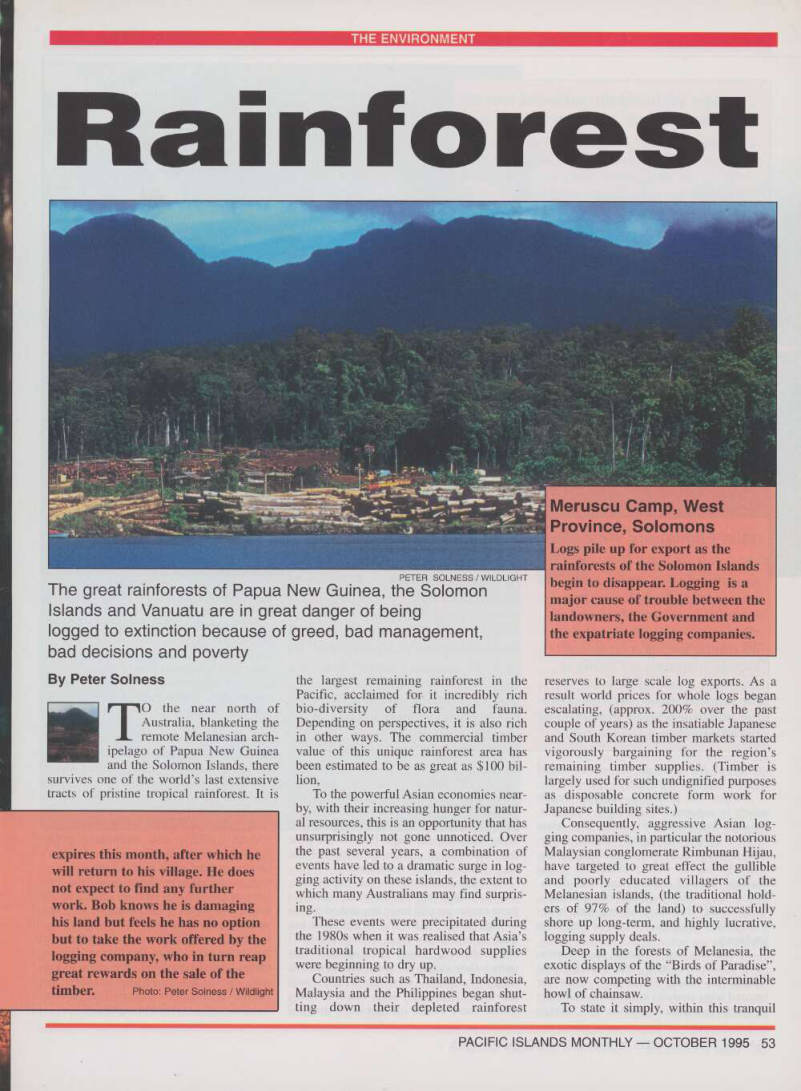
Peter Solness/Wildlight
Meruscu Camp, West Province, Solomons Logs pile up for export as the rainforests of the Solomon Islands begin to disappear. Logging is a major cause of trouble between the landowners, the Government and the expatriate logging companies.
corner of the Pacific, the controversial tropical hardwood business is booming.
Despite the promises, logging wealth
which is supposed to aid these countries, through landowner royalties and state
taxes, is clearly inadequate and dispropor
tionate to the value of the resources taken. (Largely due to well documented scams such as “transfer pricing” and “mis-decla ration and undervaluing of species”).
Quite simply there is little long-term bene fit to these countries, but a lot of long term
problems.
Whole log exports from these forests have doubled, even tripled, over the past couple of years, extracting yields far beyond what analysts consider sustainable.
Such rapacious activity by foreign
companies is having serious implications
through Melanesia, not only with the immediate problems of environmental degradation, or even through the insidious dislocation of human cultures considered intact since the stone age, but also for what this exploitation means in terms of the hard truths of global economics.
If logging continues at the current rate, it is estimated that the forest resources of these countries will be extinguished within as little as a decade. The World Bank has made it repeatedly clear to both the PNG and Solomon Island governments, that unless they reign in their unsustainable logging exports, their economies will inevitably implode. Into such a sorry melee, there would inevitably be dragged
the well meaning dollars of donor nations such as Australia.
Such “enthusiasm” by foreign logging
companies working in this region, and
their ability to sway opportunistic and short-sighted governments, promoted the now legendary 1988 Justice Toss Barnett inquiry into forest management of PNG, which concluded: “It would be fair to say of some of these companies, that they are now roaming the countryside with the self assurance of robber barons; bribing politi cians and leaders, creating social dishar mony, and ignoring the laws in order to rip out and export the last remnants of the province’s timber. These companies are fooling the landholders and making use of corrupt, gullible and unthinking politi cians. It downgrades Papua New Guinea’s sovereign status that such a rapacious for eign exploitation has been allowed to con tinue with such devastating effects to the social and physical environment, and with so few positive benefits.”
Observers confirm that if anything, in the seven years since the Barnett Report, things have deteriorated even more, as log
ging companies feverishly scramble for
further concessions before the industry becomes, (if ever) fairly regulated.
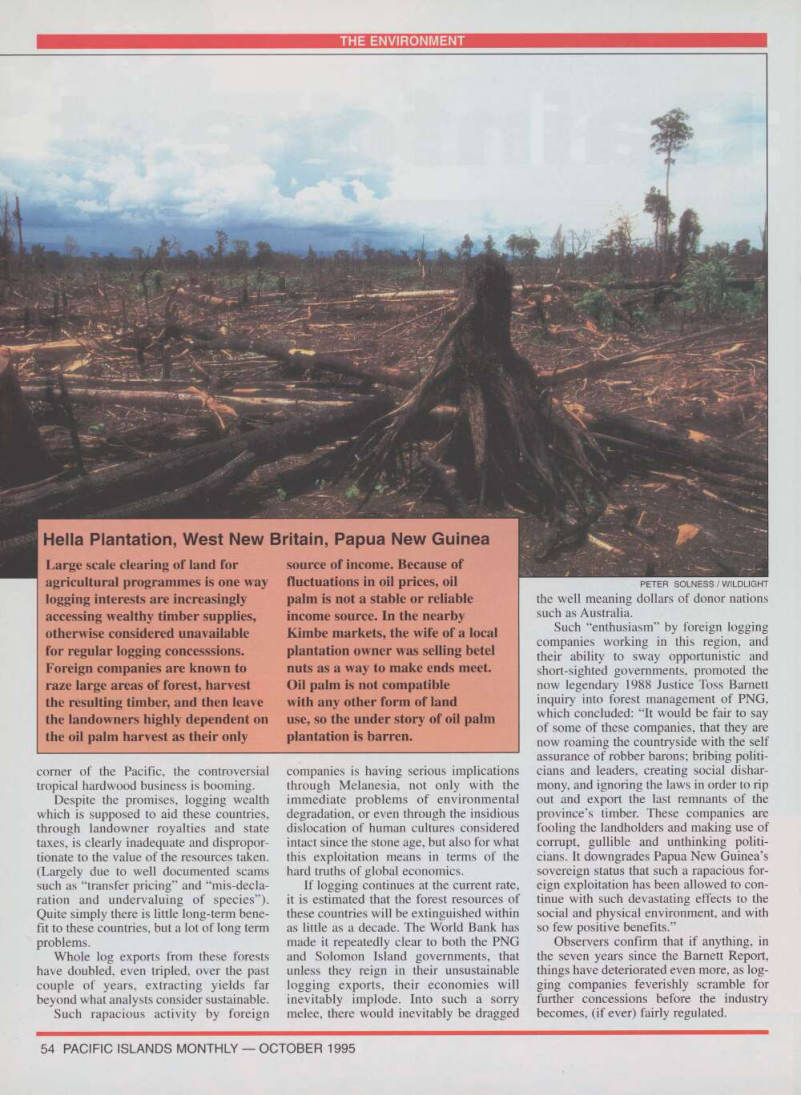
Hella Plantation, West New Britain, Papua New Guinea
Large scale clearing of land for agricultural programmes is one way logging interests are increasingly accessing wealthy timber supplies, otherwise considered unavailable for regular logging concesssions.
Foreign companies are known to raze large areas of forest, harvest the resulting timber, and then leave the landowners highly dependent on the oil palm harvest as their only
source of income. Because of fluctuations in oil prices, oil palm is not a stable or reliable income source. In the nearby Kimbe markets, the wife of a local plantation owner was selling betel nuts as a way to make ends meet.
Oil palm is not compatible with any other form of land use, so the under story of oil palm plantation is barren.
Peter Solness/Wildlight
In the meantime, efforts are afoot to assist local villages, buffeted by the arrival of the logging industry. Non Government Organisations such as Greenpeace and the World Wildlife Fund, are providing pro grammes to educate village people about the pitfalls of commercial logging and teach them to take control of their own destinies. Despite the overwhelming odds, there are some pleasing results.
Campaigns such as eco-forestry, where local people cut their own saleable timber
with the aid of portable sawmills, are ben efiting communities. There are also eco tourism projects, which allow villages to preserve the integrity of their cultures, whilst ensuring an ongoing source of much-needed cash for basic necessities.
Logging can drastically alter, not only
the landscape, but importantly the many lives who happen to depend on the rainfor est for their sustenance and cultural identi ty. There are many tragic stories in the wake of the loggers. A
Peter Solness/Wildlight
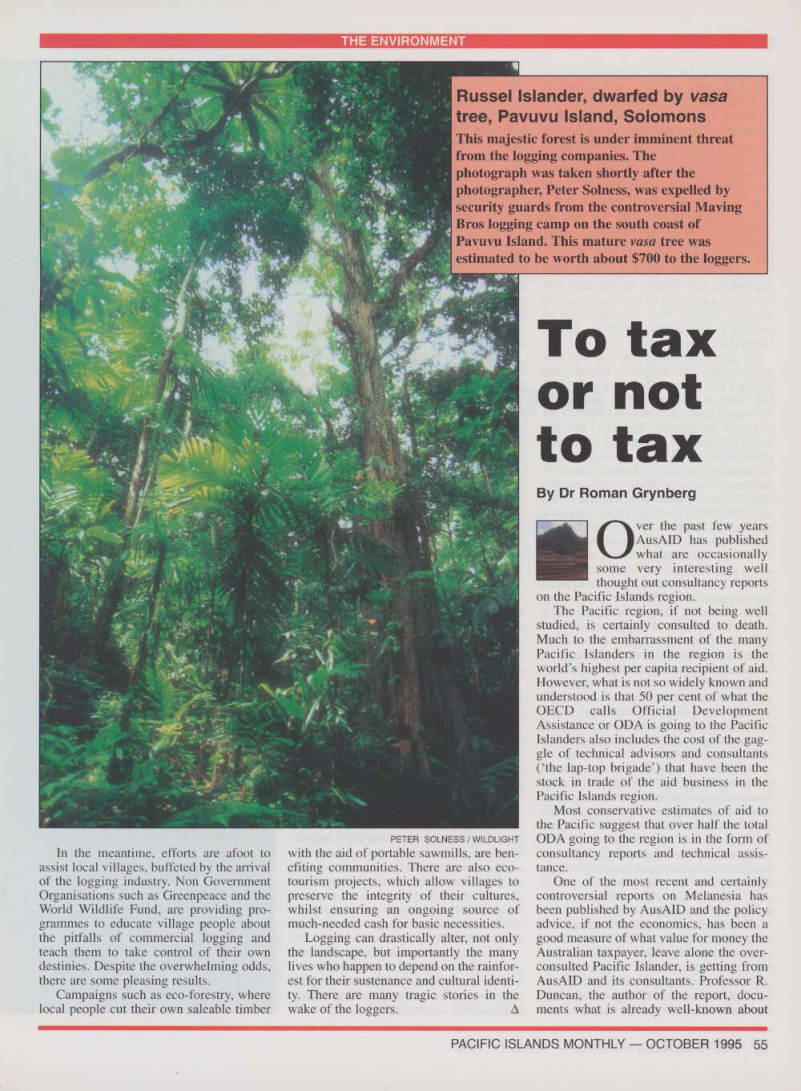
Russel Islander, dwarfed by vasa
tree, Pavuvu island, Solomons
This majestic forest is under imminent threat from the logging companies. The photograph was taken shortly after the photographer, Peter Solness, was expelled by security guards from the controversial Maving Bros logging camp on the south coast of Pavuvu Island. This mature vasa tree was estimated to be worth about $700 to the loggers.