heights on a rig
p. 51 · Read in the full issue
Lifestyle
Reaching new heights on a rig
By Sally Andrews
SQUINTING into the wind and brac ing ourselves against the freshening breeze, we spotted the 188-foot tall ship Concordia on the horizon, her two jibs flying in 25 knots of wind. Aboard the Concordia , nearly 50 North American stu dents were returning home after 10 months at sea. They had sailed across the Pacific, Indian and Atlantic oceans and had visited 41 countries.
Standing beside the lighthouse north of Sydney, Nova Scotia (Canada), the stu dents’ families wave arms, blew horns, flashed headlights, and wiped tears as the ship and her crew approached harbour.
The 1994/1995 Class Afloat was ready to
graduate.
The Concordia is barkentine-rigged and can carry 10,000 square feet of sail.
Below decks, there are 21 cabins for the students, teachers and crew, and black boards, maps, charts, textbooks, audio visual equipment and a CD ROM library.
She serves as a floating campus for stu dents wanting to study aboard a tallship
while sailing around the world. Since 1985, over 350 students have sailed 350,000 miles to hundreds of ports of call world-wide. While at sea, teachers conduct classes in anthropology, marine biology, career and life management, international politics, and philosophy as well as English, maths and science. Students also study navigation, sail theory, maritime history and stand regular watches. Sleep is often elusive.
Class Afloat is a unique experience.
Students learn the language of the sea and the unwritten rules of shipboard life. They soon adjust to the ship’s routine. “The cabin that was claustrophobic is now cosy; the lookout that was boring is now peace ful; the 50 strangers from the first day aboard are now my best friends,” says Kyla Tienhaar, a 12th grader from Ontario.
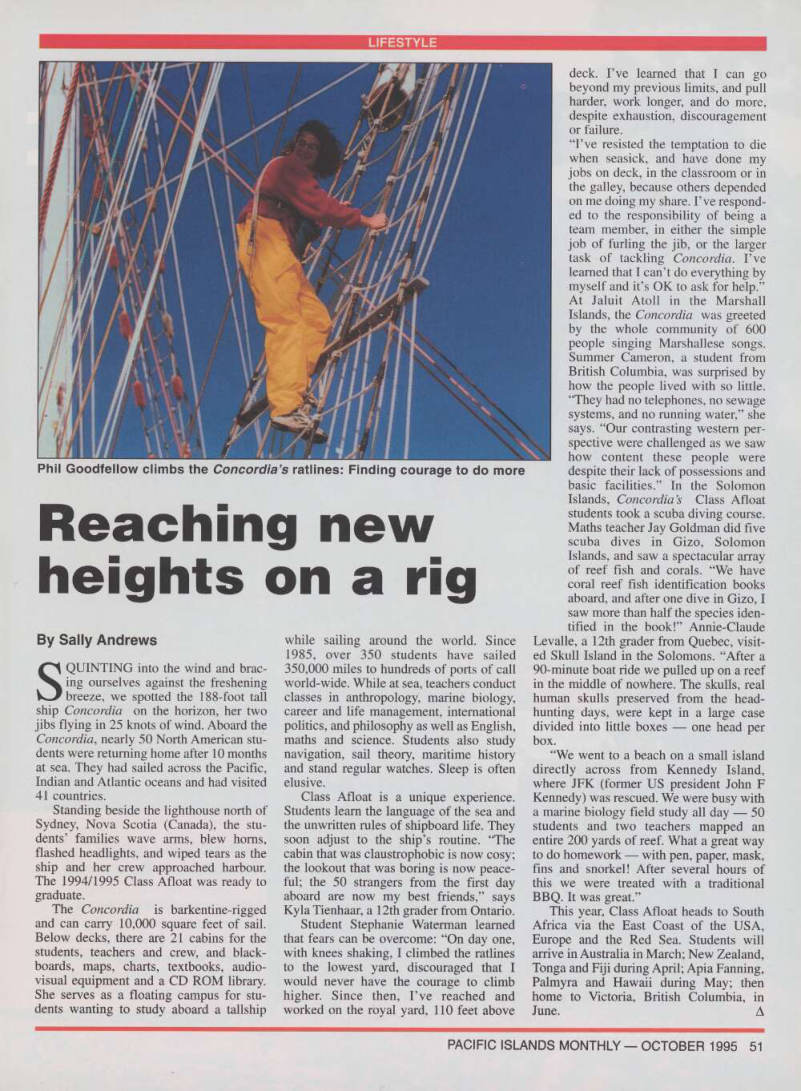
Student Stephanie Waterman learned that fears can be overcome: “On day one, with knees shaking, I climbed the ratlines to the lowest yard, discouraged that I would never have the courage to climb higher. Since then, I’ve reached and worked on the royal yard, 110 feet above
deck. I’ve learned that I can go
beyond my previous limits, and pull
harder, work longer, and do more,
despite exhaustion, discouragement
or failure.
“I’ve resisted the temptation to die when seasick, and have done my jobs on deck, in the classroom or in the galley, because others depended on me doing my share. I’ve respond ed to the responsibility of being a team member, in either the simple job of furling the jib, or the larger task of tackling Concordia. I’ve learned that I can’t do everything by myself and it’s OK to ask for help.”
At Jaluit Atoll in the Marshall Islands, the Concordia was greeted by the whole community of 600 people singing Marshallese songs.
Summer Cameron, a student from British Columbia, was surprised by how the people lived with so little.
“They had no telephones, no sewage systems, and no running water,” she says. “Our contrasting western per spective were challenged as we saw how content these people were despite their lack of possessions and basic facilities.” In the Solomon Islands, Concordia’s Class Afloat students took a scuba diving course.
Maths teacher Jay Goldman did five scuba dives in Gizo, Solomon Islands, and saw a spectacular array of reef fish and corals. “We have coral reef fish identification books aboard, and after one dive in Gizo, I saw more than half the species iden tified in the book!” Annie-Claude
Levalle, a 12th grader from Quebec, visit ed Skull Island in the Solomons. “After a 90-minute boat ride we pulled up on a reef in the middle of nowhere. The skulls, real human skulls preserved from the head hunting days, were kept in a large case divided into little boxes one head per box.
“We went to a beach on a small island directly across from Kennedy Island, where JFK (former US president John F Kennedy) was rescued. We were busy with a marine biology field study all day 50 students and two teachers mapped an entire 200 yards of reef. What a great way to do homework with pen, paper, mask, fins and snorkel! After several hours of this we were treated with a traditional BBQ. It was great.”
This year. Class Afloat heads to South Africa via the East Coast of the USA, Europe and the Red Sea. Students will arrive in Australia in March; New Zealand, Tonga and Fiji during April; Apia Fanning, Palmyra and Hawaii during May; then home to Victoria, British Columbia, in June. A
Phil Goodfellow climbs the Concordia’s ratlines: Finding courage to do more