The report that shocked
p. 46 · Read in the full issue
By Martin Tiffany
LUTE a few feathers were ruffled in I IFiji by a World Bank report which made headlines in the country in lt said a lot of things peo ple did not want to hear or see made pub lic.
The report titled Fiji: Restoring Growth in a Changing Global Environment was released in June and covered the fiscal year to December 31,1994.
The gist of the report was that Fiji’s economy had stuttered and become stag nant in the past four years and needed a good kick up the pants to get it back on track. It says a number of critical problems are facing the Fiji economy and it blames those problems on the Government’s fail ure to put in place a strategic vision for the economy.
The report says continuing political uncertainty, the lack of confidence regard ing public policy, and concern over loss of competitiveness have seen private invest ment fall to only five per cent of the GDP since 1990.
In the aftermath of the 1987 coups, two political issues need to be resolved to encourage an environment for growth, says the report. “Fiji is the issue of politi cal rights: the 1990 constitution limits the rights of Indo-Fijians, and the outcome of the ongoing constitutional review will be closely watched by the private sector,” the report says. “The second is impending sugarcane land lease renewals, which if mishandled, could further aggravate rela tions between ethnic groups. With political and property rights in question, many entrepreneurs are reluctant to make long term investments.”
The report touches on many things, from agriculture to poverty, looking at
shortfalls and offering suggestions.
Overall the report predicts a fairly positive short-term economic outlook but says crit ical changes must be made to ensure an economic upturn. The report should be used as a basis for change, and while some, understandably, feel the need to dig into the nitty-gritty of the World Bank report, such energy will be better used as a catalyst for change rather than as a plat form to argue against the report.
The Ministry for Agriculture, Fisheries and Forests disputed claims by the report that Fiji’s agricultural sector had slid into a
low-productivity, low-growth trap. John
Teiwa, the ministry’s permanent secretary, said “the report was not accurate because it was based on the assumption that agricul-
tural growth is lagging. I’m disappointed with the report because agriculture has grown in comparison with other sectors.”
Teiwa said that based on a recent report by the United Nations’ Economic and Social Commission for Asia and the Pacific (ESCAP), Fiji’s GDP increased by 3.2 per cent in 1994; the agricultural sector grew by 7.4 per cent compared to 4.9 per cent for services. He said the report also fails to acknowledge the success of the forestry and fisheries sectors.
The report also highlighted the prob lems faced by the poor administration of the Value Added Tax and the failure to col lect VAT money. In its first year alone, VAT arrears amounted to $5O million.
Fiji’s Commissioner of Inland Revenue, Tui Mailekai, questioned the World Bank source, saying “we never had any discussions with them at any stage” and did not know where they got their fig ures from. He said that if the World Bank had the latest information available in Fiji it would have seen that VAT was working well. VAT was introduced on July 1, 1992 and Mr Mailekai said the compliance rate in 1993 was 70 per cent and not 30 per cent as suggested by the World Bank. Says he: “The arrears of $5O million as at December 1993 consists mainly of Default Assessments.
These are assessments made when a
business has not furnished a return. They are not necessarily accurate because until a return is furnished the department really has very little idea how much VAT has been collected. In fact the amount of actu al VAT arrears as at December 1993 was $4,544,766.”
The report also suggests a devaluation of the Fiji currency to make Fiji more competitive. But the Reserve Bank of Fiji disagreed with that, saying broad econom ic indicators do not justify the need to devalue the Fiji dollar. It is healthy that there has been strong reaction to some of what the World Bank report says.
For Fiji, the short-term economic out look has improved according to the report; sugar and tourism are doing well, inflation is down, and growth is higher than in the recent past. But in the longer term changes need to be made. The report says that “the breathing space afforded by the economic upturn must be used to push ahead with changes that will address the critical chal
lenges facing the Fiji economy.” These
include: • restoring economic growth sufficient
ly to provide jobs;
• diversifying the economy to reduce vulnerability to volatile export markets and take advantage of opportunities; and • creating an environment conducive to growth that encourages investment. A
Yunus Rashid
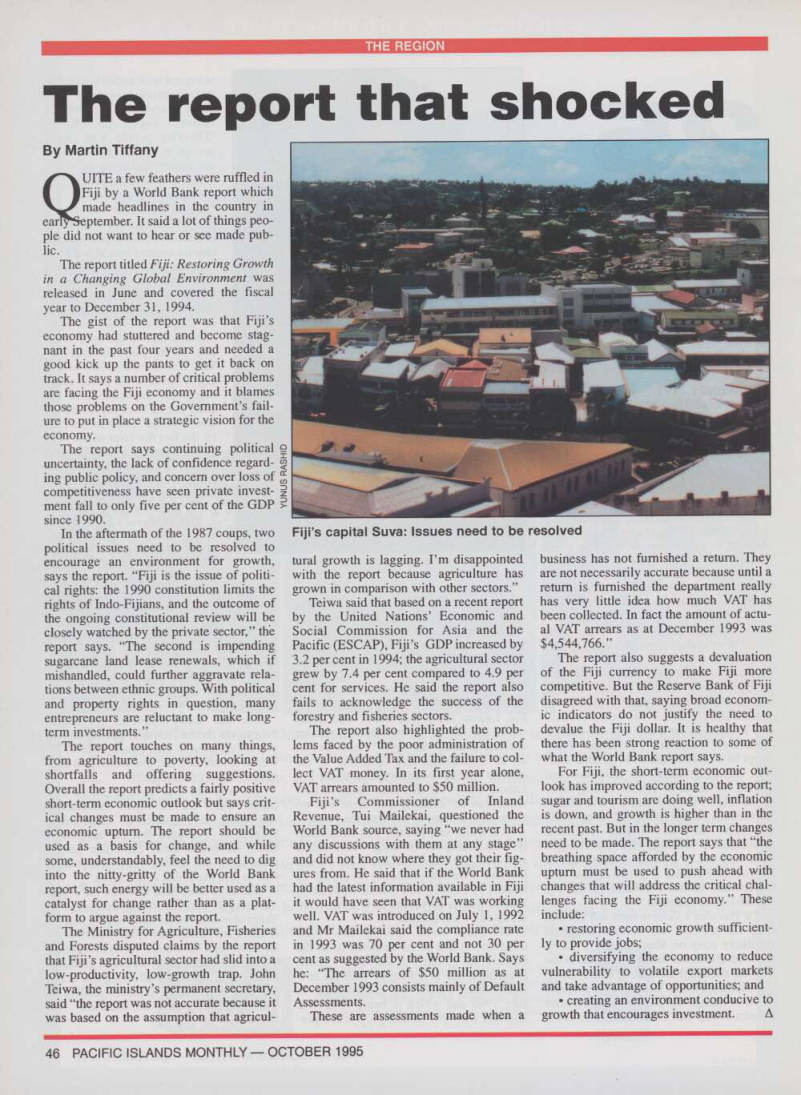
Fiji’s capital Suva: Issues need to be resolved