25 at last
p. 45 · Read in the full issue
The Region
Fiji celebrates 25 years of independence this month but growing up has not been easy
By Yunus Rashid
TWENTY-FIVE years ago on October 10, 1970, the British low ered the Union Jack for the last time and Fiji proudly hoisted its national flag, symbolising the birth of a new nation achieving independence from the rule of colonialism. A new constitution was put to the test as Fiji went forth to enjoy its new found freedom.
In the next two decades, under the lead ership of Ratu Sir Kamisese Mara as Prime Minister, Fiji was to prove itself as a fine example of how a Third World country could quickly develop with a successful economic growth and positive social changes unseen in the Pacific islands.
The 80s, however, were to bring about
changes not always happy ones that
would rewrite the course of history in Fiji.
In a meeting in Suva in 1985, the Fiji Trades Union Congress decided to form a political party, which it called the Fiji Labour Party, and prepare to contest the general election due in two years. A coali tion of the Labour Party and the Indian dominated National Federation Party swept to victory in the 1987 general elec tion, unseating Ratu Sir Kamisese and sowing the seeds of dissent among many of the Fijian people. Led by the Taukei
Movement, Fijians protested, supposedly
in fear of an Indian-dominated Government, although the Government itself was led by a Fijian, Prime Minister Dr Timoci Bavadra, a former senior civil servant and former President of the Fiji Trades Union Congress.
Dr Bavadra’s Government did not last long. The protests, and violence, triggered a military coup on May 14, 1987, led by Lieutenant Colonel Sitiveni Rabuka, at the time the third highest ranking officer in the Fiji Military Forces. International pressure failed to change the course of events after Rabuka’s coup and Dr Bavadra was never
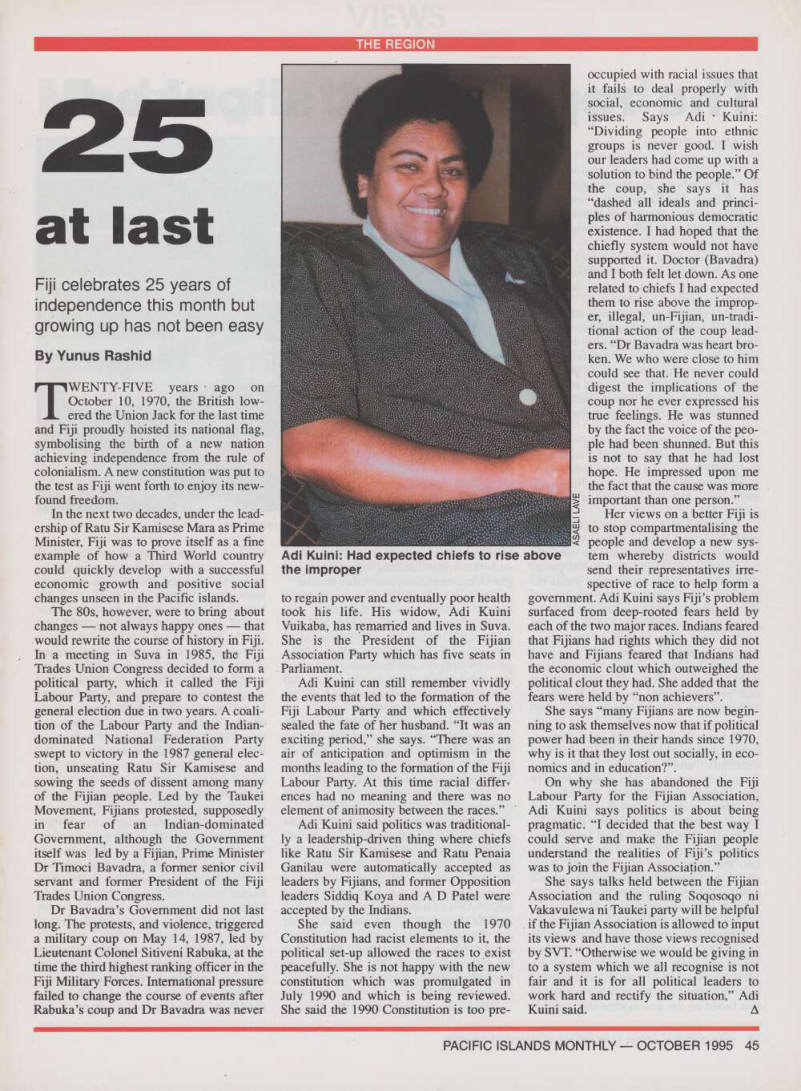
to regain power and eventually poor health took his life. His widow, Adi Kuini Vuikaba, has remarried and lives in Suva.
She is the President of the Fijian Association Party which has five seats in Parliament.
Adi Kuini can still remember vividly the events that led to the formation of the Fiji Labour Party and which effectively sealed the fate of her husband. “It was an exciting period,” she says. “There was an air of anticipation and optimism in the months leading to the formation of the Fiji Labour Party. At this time racial differr ences had no meaning and there was no element of animosity between the races.”
Adi Kuini said politics was traditional ly a leadership-driven thing where chiefs like Ratu Sir Kamisese and Ratu Penaia Ganilau were automatically accepted as leaders by Fijians, and former Opposition leaders Siddiq Koya and A D Patel were accepted by the Indians.
She said even though the 1970 Constitution had racist elements to it, the political set-up allowed the races to exist peacefully. She is not happy with the new constitution which was promulgated in July 1990 and which is being reviewed.
She said the 1990 Constitution is too pre
occupied with racial issues that it fails to deal properly with social, economic and cultural issues. Says Adi * Kuini:
“Dividing people into ethnic
groups is never good. I wish our leaders had come up with a solution to bind the people.” Of the coup, she says it has “dashed all ideals and princi ples of harmonious democratic existence. I had hoped that the chiefly system would not have supported it. Doctor (Bavadra) and I both felt let down. As one related to chiefs I had expected them to rise above the improp
er, illegal, un-Fijian, un-tradi
tional action of the coup lead ers. “Dr Bavadra was heart bro ken. We who were close to him could see that. He never could digest the implications of the coup nor he ever expressed his true feelings. He was stunned by the fact the voice of the peo ple had been shunned. But this is not to say that he had lost hope. He impressed upon me the fact that the cause was more important than one person.”
Her views on a better Fiji is to stop compartmentalising the people and develop a new sys tem whereby districts would send their representatives irre spective of race to help form a
government. Adi Kuini says Fiji’s problem surfaced from deep-rooted fears held by each of the two major races. Indians feared that Fijians had rights which they did not have and Fijians feared that Indians had the economic clout which outweighed the political clout they had. She added that the fears were held by “non achievers”.
She says “many Fijians are now begin ning to ask themselves now that if political power had been in their hands since 1970, why is it that they lost out socially, in eco nomics and in education?”.
On why she has abandoned the Fiji Labour Party for the Fijian Association, Adi Kuini says politics is about being pragmatic. “I decided that the best way I could serve and make the Fijian people understand the realities of Fiji’s politics was to join the Fijian Association.”
She says talks held between the Fijian Association and the ruling Soqosoqo ni Vakavulewa ni Taukei party will be helpful if the Fijian Association is allowed to input its views and have those views recognised by SVT. “Otherwise we would be giving in to a system which we all recognise is not fair and it is for all political leaders to work hard and rectify the situation,” Adi Kuini said. A
Adi Kuini: Had expected chiefs to rise above the improper