Land of Diversity
p. 38 · Read in the full issue
Papua New Guinea
TOURISM is a grossly under-exploited industry in Papua New Guinea today, says that country’s Tourism Promotion Authority.
Due to existence of rich mineral and forest resources within the country, little political attention was focused towards this service industry in the past. However, with its wide ly diversified geographical terrain within a small region and unique vibrant cultures, it has high potential to develop as a major tourism destination in the South Pacific region.
Papua New Guinea is a land of geo graphical diversity with high mountains, low lying swamps and volcanoes. The domi nant features of the country is the central spine, a complex of high mountain ranges intersected by alpine valleys and many plateaux.
Vast tracts of Papua New Guinea are still wild and underdeveloped. Extremely rugged mountains, thick jungles, swamps and the sea have for centuries restricted contacts among different tribes, inhibiting the growth of a common language and con tact with the outside world. This has given rise to numerous distinct, unique and
vibrant cultures and traditions which have remained practically unchanged for cen turies.
From the point of view of diverse geo graphical setting, the country is a vast, primitive and sensationally beautiful desti nation for travellers. From a tourist’s view point it is the “last great frontier on earth”.
Since independence in 1975, tourism remained a potentially sensitive issue in PNG and interest in its development waxed and waned under successive govern ments. Physical growth in the sector was very slow, and the appreciation of the cur rency (Kina) in the past on the back of large-scale resource development meant that tourism became an expensive, low vol ume and high yield sector.
However, the tourism scenario in PNG is undergoing a rapid change now. The national government of the country now regards tourism as one of its key priority areas for generation and employment.
The government established a new and specialised body, the Tourism Promotion Authority (TPA) in early 1993 to change the nature of tourism in the country. It is to
operate as a stimulus for the private sector by promoting the overall tourism image of the country and by facilitating the growth and development of the industry at home.
TPA expects that there will be a signifi cant upsurge of visitors in PNG in the near future the great majority of them being holiday-makers. However, to maintain the quality of tourism products of PNG unaf fected, a sudden upsurge of international visitors may not be desirable. It ideally needs a slow but very steady process of growth maintaining close link with the car rying capacity of the industry at home.
After decades of no growth, to achieve this, it is essential that the momentum and direction initiated by the TPA in the market ing and developmental areas so far be maintained and enhanced in future years.
And, at the same time, structural bottle necks in the areas of aviation and other infrastructural areas need to be eased.
Then only we can have a strong and viable tourism industry in PNG in the near future which can provide a practical solution to the economic and social problems the country is facing today.
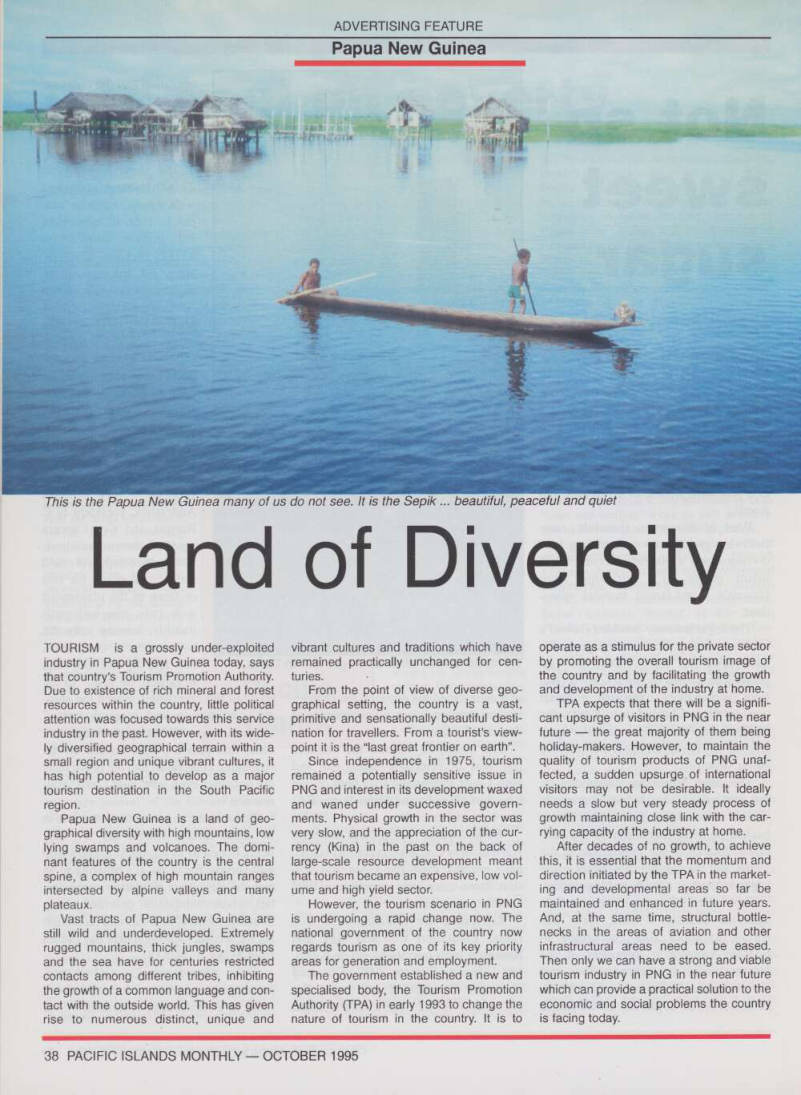
This is the Papua New Guinea many of us do not see. It is the Sepik ... beautiful, peaceful and quiet