Not so
p. 37 · Read in the full issue
sweet sugar
By Bruce Dunford
FOR more than a century, sugar was king in Hawaii, a powerful force that drove the islands’ econ omy and politics. Now, the dynasty’s sweetness has gone sour. Where there once were tall stands of lush sugar cane spreading across thousands of acres, many fields are fallow, tarnished with a dry, yellowish stubble of scrub cane and weeds.
West of downtown Honolulu, cane fields are giving way to sprawling sub divisions and a planned “second city” urban centre. It’s detracting from Hawaii’s world-famed tropical splen dour.
The sugar industry moulded Hawaii’s modem social and political fabric. In the late 1800 s and early 1900 s, the vast plantations owned by the so-called “Big Five” companies, imported contract workers from China, Japan, Korea, the Philippines, Puerto Rico and Portugal, leading to Hawaii’s largely harmonious ethnic diversity.
The often repressive conditions on the plantations also led to sometimes violent union organisation and a union backed political revolution by the edu cated children of the immigrants in the 19505. But the number of workers in the siigar industry is now dwindling rapidly.
From some 9000 employees a decade ago, the industry’s work force has shrunk to about 2000, according to Eusebio Lapenia Jr, president of the International Longshoremen’s and Warehousemen’s Union Local 142. In June, Mcßryde Sugar Co. on the island
of Kauai joined the growing list of plan tations shutting down, citing decades of financial losses.
The shutdown follows the closures last year of Hamakua Sugar Co. and Hilo Coast Processing Co., both on the island of Hawaii, and Oahu Sugar Co., just west of Honolulu.
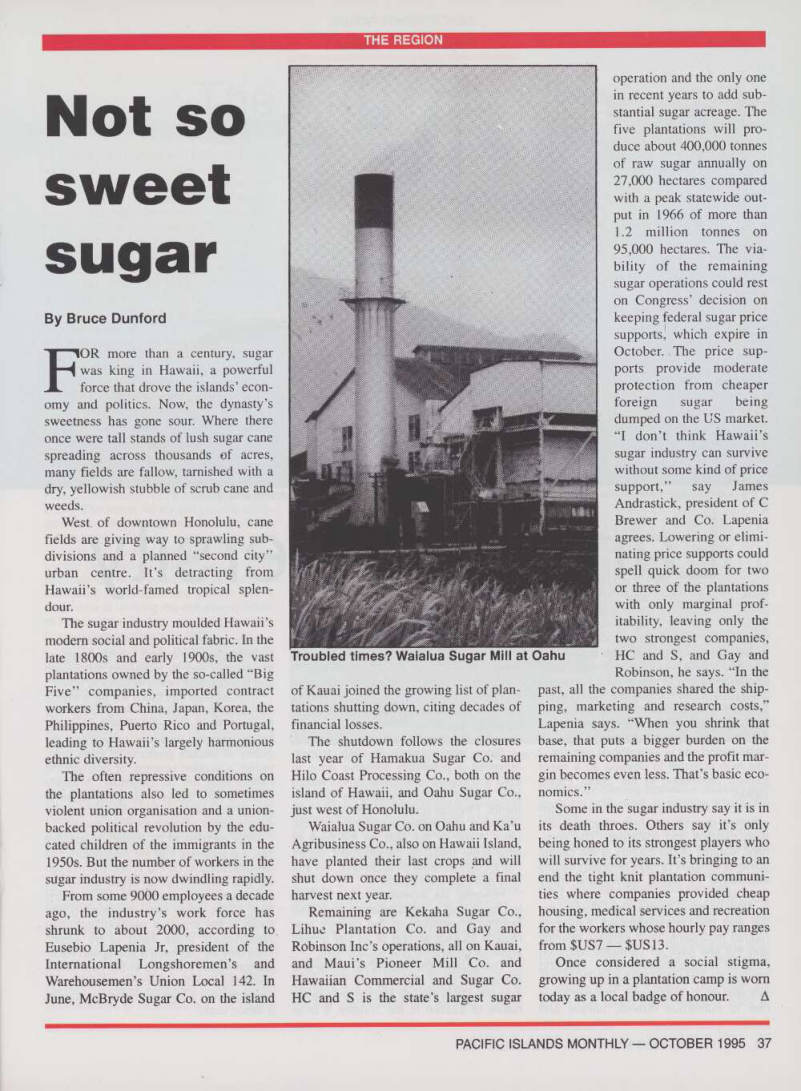
Waialua Sugar Co. on Oahu and Ka’u Agribusiness Co., also on Hawaii Island, have planted their last crops and will shut down once they complete a final harvest next year.
Remaining are Kekaha Sugar Co., Lihue Plantation Co. and Gay and Robinson Inc’s operations, all on Kauai, and Maui’s Pioneer Mill Co. and Hawaiian Commercial and Sugar Co.
HC and S is the state’s largest sugar
operation and the only one in recent years to add sub stantial sugar acreage. The five plantations will pro duce about 400,000 tonnes of raw sugar annually on 27.000 hectares compared with a peak statewide out put in 1966 of more than 1.2 million tonnes on 95.000 hectares. The via bility of the remaining sugar operations could rest on Congress’ decision on
keeping federal sugar price
supports] which expire in
October. The price sup ports provide moderate protection from cheaper foreign sugar being dumped on the US market.
“I don’t think Hawaii’s sugar industry can survive without some kind of price support,” say James Andrastick, president of C Brewer and Co. Lapenia agrees. Lowering or elimi nating price supports could spell quick doom for two or three of the plantations with only marginal prof itability, leaving only the two strongest companies, HC and S, and Gay and Robinson, he says. “In the
past, all the companies shared the ship ping, marketing and research costs,”
Lapenia says. “When you shrink that base, that puts a bigger burden on the remaining companies and the profit mar gin becomes even less. That’s basic eco nomics.”
Some in the sugar industry say it is in its death throes. Others say it’s only being honed to its strongest players who will survive for years. It’s bringing to an end the tight knit plantation communi ties where companies provided cheap housing, medical services and recreation for the workers whose hourly pay ranges from SUS 7 SUSI 3.
Once considered a social stigma, growing up in a plantation camp is worn today as a local badge of honour. A
Troubled times? Waialua Sugar Mill at Oahu