Little Wonders
pp. 52-55 · Read in the full issue
Sports
As Fiji fights back to regain lost rugby union glory, two of its sons find new magic on the field
By Atama Raganivatu
HERE’S a question that will have sports trivia enthusiasts scratch ing their heads in the decades to come: Which pair of brothers scored tries for two different international rugby union sides on the same weekend?
The answer is (and I doubt if many out side of Fiji would have answered cor rectly) Walter and Laurence Little who crossed the trylines of Scotland and England A respectively within hours of each other in mid June this year while representing New Zealand and Fiji.
Walter’s World Cup quarterfinal effort was the more significant.
However, Laurence’s probably gave the greater personal satisfaction as it helped him cement his place on an international stage that, just a few months ago, he seemed destined never to grace.
Throughout his career, Laurence has lived in Walter’s shadow. Whereas Walter was earmarked for worldwide stardom while still at school, Laurence had struggled to make any real impact beyond club level until called up for Fiji duty in April 1995.
Both were bom in Tokoroa, a small city in the Waikato province of New Zealand, and it is through their parents, Edward and Rewa, that Laurence gained eligibility to represent Fiji. Rewa hails from Yadua village in Nadroga and Edward was bom in Ba, both on Fiji’s main island of Viti Levu, where the cou ple commenced their married life together before moving on to Sigatoka, then Lautoka. They were in Lautoka when Edward decided they would emi grate to New Zealand.
“I had itchy feet in those days,”
Edward recalls. “We Littles have always been globetrotters. It must be something to do with our Scottish blood. The Scots are great roamers. My grandfather came from Scotland and my father is Tongan!
I felt like a change of lifestyle, so we moved to New Zealand.”
And so, in 1965, the Little family (then six strong) travelled to Tokoroa, where Edward and Rewa still live. Two of their Eiji-bom sons also played first class rugby; Kevin and Lrankie repre senting the always formidable Waikato provincial XV, but a series of injuries hampered Lrankie’s progress and Kevin sacrificed the game in order to take up a
job opportunity in Australia.
Edward also blames injuries for restricting Laurence’s development, as well as the four hours of travelling required each week between Tokoroa and Hamilton, in order to attend training in the latter city with Waikato, which
drained him of the enthusiasm required to succeed at the top level. He played only a handful of games for “The Mooloos” before joining Walter in the North Harbour provincial union in 1993.
Edward believes that Laurence’s rugby would have benefited immensely had he moved north earlier, as the more com petitive environment there and the less arduous travelling demands rekindled his keenness.
Unfortunately, Laurence has, at the time of writing, been restricted to just a single appearance for the star-studded North Harbour combination and club rugby has provided him with his only
opportunities to play regularly alongside
his famous younger (by two years) brother — both in New Zealand and Italy, where they have spent several northern hemisphere winters.
It was former All Black Brad Johnstone, in his capacity as coaching
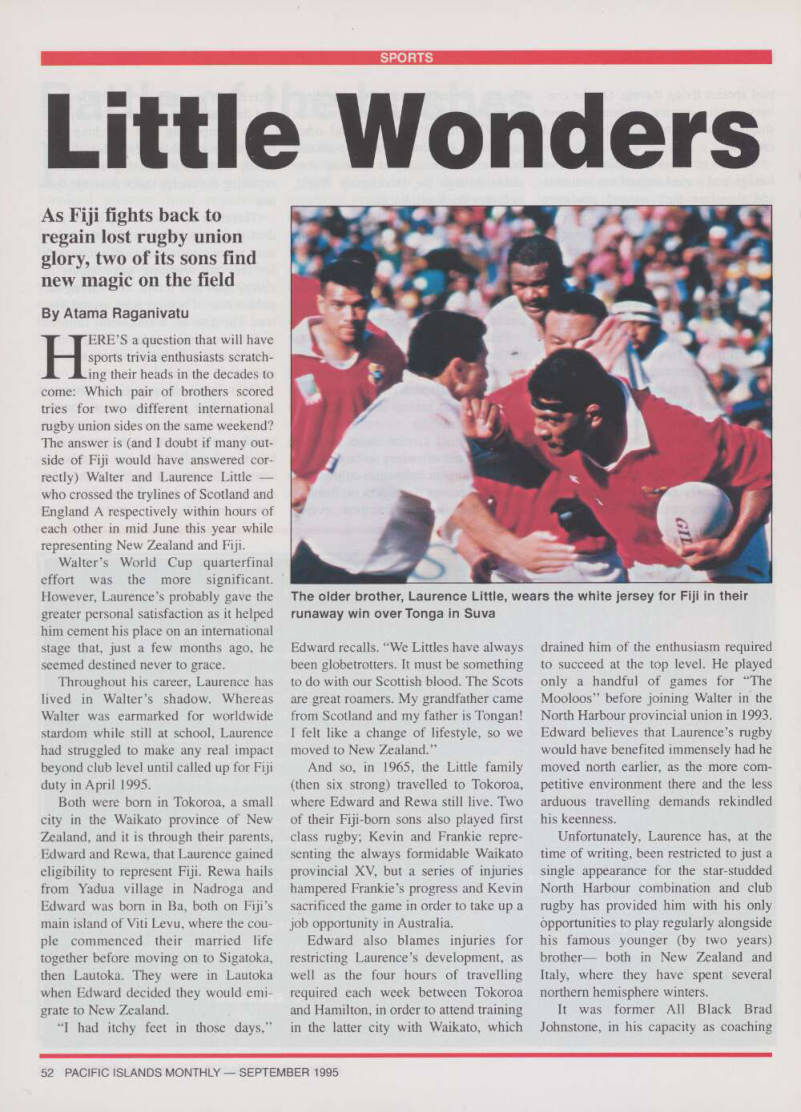
The older brother, Laurence Little, wears the white jersey for Fiji in their runaway win over Tonga in Suva
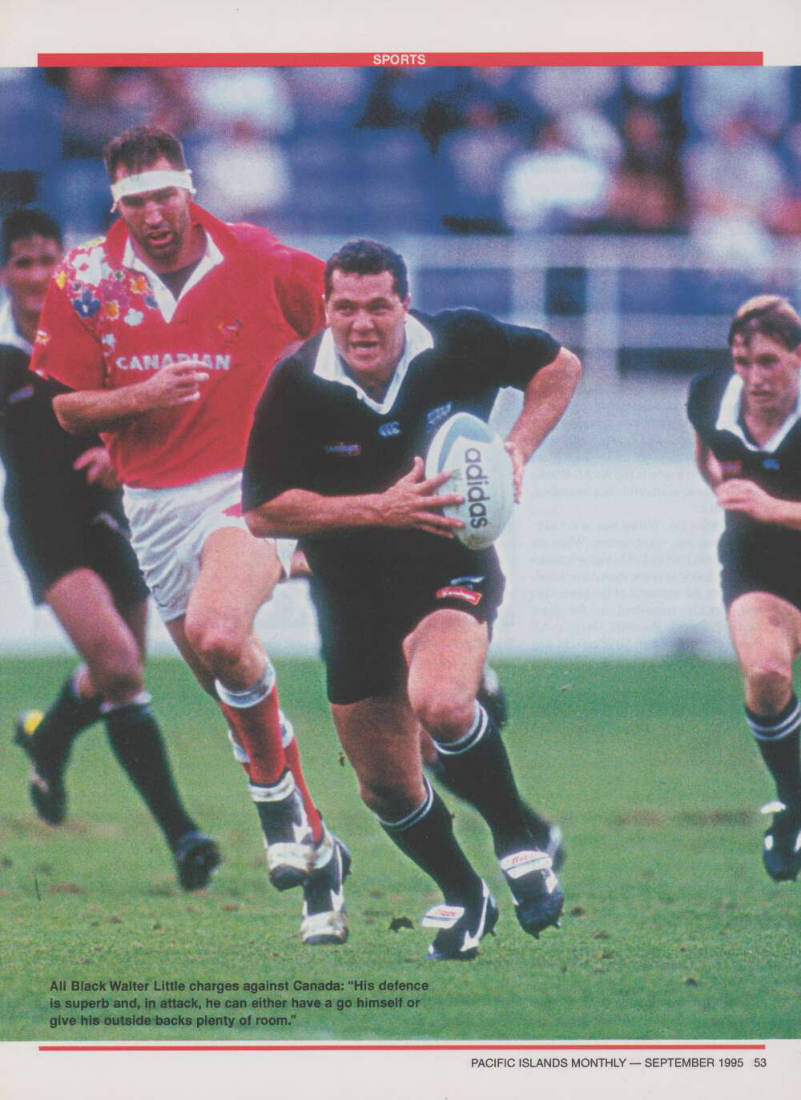
All Black Walter Little charges against Canada: “His defence is superb and, in attack, he can either have a go himself or give his outside backs plenty of room."
assistant to the Fiji Rugby Football Union, who approached Laurence and enquired if he would consider playing for his parents’ home country. He leapt at the chance and made a fine debut against Canada at Nadi in April.
Johnstone not only paved the way for Laurence’s unexpected elevation into international rugby, but also enabled him to rediscover his roots. Since the call up, he has become very interested in the Fijian way of life and gained a love of the local culture.
Laurence is now a hero in Fiji, as the immensely proud and elated Edward discovered when there to see his son play against Tonga in July. “Everywhere we went, we were feted,” he enthused after returning to Tokoroa. “People were forever coming up to us, introducing themselves and wishing us well. And, also Walter. They obviously take great delight in his exploits for the All Blacks too. It was a wonderful, but humbling, experience.”
Sadly for Fiji, Walter was never like ly to wear her white jersey. When he came to the fore in 1988, Fiji selections were still strictly home-based units and, moreover, the youngest of the Little clan was already enmeshed in the New Zealand Rugby Football Union’s All Black production line by then. He had moved from Tokoroa to board at Auckland’s Hato Patero College while in his mid teens in order to advance his rugby at the behest of NZRFU coaches and, when there, appeared for the Kiwi national schools XV.
Remaining in the Auckland area after leaving Hato Patero, Walter broke into North Harbour’s senior representative side during their 1988 campaign. The following year saw him capped by the New Zealand Colts (under 21 side) before graduating to the senior All Blacks for their tour to Canada, Wales and Ireland at the end of that same sea son.
His inevitable test baptism came against Scotland at Dunedin in 1990.
However, a year later, he found himself as the understudy to the more consistent (at that time) but less gifted Bemie McCahill when the World Cup com-
menced. McCahill’s ineffectuality as the All Blacks were beaten by Australia in the semifinals and Walter’s brilliance during the subsequent third-place play off win over Scotland proved the selec tors to have erred.
Still, Walter was to experience more
setbacks before returning triumphantly to the World Cup arena four years hence.
A tom knee ligament, sustained during the first test against the British Lions in 1993, commenced a frustrating period blighted by further injuries, bad luck and indifferent form. At the start of the 1994 season, several commentators suggested that he was, at 24, washed up. Not until the year’s final international, against Australia in Sydney, did he win back his starting line-up place. A dynamic perfor mance that evening ensured he would be a key figure in New Zealand’s 1995 World Cup plans.
Walter was the best second five eighth on display as New Zealand fought vainly to recapture the Webb Ellis Cup. His mercurial running, confi dence and solid tackling were evident in
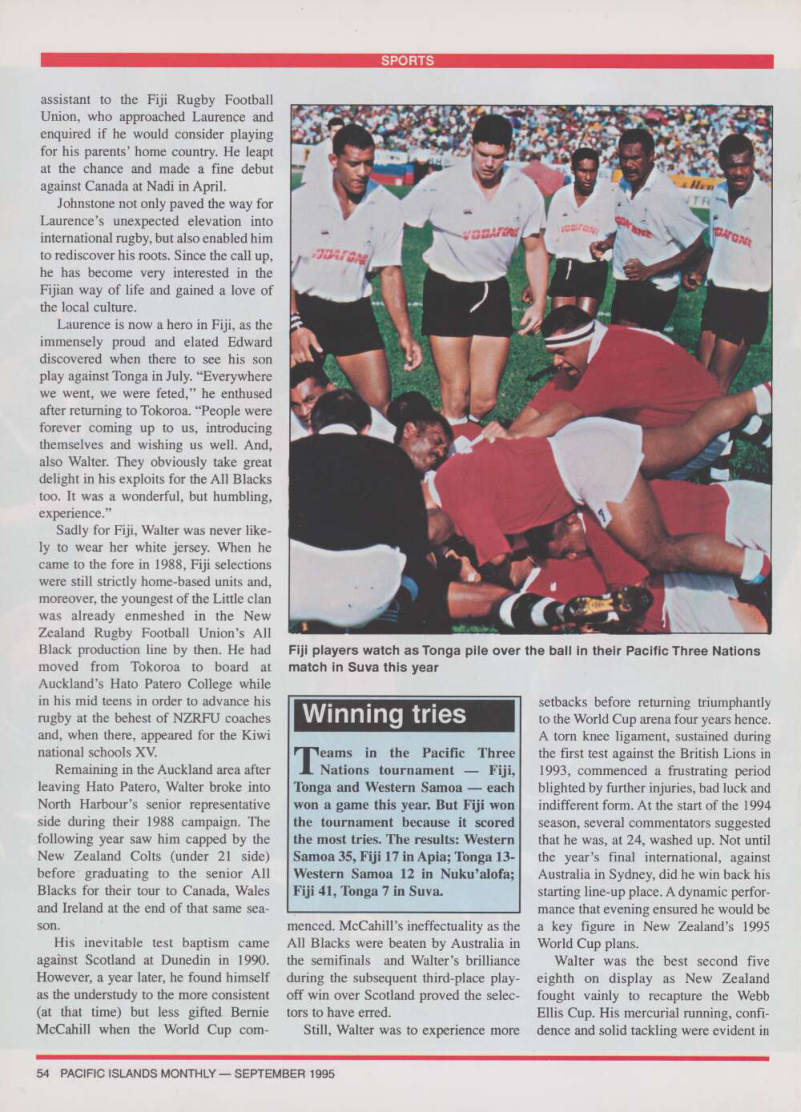
Fiji players watch as Tonga pile over the ball in their Pacific Three Nations match in Suva this year
each game he played, as was the ability to create space for the incredible Jonah Lomu and feed the gigantic Tongan with astute passes.
All players, teammates and oppo nents alike, approached in respect of this article were eager to give testimony to Walter’s prowess. Perhaps the most per tinent comment came from his long time adversary, the Australian centre Tim Horan, who said: “His defence is superb and, in attack, he can either have a go himself or give his outside backs plenty of room. He’s probably the best in the
world at his position now.” Like Laurence, Walter has dabbled with the roles of first five-eighth and centre but is now regarded as a specialist second five eighth. The pair’s personalities, though, have never changed. The words “friend ly”, “obliging”, “honest”, “shy” and “likeable” recurred frequently when speaking to people who knew the Littles before they gained fame and those close to them now.
When this feature was written, Walter’s future had become the subject of much speculation. Several Australian
rugby league clubs were reported to be offering him lucrative contracts that would secure the financial welfare of his family. According to All Black coach Laurie Mains, “He is 50-50 about it.”
Laurence, though, is certain about where his aspirations lie. Having tasted success with the Three Nations Tournament winning Fiji side, he is keen to help his adopted country continue their revival.
The name Little, then, should be on the international rugby union scene for some time yet. A