Giving turtles
pp. 46-47 · Read in the full issue

Conservation
Giving turtles a chance
By Patrick Decloitre
IN this International Year of the Turtle, Vanuatu’s northern Malampa province has taken steps to set up what will be the largest protected area in Vanuatu and the Pacific.
Project promoter Luca Tacconi, an Australian-funded environmental econo mist from the Department of Economics at the University of New South Wales, said some five protected areas, totalling 14,000 hectares will soon be reserved.
This will make Malekula the largest area to become protected in Vanuatu.
Previous projects, on southern Erromango and northern Santo islands, totalled some 7000 hectares of protected areas focusing on forest preservation.
On Malekula, the focus will not only be on forestry, but also on marine resources protection, especially turtles.
A total of 21 kilometres of turtle-nest ing coastlines is protected under the scheme. Vanuatu has declared a total ban on turtle hunting, that is presently being enforced by the landowners of
Malekula. Fiji has also banned the killing and molesting of turtles for a year In Vanuatu, a legislation is being drafted by the Attorney General’s Office.
In 1983, fisheries regulations were introduced to Vanuatu, forbidding to possess, sell or buy turtle eggs or to interfere with any turtle nest.
On the tropical beaches of this island, usually between November and January, between 55 to 145 turtles comes to nest.
Four weeks later, at night, female tur tles make their way to the beach and drag their heavy weight over the sand above the high tide mark where they will lay around 120 round white eggs, then crawl back to the water. About two weeks later, they will return to lay anoth er clutch of eggs.
Any movement or light scares them back into the water.
“Our environment is god’s gift. If we destroy it, it will never come back and what will be left for our children? That’s why me and my family agreed to make
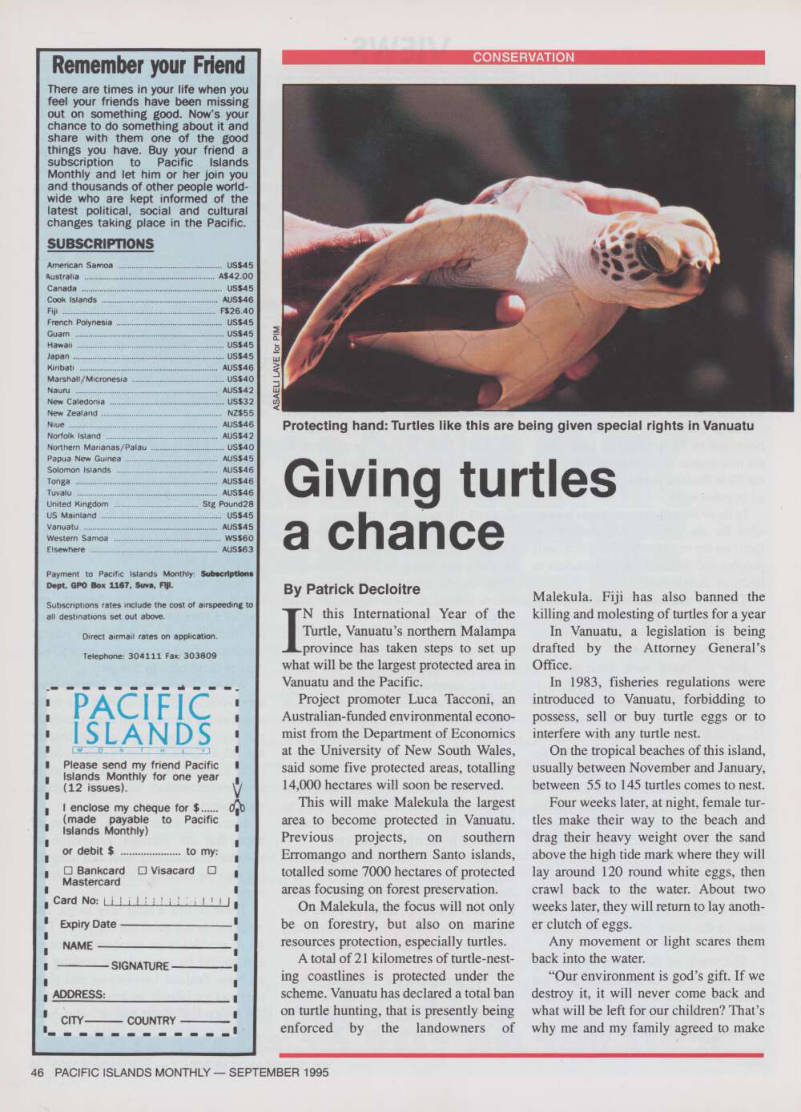
Protecting hand: Turtles like this are being given special rights in Vanuatu
our land a protected area,” chief Timothy Nehapi, one of the traditional owners of the protected beaches, said.
Province President Frank Kenneth quoted Article 7 of the Vanuatu constitu tion, which says every individual has the fundamental right to protect national resources and the environment for the sake of the present generation and the generations to come.
“We strongly believe that conserva tion areas have to be dealt with as a mat ter of priority. We don’t want our resources loaded and unloaded in ships to Asia,” Kenneth said.
A recent South Pacific Regional Environment Programme (SPREP) study points out that in many Pacific Islands countries, turtles are hunted for food, or for their shells, or to use their oil in cosmetics. Sometimes, small turtles are captured and sold to tourist alive.
A SPREP conference held in Port Vila six years ago declared some sites in the islands of Malekula, Erromango and
Santo of “regional and international importance.” In Vanuatu, green and
hawksbill turtles have been exploited for their meat and eggs on a local level, but were not sold for cash. In south ern Tanna, turtle is even part of the tradition, and some fami lies claim to descend from them. Only those “turtle
men” are al-lowed to capture turtles in specific taboo areas.
In South Malekula, it is customary to kill turtles when the yam harvesting sea son comes.
“This is part of the culture, but tur tles are also part of the environment,”
says Vanuatu Fisheries Department Director Doresty Kenneth, who is from the same island.
“This is a nursery area for turtles, and it is particularly important to protect it, because this year is the international year of the turtle.”
Vanuatu’s director of environmental unit, Ernest Bani, confirms in some areas of Malekula, it is a tradition to eat turtles in February, when the yams roots are harvested.
“One week before February 4 each year, villagers take their canoes to sea and jump on the turtles to catch them.
Then they keep them in fenced yards until the feast takes place. Then they kill the turtles,” he said.
“This is difficult for us to prevent because this is their tradition. We can only rely on the local chiefs to pass on the message and tell their villagers to restrict the number to the very mini mum, say a maximum of 15 turtles, which is enough.” A
Tacconi: Promoter