Where’s Uncle Sam?
pp. 26-28 · Read in the full issue
The Region
Cost cuts in the United States result in a significant absence in the Pacific. Are the small island states victims of a new swing in international politics?
By David North
IS Washington losing interest in the South Pacific? Many signs point in that direction, but one of them was reversed in late July when President Bill Clinton finally nominated California businessman Don Lee Gevirtz to be Ambassador to Fiji.
Some signs of US disinterest includ ed: • the closing of the regional USAID mission in Suva; • the closing of the small diplomatic post in Honiara; • the State Department’s renewed threat to shut down the US diplomatic post in Apia; • the Clinton Administration’s deci sion to downsize the Interior Department’s island affairs office; • the House of Representatives’ deci sion to obliterate any funding for Interior’s role in the islands; • the minimal achievements of the Joint Commercial Commission, the trade-not-aid programme started by George Bush that created high hopes in he islands; and • the Administration’s previously cited failure, for more than two years, to place an ambassador in Suva.
But as one Washington observer noted: “Hey guys, do not take it person ally Washington has lost interest in lots of things, both foreign and domes tic.”
For example, in contrast to Bush’s
strong intervention in Iraq, and his entry into Somalia, Clinton pulled out of Somalia when the gang leaders started shooting back. Neither Bush nor Clinton was willing to ride to the rescue of the Bosnian Muslims as Bush rescued the Arab princes from Saddam Hussein.
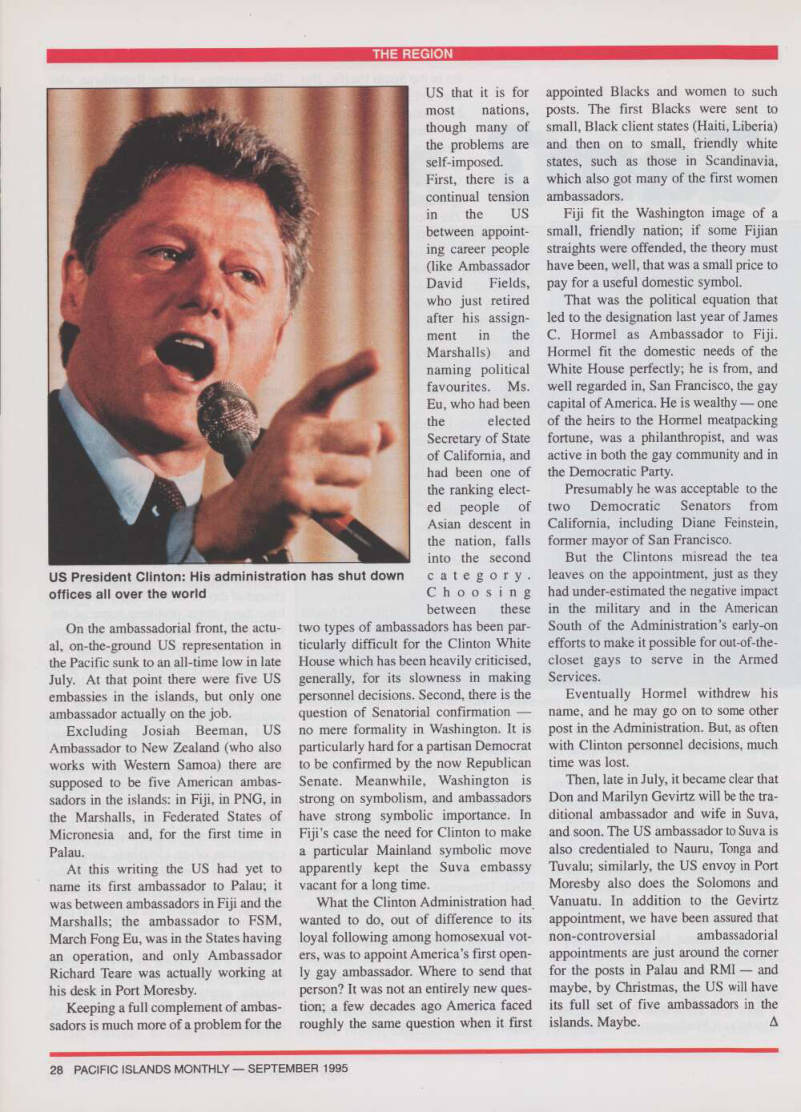
And, more to point in the Pacific, the State Department has shut down offices all over the world.
It should be remembered that on the domestic scene that Clinton defeated Democrats who really like government in the run-up to the 1992 Presidential election. Then, topping that, in November of the past year, the Democrats in the Congress lost to a col lection of Republicans ranging from
those who hate government (e.g.
Senators Jesse Helms (NC) and Phil Gramm (TX) to those who simply want to wipe out most of it (e.g. House Speaker Newt Gingrich (GA).
So, to over generalise, Washington has lost interest in the poor, in kids need ing vaccines or education, in minorities, in the unemployed and in spending money overseas. The one exception: the Republicans want to appropriate more money for guns.
Further, for the first time in decades, American politicians really feel that they have to eliminate the annual gap between income and outgo. The Reagan Administration, with some help from a complacent Democratic Congress, cut
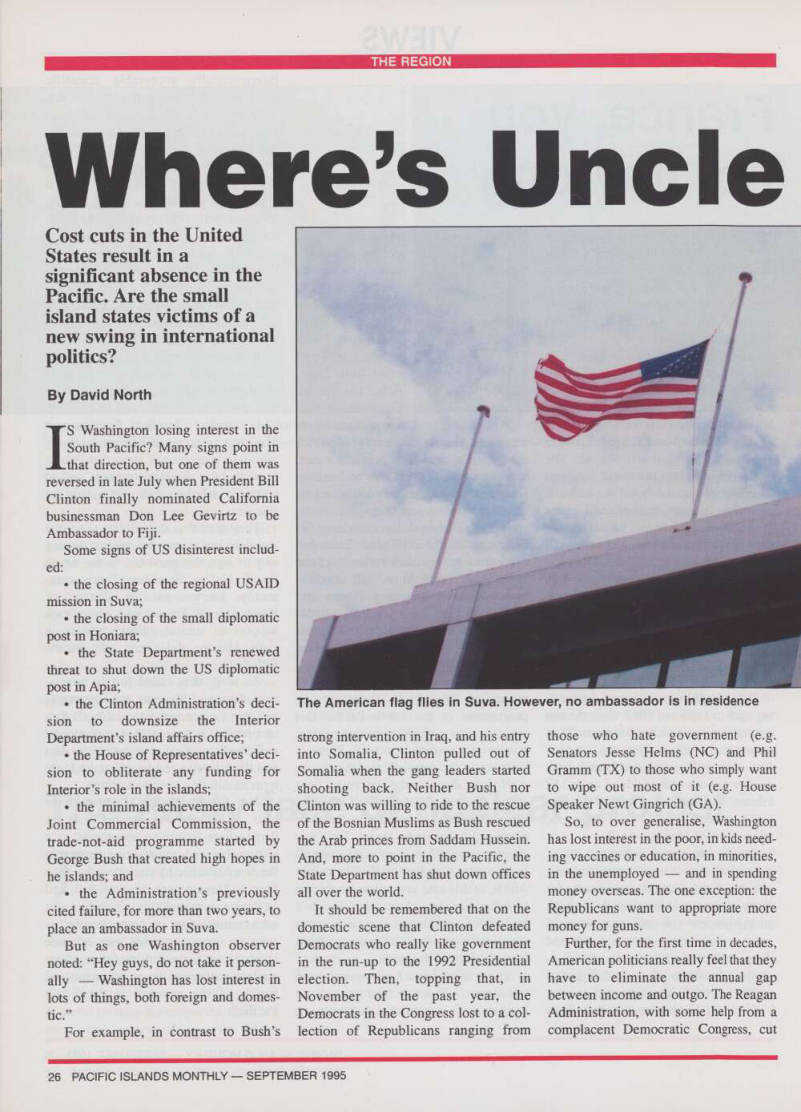
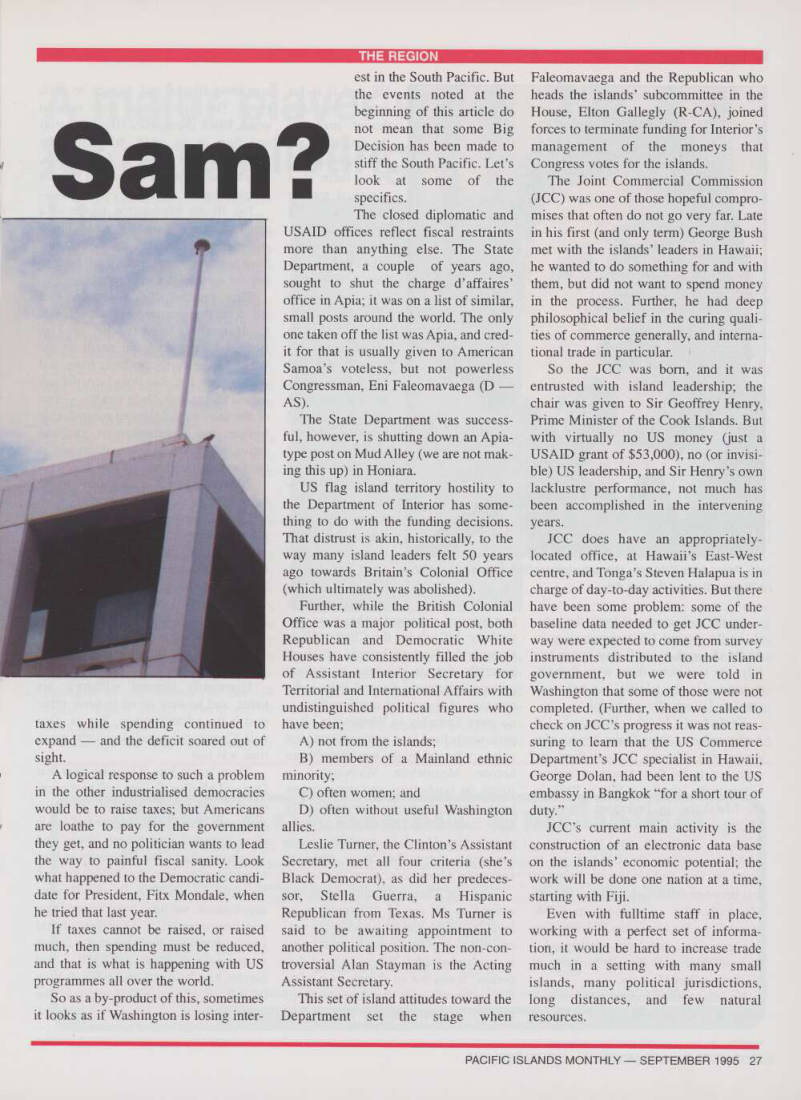
The American flag flies in Suva. However, no ambassador is in residence
taxes while spending continued to expand and the deficit soared out of
sight.
A logical response to such a problem in the other industrialised democracies would be to raise taxes; but Americans are loathe to pay for the government they get, and no politician wants to lead the way to painful fiscal sanity. Look what happened to the Democratic candi date for President, Fitx Mondale, when he tried that last year.
If taxes cannot be raised, or raised much, then spending must be reduced, and that is what is happening with US programmes all over the world.
So as a by-product of this, sometimes it looks as if Washington is losing inter
est in the South Pacific. But the events noted at the beginning of this article do not mean that some Big Decision has been made to stiff the South Pacific. Let’s look at some of the specifics.
The closed diplomatic and
USAID offices reflect fiscal restraints more than anything else. The State Department, a couple of years ago, sought to shut the charge d’affaires’ office in Apia; it was on a list of similar, small posts around the world. The only one taken off the list was Apia, and cred it for that is usually given to American Samoa’s voteless, but not powerless Congressman, Eni Faleomavaega (D AS).
The State Department was success ful, however, is shutting down an Apia type post on Mud Alley (we are not mak ing this up) in Honiara.
US flag island territory hostility to the Department of Interior has some thing to do with the funding decisions.
That distrust is akin, historically, to the way many island leaders felt 50 years ago towards Britain’s Colonial Office (which ultimately was abolished).
Further, while the British Colonial Office was a major political post, both Republican and Democratic White Houses have consistently filled the job of Assistant Interior Secretary for Territorial and International Affairs with undistinguished political figures who have been; A) not from the islands; B) members of a Mainland ethnic minority; C) often women; and D) often without useful Washington allies.
Leslie Turner, the Clinton’s Assistant Secretary, met all four criteria (she’s Black Democrat), as did her predeces sor, Stella Guerra, a Hispanic Republican from Texas. Ms Turner is said to be awaiting appointment to another political position. The non-con troversial Alan Stayman is the Acting Assistant Secretary.
This set of island attitudes toward the Department set the stage when
Faleomavaega and the Republican who heads the islands’ subcommittee in the House, Elton Gallegly (R-CA), joined forces to terminate funding for Interior’s management of the moneys that Congress votes for the islands.
The Joint Commercial Commission (JCC) was one of those hopeful compro mises that often do not go very far. Late in his first (and only term) George Bush met with the islands’ leaders in Hawaii; he wanted to do something for and with them, but did not want to spend money in the process. Further, he had deep philosophical belief in the curing quali ties of commerce generally, and interna tional trade in particular, i So the JCC was bom, and it was entrusted with island leadership; the chair was given to Sir Geoffrey Henry, Prime Minister of the Cook Islands. But with virtually no US money (just a USAID grant of $53,000), no (or invisi ble) US leadership, and Sir Henry’s own lacklustre performance, not much has been accomplished in the intervening years.
JCC does have an appropriately located office, at Hawaii’s East-West centre, and Tonga’s Steven Halapua is in charge of day-to-day activities. But there have been some problem; some of the baseline data needed to get JCC under way were expected to come from survey instruments distributed to the island government, but we were told in Washington that some of those were not completed. (Further, when we called to check on JCC’s progress it was not reas suring to leam that the US Commerce Department’s JCC specialist in Hawaii, George Dolan, had been lent to the US embassy in Bangkok “for a short tour of duty.”
JCC’s current main activity is the construction of an electronic data base on the islands’ economic potential; the work will be done one nation at a time,
starting with Fiji.
Even with fulltime staff in place, working with a perfect set of informa tion, it would be hard to increase trade much in a setting with many small islands, many political jurisdictions, long distances, and few natural resources.
On the ambassadorial front, the actu al, on-the-ground US representation in the Pacific sunk to an all-time low in late July. At that point there were five US embassies in the islands, but only one ambassador actually on the job.
Excluding Josiah Beeman, US Ambassador to New Zealand (who also works with Western Samoa) there are supposed to be five American ambas sadors in the islands; in Fiji, in PNG, in the Marshalls, in Federated States of Micronesia and, for the first time in Palau.
At this writing the US had yet to name its first ambassador to Palau; it was between ambassadors in Fiji and the Marshalls; the ambassador to FSM, March Fong Eu, was in the States having an operation, and only Ambassador Richard Teare was actually working at his desk in Port Moresby.
Keeping a full complement of ambas sadors is much more of a problem for the
US that it is for most nations, though many of the problems are self-imposed.
First, there is a continual tension in the US
between appoint
ing career people (like Ambassador David Fields, who just retired after his assign ment in the Marshalls) and naming political favourites. Ms.
Eu, who had been the elected Secretary of State of California, and had been one of the ranking elect ed people of Asian descent in the nation, falls into the second category.
Choosing between these
two types of ambassadors has been par ticularly difficult for the Clinton White House which has been heavily criticised, generally, for its slowness in making personnel decisions. Second, there is the question of Senatorial confirmation no mere formality in Washington. It is particularly hard for a partisan Democrat to be confirmed by the now Republican Senate. Meanwhile, Washington is strong on symbolism, and ambassadors have strong symbolic importance. In Fiji’s case the need for Clinton to make a particular Mainland symbolic move apparently kept the Suva embassy vacant for a long time.
What the Clinton Administration had wanted to do, out of difference to its loyal following among homosexual vot ers, was to appoint America’s first open ly gay ambassador. Where to send that person? It was not an entirely new ques tion; a few decades ago America faced roughly the same question when it first
appointed Blacks and women to such posts. The first Blacks were sent to small, Black client states (Haiti, Liberia) and then on to small, friendly white states, such as those in Scandinavia, which also got many of the first women ambassadors.
Fiji fit the Washington image of a small, friendly nation; if some Fijian straights were offended, the theory must have been, well, that was a small price to pay for a useful domestic symbol.
That was the political equation that led to the designation last year of James C. Hormel as Ambassador to Fiji.
Hormel fit the domestic needs of the White House perfectly; he is from, and well regarded in, San Francisco, the gay capital of America. He is wealthy one of the heirs to the Hormel meatpacking fortune, was a philanthropist, and was active in both the gay community and in the Democratic Party.
Presumably he was acceptable to the two Democratic Senators from California, including Diane Feinstein, former mayor of San Francisco.
But the Clintons misread the tea leaves on the appointment, just as they had under-estimated the negative impact in the military and in the American South of the Administration’s early-on efforts to make it possible for out-of-the closet gays to serve in the Armed Services.
Eventually Hormel withdrew his name, and he may go on to some other post in the Administration. But, as often with Clinton personnel decisions, much time was lost.
Then, late in July, it became clear that Don and Marilyn Gevirtz will be the tra ditional ambassador and wife in Suva, and soon. The US ambassador to Suva is also credentialed to Nauru, Tonga and Tuvalu; similarly, the US envoy in Port Moresby also does the Solomons and Vanuatu. In addition to the Gevirtz appointment, we have been assured that non-controversial ambassadorial appointments are just around the comer for the posts in Palau and RMI and maybe, by Christmas, the US will have its full set of five ambassadors in the islands. Maybe. A
US President Clinton: His administration has shut down offices all over the world