Mururoa’s sinking feeling
pp. 22-24 · Read in the full issue
The Region
The French invited journalists to Mururoa but failed to provide all the answers
By Alfred Sasako
TWO hours by jet out of the French Polynesian capital of Papeete lies the South Pacific atolls of Mururoa and Fangataufa. They were once the idyllic Pacific paradise, perhaps with no comparison on the face of the earth clean, white sandy beach es, crystal-clear blue water and an unspoiled, undisturbed environment on a windswept outpost untouched by the outside world. Nearly 500 Polynesians live on Mururoa, the larger of the two Atolls.
More people live on other nearby islands like Torea with similar beauty and tranquillity. Sadly, for Mururoa and Fangataufa, those were the descriptions of yesteryears.
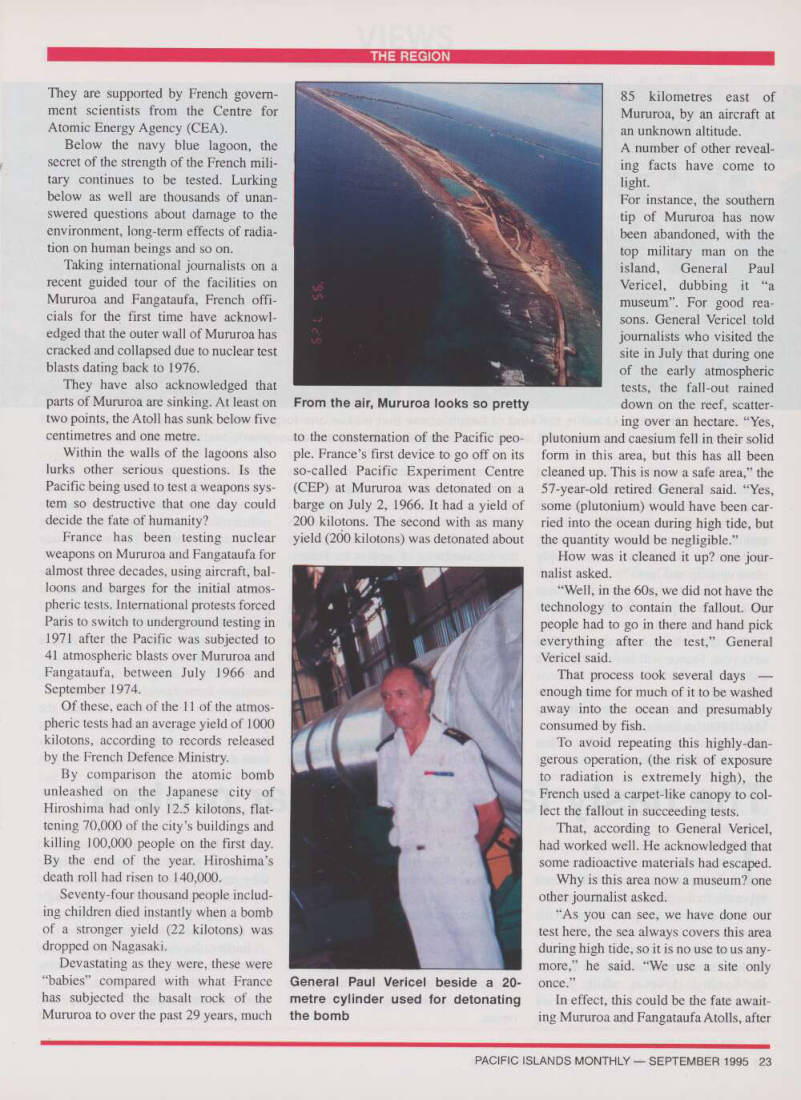
Mururoa is an oval-shaped lagoon about 600 km in length with varying width from 400 metres in the north to 1100 metres in the west. It has a natural inlet, leading into the once crystal clear blue waters synonymous with the Pacific. Coconut trees and other vegeta tion grow on the island. It has a military airport, complete with a reinforced con crete seawall around the parameter of the airport with a web of electronic devices such as satellite dishes and elec tronic gear.
Fangataufa, the smaller of the two atolls, was once a closed lagoon. It also has some vegetation and measures an average 300 metres in width. Using high explosives, the French blasted an artifi cial inlet on its northern coast. This gives the French access to the lagoon
which has been subjected to up to 150 kilotons of nuclear blasts.
Some devises that France had deto nated over the years were 10 times stronger than the atomic bomb that flat tened the Japanese city of Nagasaki, maiming tens of thousands of people at the height of the World War Two 50 years ago.
From the air, both Mururoa and Fangataufa are as idyllic as ever with some degree of innocence so synony mous with the Pacific Ocean and their people. Today, both atolls continue to display some form of innocence, except that the muzzle of the gun now guards both of them.
Up to 2000 French soldiers including members of the Foreign Legionnaires are permanently stationed on Mururoa.
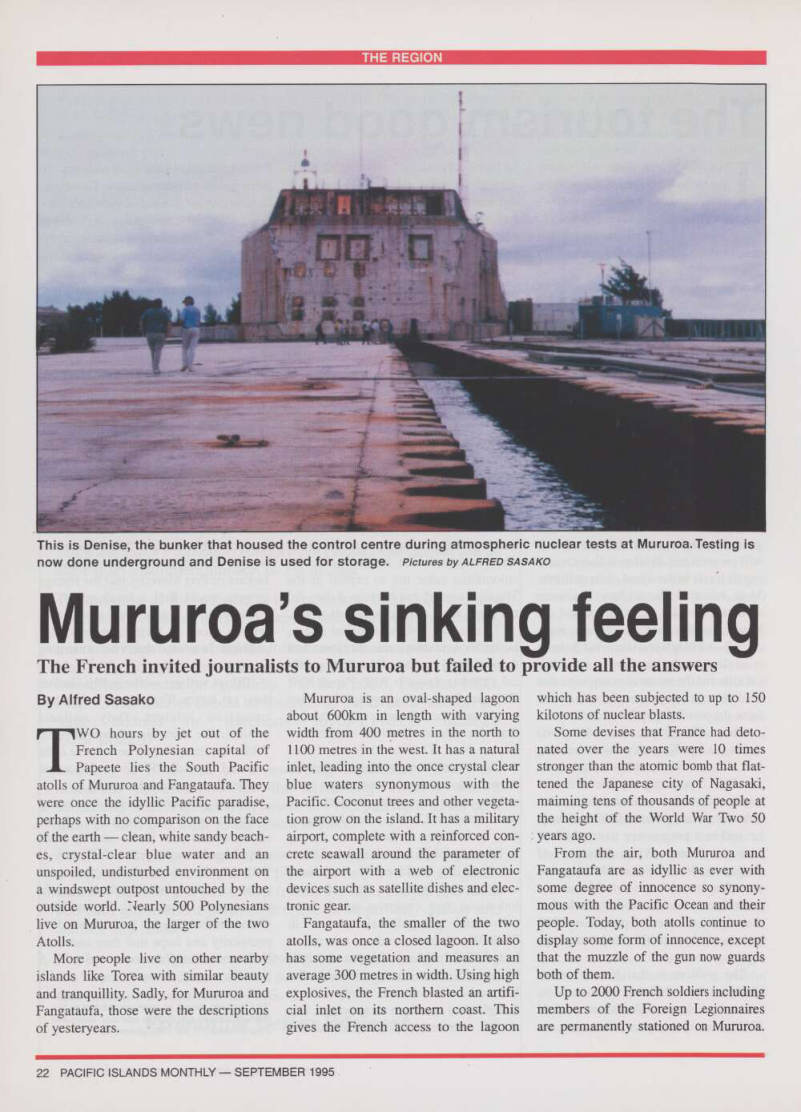
This is Denise, the bunker that housed the control centre during atmospheric nuclear tests at Mururoa. Testing is now done underground and Denise is used for storage. Pictures by ALFRED SASAKO
They are supported by French govern ment scientists from the Centre for Atomic Energy Agency (CEA).
Below the navy blue lagoon, the secret of the strength of the French mili tary continues to be tested. Lurking below as well are thousands of unan swered questions about damage to the environment, long-term effects of radia tion on human beings and so on.
Taking international journalists on a recent guided tour of the facilities on Mururoa and Fangataufa, French offi cials for the first time have acknowl edged that the outer wall of Mururoa has cracked and collapsed due to nuclear test blasts dating back to 1976.
They have also acknowledged that parts of Mururoa are sinking. At least on two points, the Atoll has sunk below five centimetres and one metre.
Within the walls of the lagoons also lurks other serious questions. Is the Pacific being used to test a weapons sys tem so destructive that one day could decide the fate of humanity?
France has been testing nuclear weapons on Mururoa and Fangataufa for almost three decades, using aircraft, bal loons and barges for the initial atmos pheric tests. International protests forced Paris to switch to underground testing in 1971 after the Pacific was subjected to 41 atmospheric blasts over Mururoa and Fangataufa, between July 1966 and
September 1974.
Of these, each of the 11 of the atmos pheric tests had an average yield of 1000 kilotons, according to records released by the French Defence Ministry.
By comparison the atomic bomb unleashed on the Japanese city of Hiroshima had only 12.5 kilotons, flat tening 70,000 of the city’s buildings and killing 100,000 people on the first day.
By the end of the year. Hiroshima’s death roll had risen to 140,000.
Seventy-four thousand people includ ing children died instantly when a bomb of a stronger yield (22 kilotons) was dropped on Nagasaki.
Devastating as they were, these were “babies” compared with what France has subjected the basalt rock of the Mururoa to over the past 29 years, much
to the consternation of the Pacific peo ple. France’s first device to go off on its so-called Pacific Experiment Centre (CEP) at Mururoa was detonated on a barge on July 2, 1966. It had a yield of 200 kilotons. The second with as many yield (200 kilotons) was detonated about
85 kilometres east of Mumroa, by an aircraft at an unknown altitude.
A number of other reveal ing facts have come to light.
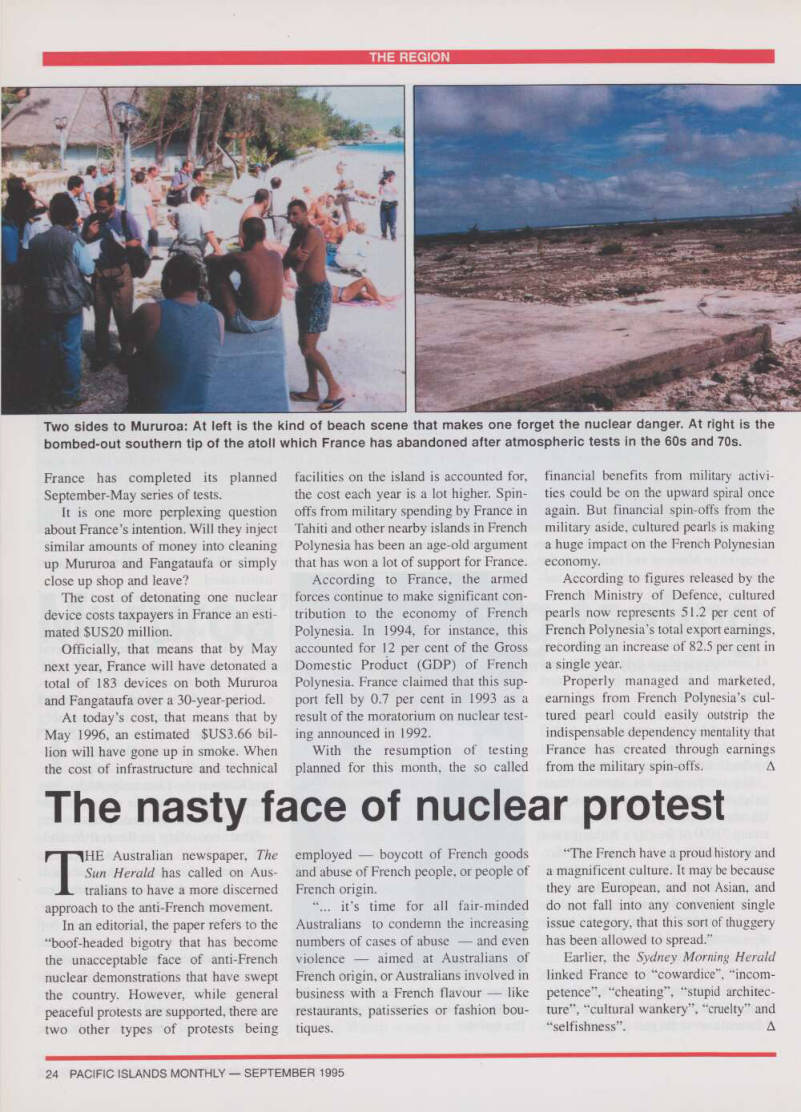
For instance, the southern tip of Mururoa has now been abandoned, with the top military man on the island, General Paul Vericel, dubbing it “a museum”. For good rea sons. General Vericel told journalists who visited the site in July that during one of the early atmospheric tests, the fall-out rained down on the reef, scatter ing over an hectare. “Yes,
plutonium and caesium fell in their solid form in this area, but this has all been cleaned up. This is now a safe area,” the 57-year-old retired General said. “Yes, some (plutonium) would have been car ried into the ocean during high tide, but the quantity would be negligible.”
How was it cleaned it up? one jour nalist asked.
“Well, in the 60s, we did not have the technology to contain the fallout. Our people had to go in there and hand pick everything after the test,” General Vericel said.
That process took several days enough time for much of it to be washed away into the ocean and presumably consumed by fish.
To avoid repeating this highly-dan gerous operation, (the risk of exposure to radiation is extremely high), the French used a carpet-like canopy to col lect the fallout in succeeding tests.
That, according to General Vericel, had worked well. He acknowledged that some radioactive materials had escaped.
Why is this area now a museum? one other journalist asked.
“As you can see, we have done our test here, the sea always covers this area during high tide, so it is no use to us any more,” he said. “We use a site only once.”
In effect, this could be the fate await ing Mururoa and Fangataufa Atolls, after
From the air, Mururoa looks so pretty
General Paul Vericel beside a 20metre cylinder used for detonating the bomb
France has completed its planned September-May series of tests.
It is one more perplexing question about France’s intention. Will they inject similar amounts of money into cleaning up Mururoa and Fangataufa or simply close up shop and leave?
The cost of detonating one nuclear device costs taxpayers in France an esti mated SUS2O million.
Officially, that means that by May next year, France will have detonated a total of 183 devices on both Mururoa and Fangataufa over a 30-year-period.
At today’s cost, that means that by May 1996, an estimated $U53.66 bil lion will have gone up in smoke. When the cost of infrastructure and technical
facilities on the island is accounted for, the cost each year is a lot higher. Spin offs from military spending by France in Tahiti and other nearby islands in French Polynesia has been an age-old argument that has won a lot of support for France.
According to France, the armed forces continue to make significant con tribution to the economy of French Polynesia. In 1994, for instance, this accounted for 12 per cent of the Gross Domestic Product (GDP) of French Polynesia. France claimed that this sup port fell by 0.7 per cent in 1993 as a result of the moratorium on nuclear test ing announced in 1992.
With the resumption of testing planned for this month, the so called
financial benefits from military activi ties could be on the upward spiral once again. But financial spin-offs from the military aside, cultured pearls is making a huge impact on the French Polynesian economy.
According to figures released by the French Ministry of Defence, cultured pearls now represents 51.2 per cent of French Polynesia’s total export earnings, recording an increase of 82.5 per cent in a single year.
Properly managed and marketed, earnings from French Polynesia’s cul tured pearl could easily outstrip the
indispensable dependency mentality that
France has created through earnings from the military spin-offs. A
Two sides to Mururoa: At left is the kind of beach scene that makes one forget the nuclear danger. At right is the bombed-out southern tip of the atoll which France has abandoned after atmospheric tests in the 60s and 70s.