radiation?
Aid or radiation?
Cooks Prime Minister Sir Geoffrey Henry has two options. One to go along with France’s plan of resuming nuclear testing and get aid or condemn the plan and don’t get aid? Which will it be?
By Lisa Williams
The Cook Islands are a mere hours flight away from the islands of French Polynesia, or a few days by canoe if you take into account the latest cultural rebirth of the Pacific Voyaging Alliance two months ago, at the Taputapuatea marae in Tahiti.
But the vibrant canoeing tradition, last seen some six centuries ago, isn’t the only revival in French Polynesia - underground nuclear testing is about to make a come back.
And the silence from the neighbours has
been deafening, considering the Copoks
are undecided over whether or not they will attend the South Pacific Games this month while Western Samoa and Nauru have pulled out in protest over the French stance.
The French Polynesia Maohi are con sidered the cousin race, like their Kiwi cousins, of the Cook Islands Maori.
Across the Pacific, from countries who face less qualms about eating the same fish that swims in the Mururoa lagoons as the Tahitians, there’s been loud reaction to Chirac's announcement that nuclear test ing will resume come September at the island of Mururoa.
Meanwhile, Cook Islanders sat and watched nightly reports on overseas TV carrying widespread reaction and official condemnation from New Zealand and Australia of the French stance.
For the country’s leader, the issue has prompted a somewhat two faced approach: at one level Sir Geoffrey Henry and his Cabinet support a peace march protesting the nuclear testing, a march where he calls on church leaders to use the power of prayer in a bid to stop the testing. But at another level he won’t commit to official boycotts or anything that would make the Cook Islands protest stand out.
“Right now Paris can’t see us, right now Paris is not hearing us - but there is some body that is hearing us and he is watching over today’s activities,” he told a gathering of 2000 at the biggest protest march in the nation’s history.
“If all our people say one prayer that the good lord will touch the hearts of those in France, that they may have the courage to reverse their decision to resume the test
ing.”
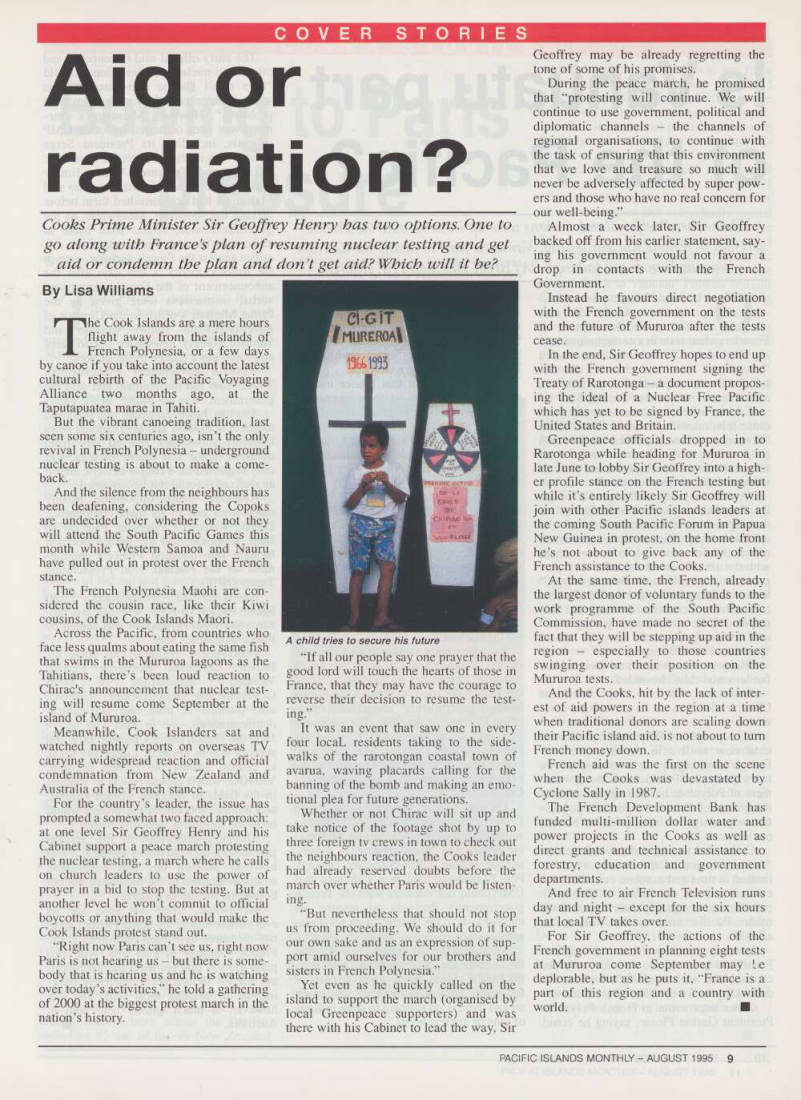
It was an event that saw one in every four locaL residents taking to the side walks of the rarotongan coastal town of avarua, waving placards calling for the banning of the bomb and making an emo tional plea for future generations.
Whether or not Chirac will sit up and take notice of the footage shot by up to three foreign tv crews in town to check out the neighbours reaction, the Cooks leader had already reserved doubts before the march over whether Paris would be listen
ing.
“But nevertheless that should not stop us from proceeding. We should do it for our own sake and as an expression of sup port amid ourselves for our brothers and sisters in French Polynesia.”
Yet even as he quickly called on the island to support the march (organised by local Greenpeace supporters) and was there with his Cabinet to lead the way, Sir
Geoffrey may be already regretting the tone of some of his promises.
During the peace march, he promised that “protesting will continue. We will continue to use government, political and diplomatic channels - the channels of regional organisations, to continue with the task of ensuring that this environment that we love and treasure so much will never be adversely affected by super pow ers and those who have no real concern for our well-being.”
Almost a week later, Sir Geoffrey backed off from his earlier statement, say ing his government would not favour a drop in contacts with the French Government.
Instead he favours direct negotiation with the French government on the tests and the future of Mururoa after the tests cease.
In the end, Sir Geoffrey hopes to end up with the French government signing the Treaty of Rarotonga - a document propos ing the ideal of a Nuclear Free Pacific which has yet to be signed by France, the United States and Britain.
Greenpeace officials dropped in to Rarotonga while heading for Mururoa in late June to lobby Sir Geoffrey into a high er profile stance on the French testing but while it’s entirely likely Sir Geoffrey will join with other Pacific islands leaders at the coming South Pacific Forum in Papua New Guinea in protest, on the home front he’s not about to give back any of the French assistance to the Cooks.
At the same time, the French, already the largest donor of voluntary funds to the work programme of the South Pacific Commission, have made no secret of the fact that they will be stepping up aid in the region - especially to those countries swinging over their position on the Mururoa tests.
And the Cooks, hit by the lack of inter est of aid powers in the region at a time when traditional donors are scaling down their Pacific island aid, is not about to turn French money down.
French aid was the first on the scene when the Cooks was devastated by
Cyclone Sally in 1987.
The French Development Bank has funded multi-million dollar water and power projects in the Cooks as well as direct grants and technical assistance to forestry, education and government
departments.
And free to air French Television runs day and night - except for the six hours that local TV takes over.
For Sir Geoffrey, the actions of the French government in planning eight tests at Mururoa come September may le deplorable, but as he puts it, “France is a part of this region and a country with world. ■
A child tries to secure his future