Cliffs,
pp. 56-57 · Read in the full issue
Yachting
Cliffs, Caves and Coral
A little French , a lot of interest go a long way in the Loyalties
By Sally Andrew
£ £ T'fc oger. Roger. Talk to you tomorrow.”
When cruising, keeping in touch with
friends across the Pacific via amateur radio is an important part of the morn ing. So finally, after chatting with a friend in Moorea, we pulled up the hook and sailed to the village of Lekine, anchoring just north of the bridge con necting He Mouli to the main island of
Ouvea in the Loyalties.
Patrick, a Kanak with an incredibly long and fat Rastafarian dreadlock, was sitting on the beach when we brought our dinghy ashore. Writing in the sand, Patrick spelt out the names of local vil lages for me. He spoke to us about inde pendence and we tried hard to under stand as he talked about New Caledonia’s political problems. My French was not up to the complexity.
He waved good-bye as we left to hike around to the high grey cliffs of Lekine - impressive geological structures that can be reached by following the beach around from the bridge. Towering walls of limestone, undercut by waves long before the island was uplifted, now have massive stalactites caused by fresh water percolating through the limestone cap above the overhang. The cliffs are dotted with gaping caves and face Lekine Bay’s shimmering colours. The cliffs and caves extend for miles and, with the low afternoon lighting, were quite fantastic.
By the time we strolled through the village of Lekine it was late afternoon.
The settlement is divided into sections, with one family per section. Like us, the electricity followed the dirt road. A stuccoed concrete block church, not of any great age, was painted white, blue and yellow. People, busy with normal late afternoon activities, were lighting cooking fires and taking showers. Copra
must have been, and still may be, a source of income since the old trees, all in rows, are being supplemented with new plantings.
Heading home we found “Free Blaks” painted in orange across the main road, Why wasn’t the graffiti in French or Ouvean? Judging by the number of young “dreadlocked” people and Bob Marley T-shirts, Jamaican reggae king Bob Marley must have a strong influence on language and style.
At dusk we noticed an old man busy with a machete on the beach. “Hello!
Bon soir” . The man was building a small boat out of a coconut husk. Our first thought was, “What a bizarre occupation for an old man.” We watched as he rigged a small sail, then with a quick flick of his machete he cut a small rudder and jammed it into a slit in the bottom of the husk. Finished, I suggested maybe it could now sail to Vanuatu since the winds were quite strong from the south.
Smiling and silent, the old man stood up. We followed him to the water’s edge. Suddenly it dawned on me that he had made the little boat for fishing and we watched as he launched it. The tiny coconut husk sailboat sailed his baited hooks off the beach and into deeper water. As we turned to leave, I cried, “Bon voyage, et bonne chance.”
With the winds unfavourable for
heading back to Noumea, we headed off to the village of St Joseph in hopes that we could get permission to visit two small outer islands - Beautemps- Beaupre and Deguala. Beam reaching under mainsail across flat water, we passed boobies diving for fish and spot ted crested terns whose undersides alternately appeared pure white and then turquoise as they wheeled and soared in the sky. When the angle of flight was right, their feathers reflected the iridescent blues of the lagoon, St Joseph’s is a tenuous anchorage on a hard bottom but all yachts need to come here to get permission from the chiefs to visit the outer islets. By radio, friends had warned us to avoid St Joseph’s especially on le weekend. Too late - here we were, and it was Friday afternoon.
Our friends on the Australian yacht Copper Lady and we were met on the beach by a drunken local who was most unwelcoming. Explaining that we were here to visit the chief, he still continued to hassle us. In the end we wished him a good-day and walked off. We found a cheferie near the homes and plantations of Takadji.
Daniel Nekelo, chief of the Takadji tribe, kindly gave us permission to visit nearby Deguala Island and answered our many questions. Can you tell us about Ouvea’s tiny parakeet, the colour
ful perruchel Are the turtles reserved for the chief’s dining table? When do the whales appear? What we really wanted to ask him was why there was so much marijuana growing in everyone’s garden. It had been pointed out to us by a local road crew.
The chief of the village of Eot, Joh Underwood, gave us permission to visit Beautemps-Beaupre. Joh has two daughters - one teaches French and the other is a hostess at Tonouta. We inquired about Job’s name and found out his grandfather was an Australian whaler. Although his father spoke English, Joh does not. He inherited the position of chief from his mother’s brother who had no sons. We asked Joh about the sea turtles we’d spotted and he told us the turtles might be laying their eggs on the beach at Beautemps- Beaupre this month. Turtles belong to the chief of the area where they’re caught and are shared with the village, Whales, he said, are often seen in local waters around September and October, When we returned to the beach the drunken soul had “borrowed” our dinghy, swamped it and almost drowned himself trying to “visit” the yachts while we were away. In contrast to the friendliness of Daniel and Joh, the aggressiveness of this young man unnerved us. We left St Joseph at first light the next day. ■
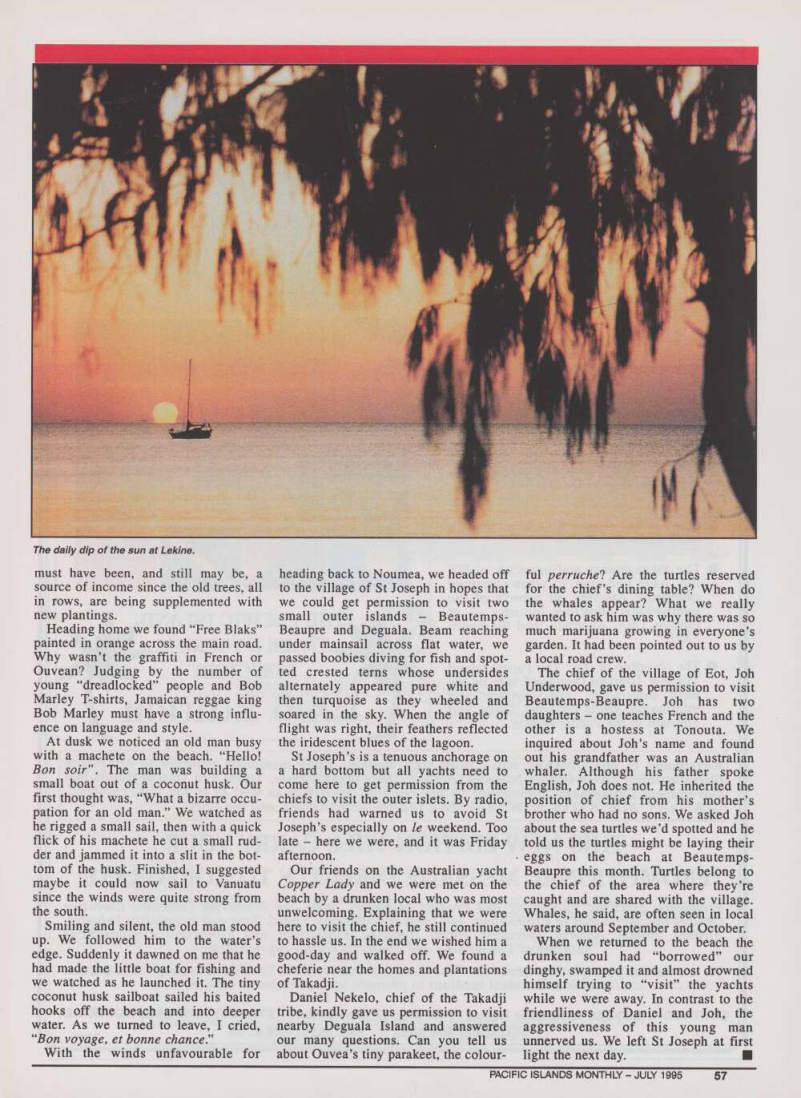
The daily dip of the sun at Lekine.