United we stand
pp. 51-53 · Read in the full issue
Rugby
United we stand a chance
Pacific Island nations pride in their rugby skills was dampened at the World Cup Rugby. Maybe it’s time to review the arrangement
By Atama Raganivatu
The past few months have been sobering ones for the Pacific islands rugby union fraternity.
Western Samoa’s dream of credibility as a major player on the world stage was shattered when South Africa beat them 60 - 8 in a test match in Johannesburg, Tonga lost all their games in the Super Ten Series (including a horrendous 75 - 5 hammering by New Zealand’s third ranked provincial team, Canterbury) and an undistinguished Canadian side over came Fiji 22 - 10 in Nadi. Western Samoa later proved themselves as the best minnows at the World Cup but min nows they most certainly will remain.
The biggest blow to the welfare of Pacific island rugby was executed off the field though when leading Southern Hemisphere administrators met and approved the introduction of two new international competitions. Neither fea ture island teams. Although lip service was given to the region’s inclusion in future years, the fact is that we are in danger of being cast aside from world cup rugby’s mainstream. A proposed Southern Hemisphereversion of Europe Five Nations Tournament involves only Australia, New Zealand and South Africa, while the old Super Ten (in which the islands always had one repre sentative) is to be scrapped in favour of
a championship catering only for
domestic sides from “The Big Three”.
The exclusion of island teams from these competitions is due solely to eco nomic considerations. Rugby union will soon formally adopt professionalism and Fiji, Tonga Western Samoa are seen by those who run the game as financial liabilities in an environment which will require every possible cent to be lured into international rugby for it to remain viable. The sad truth is that our three
international also-rans do not have the necessary stature to persuade spectators to buy match tickets or major corporations to sign sponsorship cheques.
Western Samoan, Tongan and Fijian rugby union officials have every reason to view the advent of professionalism with much trepidation. All three already experience great difficulty in retaining the allegiances of their best players, With extra money at hand, Australia and
New Zealand will surely become all the more eager to lure the Pacific island tal ents to their causes, The Australian and New Zealand squads in South Africa for this year’s World Cup included, between them, five Western Samoans, two Fijians and three Tongans. Even more relevant is the large number of exiled Pacific Islanders who were omitted from these squads yet declined opportunities to represent
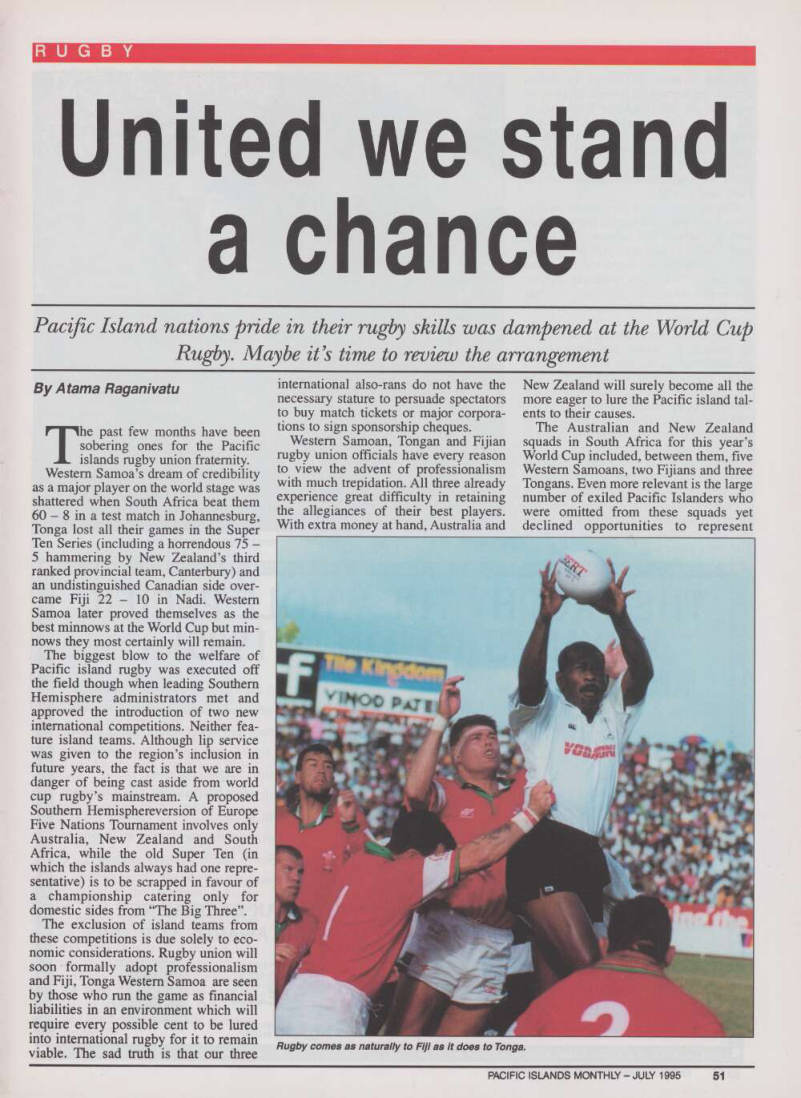
Rugby comes as naturally to Fiji as it does to Tonga.
Western Samoa or Tonga in South Africa, preferring to remain eligible to play for the All Blacks or Wallabies in the future. Five members of the king dom’s original squad did this and Manu Samoa were similarly affected (although they did not announce their travelling party until all players availabilities had been confirmed).
Players do not turn their backs on Fiji, Tonga and Western Samoa because they lack patriotism but because All Black and Wallaby call-ups provide greater kudos, financial opportunities and prospects for international glory.
Professionalism will certainly increase the gulf between international rugby’s rich and poor.
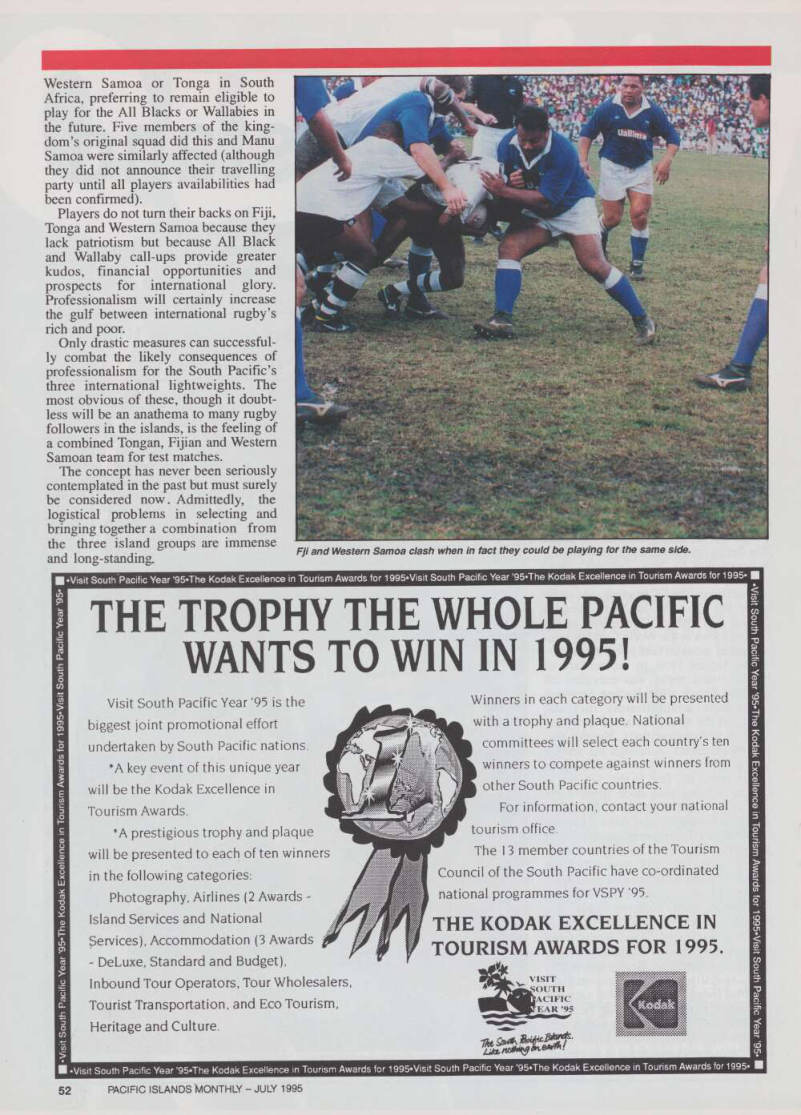
Only drastic measures can successful ly combat the likely consequences of professionalism for the South Pacific’s three international lightweights. The most obvious of these, though it doubt less will be an anathema to many rugby followers in the islands, is the feeling of a combined Tongan, Fijian and Western Samoan team for test matches.
The concept has never been seriously contemplated in the past but must surely be considered now. Admittedly, the logistical problems in selecting and bringing together a combination from the three island groups are immense and long-standing.
Fji and Western Samoa clash when in fact they could be playing for the same side.
and often bitter rivalries would not dis appear overnight. However, the pros of the notion greatly outweigh the cons.
The major advantage, of course, is that a combined team would have the potential to be not only a world-beater, but one of the greatest combinations seen on the international stage and, con sequently, a huge revenue earner. With or without professionalism, internation al rugby union is big business.
Successful sides generate huge amounts of money through gate receipts, spon sorship deals, broadcasting rights sales and merchandising contracts. A thriving combined team could expect to acquire vast amounts from all of these sources.
Financial problems have always bedevilled Pacific islands national rugby unions. Only a combined team is capa ble of generating the money necessary to both keep top players at home and adequately develop future talent to fill their boots.
Foreign players currently enjoy a
Players turn their backs on Fiji , Tonga and Western Samoa because All Black
and Wallaby call-ups
provide greater
financial opportuni
ties.
huge advantage over their island coun terparts, due to the vastly superior facil ities and training equipment they have access to. An obvious example is scrum machines, which are commonplace at even the most rustic New Zealand clubs, but remain rarities in our region.
The mind boggles when considering the potential of raw Pacific islands talent if it is cultivated like promising young Aussie and Kiwi players are.
The sporting world already possesses an equivalent of the combined team. In the late 19205, cricket officials from four diverse British colonies in the Caribbean realised that, individually, their coun tries had little chance of making a sub stantial impact on the international scene and agreed to field a united side. It took the West Indies 30 years to reach the top of the heap but they have remained there throughout the interven ing four decades. ■
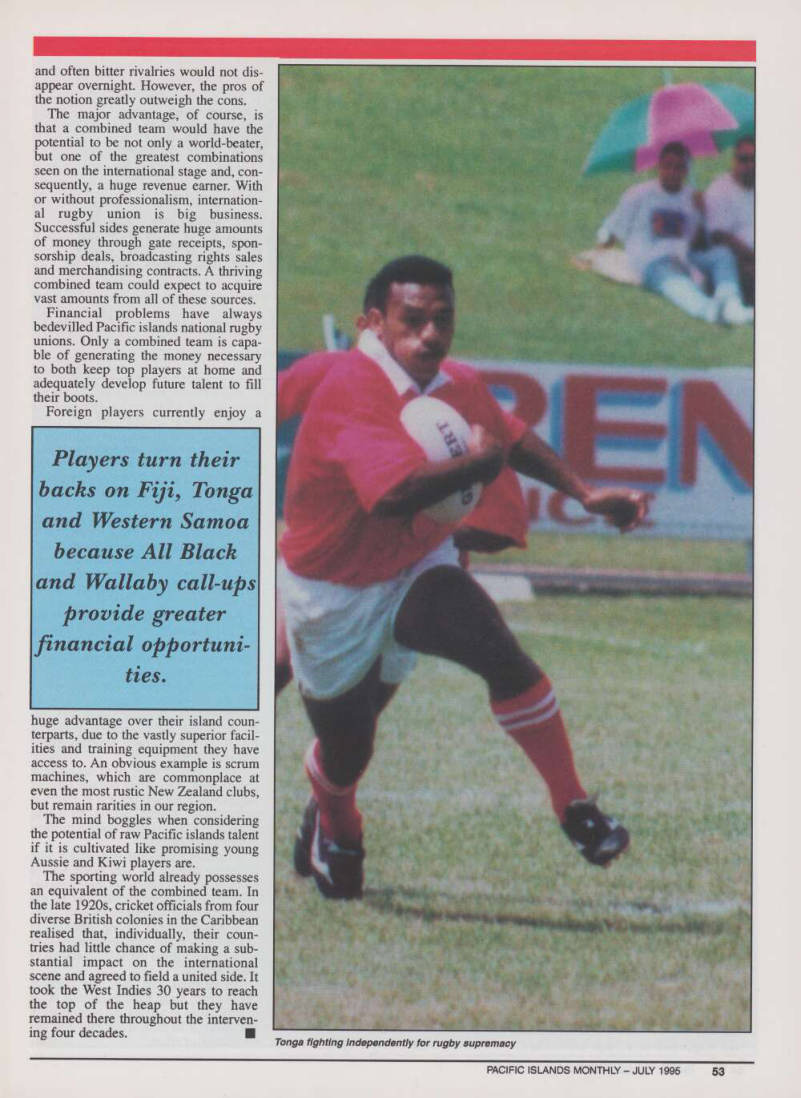
Tonga fighting independently for rugby supremacy